Survitec validates performance of high viscosity fluorine free foam concentrates as the industry prepares to transition


Survitec, a global leader in Survival Technology, has successfully completed extensive performance testing of new alcohol-resistant fluorine-free firefighting foam concentrates. The results validate the compatibility of the new foam concentrates with marine foam mixing systems and demonstrate that a safe transition away from PFAS based products is not only feasible and ready for operational deployment across a range of vessel types, but also technically proven.
The latest performance tests are a continuation of extensive due diligence work by Survitec on the new fluorine-free formulae. Last year, Survitec’s fire safety specialists conducted laboratory fire tests to assess performance in accordance with maritime rules and regulations using various types of foam sprinkler nozzles on different burning media across different setups. The results confirmed that the foam remained stable and performed well, even against challenging fuels such as methanol.
However, in the case of alcohol-resistant, fluorine-free foam concentrates, there was an additional challenge to address: viscosity. These new formulations rely on different active ingredients to maintain firefighting effectiveness without using fluorinated compounds. The result is a denser, more viscous fluid that behaves differently under varying flow conditions, posing new challenges for marine dosing systems originally designed for lower-viscosity foams.
“Standard proportioners are not typically designed to handle this kind of fluid, so it was essential that we rigorously test the system to ensure compatibility and dosing accuracy,” explained Maciej Niescioruk, Product Manager, Foam Systems, at Survitec.
Rather than replacing existing proportioning systems, Survitec focused on engineering modifications to internal components and orifices. The outcome of the tests was clear; the extent of system modifications varied depending on the type and size of the system, with certain configurations requiring more substantial redesign than others to maintain accurate dosing within the required range.
As Niescioruk explains, “An incorrect dosing ratio can result in a foam that is ineffective in suppressing a fire. Foam proportioning systems must comply with a strict dosing accuracy range of -0% to +30% to ensure that underdosing does not occur – a critical requirement to avoid system failure.
“This is particularly important when using high-viscosity foam concentrates, which typically generate higher flow resistance. If a standard, unchanged, proportioner is used, the increased resistance can cause the actual mixing ratio to fall below the nominal value, violating regulatory requirements and compromising foam performance. By implementing our findings from these tests, we can ensure that our customers won’t face that risk.”
In addition to proportioner compatibility, appropriate pump selection is essential. A standard centrifugal pump designed for low-viscosity, Newtonian fluids, such as the fluoroprotein alcohol-resistant foam concentrates, will most likely fail with the new, fluorine-free formulae, which exhibit non-Newtonian, pseudoplastic behaviour. The worst case scenario is a total system malfunction, where no foam is produced.
The tests come at a crucial time for the industry. From January 1, 2026, the IMO’s MSC.532(107) regulation will prohibit the use and storage of foams containing PerFluoroOctane Sulfonate (PFOS). This chemical is part of the wider PFAS family now being phased out globally due to growing concerns over its impact on human health and the environment. However, some manufacturers have already discontinued production of PFAS foam concentrates in anticipation of further restrictions. Consequently, for shipowners and operators, managing the transition to fluorine-free alternatives is not only a compliance issue but a safety-critical one.
“Fluorine-free, alcohol-resistant foams are particularly suited for chemical tankers, Norwegian double-ended ferries, and methanol-fuelled vessels, where environmental performance and fire safety are paramount. The successful completion of these performance tests allows Survitec to offer a tested and validated solution that mitigates technical risk and supports a smooth, compliant transition to fluorine-free technology. The findings are already being implemented in current projects, including a system commissioning in Turkey,” added Niescioruk.
As additional PFAS restrictions loom and more countries advocate for a total ban on fluorinated foam concentrates, the results of Survitec’s testing offer reassurance that regulatory compliance does not need to come at the expense of safety or operational readiness. However, planning and the support of an OEM are essential to avoid costly mistakes.
“These are safety-critical systems,” warns Niescioruk. Any significant changes to these systems must be handled carefully, allowing time to assess the engineering requirements and obtain the proper approvals. Our message to the market is clear: plan now, test early, and work with an OEM partner who understands the technical and regulatory landscape.”



Related News.

Navigating the Multi-Orbit Era: In Conversation with Intellian’s Jon Harrison at SMM 2026
At SMM 2026 in Hamburg, the rapid evolution of maritime satellite communications took centre stage. Across the exhibition halls, discussions among…
Cyprus ports need joint energy and investment strategy, shipping agents chief says
Cyprus needs a coordinated strategy for shipping, energy and environmental protection to support port investment and modernisation, Cyprus shipping…

MASO Public Affairs introduces MASO Regulatory Intelligence
A new subscription service helping businesses understand what is changing and what it means for them MASO Public Affairs introduces MASO Regulatory…
Anglo-Eastern helps turn CMBTECH’s ammonia ambition into an operational reality
From early feasibility study and risk-based design to newbuilding supervision, crew readiness and technical management, Anglo-Eastern drew on its…

Escalation of attacks threatens to derail recovery in Middle East oil exports
World oil demand is forecast to fall by 2.5 mb/d y-o-y in 4Q26 and 2.6 mb/d on average in 2026. As the Iran war manifests itself through restricted…
New study finds shipping pays twice its share to EU ETS earmarked revenues should triple to help build market for sustainable fuels and technologies
Shipping is responsible for around 10% of EU ETS emissions but pays almost 20% of the ETS bill. Unlike other sectors, it has never received free…
MSARC strengthens maritime mass rescue readiness through training and national live exercise off Dakar, Senegal
Joint MSARC–FHAS programme combines three days of SAR training with a national multi-agency live exercise The Maritime Search and Rescue Council ,…
Sogese report deliveries are still being delayed as container freight rates fluctuate
FOR IMPORTERS Spot rates into the Mediterranean are back at January levels, Far East to Europe reliability sits at pandemic lows, and nearly…

Glencore begins trading on Australian Securities Exchange
Glencore has begun trading on the Australian Securities Exchange under the ASX code GLC. Gary Nagle, Glencore’s CEO, said it was an exciting day for…
BIMCO Shipping Number of the Week
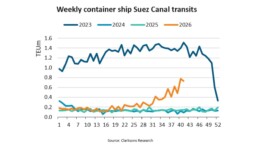
Suez Canal container ship transits exceed 50% of pre-disruption levels "During the first two weeks of October, weekly container ship capacity…
Subscribe to our newsletter!
if you dont want to swim alone in the ocean of news, sign up for the newsletter, and you will receive daily all the important news of world shipping!
