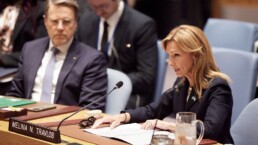

“We need to collectively defend freedom of navigation, as a shared global responsibility and a cornerstone of peace and humanity.
The seas must be open, free, safe, and secure”.
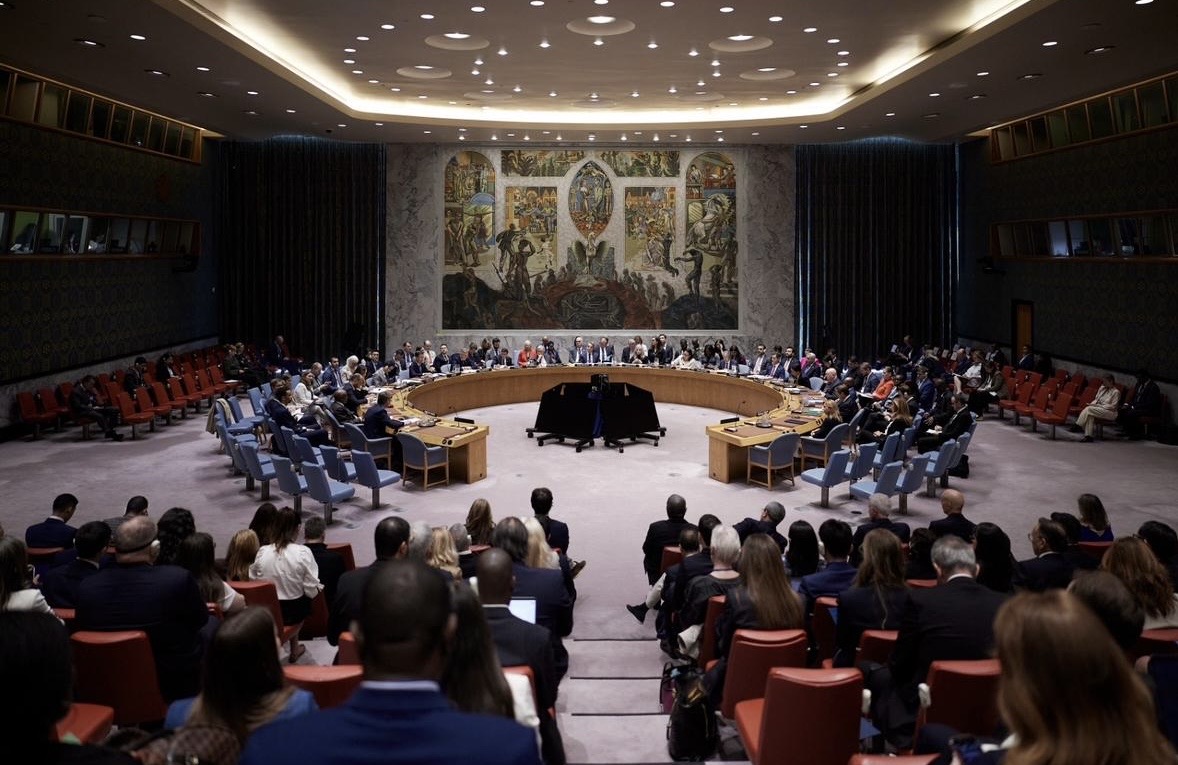
On the occasion of the Presidency of Greece, the United Nations Security Council convened a high-level open debate on the theme of “Strengthening Maritime Security through International Cooperation for Global Stability”, under the item “Maintenance of international peace and security”, in the Security Council Chamber at UN Headquarters, on 20 May 2025.
The debate was chaired by H.E. Kyriakos Mitsotakis, Prime Minister of Greece and the briefers were Mr. António Guterres, UN Secretary-General, Ms. Melina Travlos, President of the Union of Greek Shipowners (UGS), and Mr. Christian Bueger, Professor of International Relations at the University of Copenhagen and a research fellow at UNIDIR.
In her influential briefing, the UGS President Melina Travlos placed the true gravity of maritime security at the forefront of the debate, as “the security of our seas affects everyone, everywhere”. She highlighted shipping’s indispensable role in sustaining the global ecosystem and safeguarding human welfare, while stressing the urgent need to protect the industry from emerging threats.
The Union of Greek Shipowners’ historic participation in this debate, is yet another testament to the leading role of Greek shipping on the global stage. President Travlos stated that “Greece is a proud maritime nation, by identity and by history”. Greek shipping—accounting for more than 20% of the global fleet and over 61% of the EU fleet—is at the cutting edge of industry developments, driving dialogue and action, shaping and adopting best-practice policies to address today’s challenges.
Ms. Melina Travlos presented the facts of shipping to the Council:
- 110,000 ships navigate the seas globally.
- carrying 90% of international trade — efficiently, reliably, cost-effectively.
- More than 12 billion tonnes of goods are transported annually — food, medicines, energy, raw materials, consumer goods, everything that sustains our daily lives.
- Even 1.3 million kilometers of undersea cables for communication and electric power transmission are laid by ships.
- At the heart of our industry stand nearly 2 million seafarers, working day and night, to keep the world moving.
She highlighted that “shipping is more than a means of trade, it is the silent guardian of global welfare. It unites the world, not occasionally, but consistently; and it delivers, under any circumstances, even during universal crises, such as the COVID-19 pandemic, when all other sectors shut down, we kept supply chains alive, delivering the medicines and goods that people needed everywhere, and in humanitarian crises such as mass migration and displacement, our vessels regularly participate in rescue operations”.Yet she reminded that “while we diligently uphold our legal obligations and moral duty, States must assume their own responsibilities”.
The President of th Union of Greek Shipowners made clear that “shipping is increasingly being weaponized – economically, politically and physically”. She outlined the industry’s evolving threats, stating that:
- “Piracy is not a distant memory. It is evolving — not retreating. It poses constant risks to vessels, crews and cargoes. In 2024, 116 incidents were reported, recording a 35% increase from the previous year.
- Geopolitical conflict and political instability are growingly endangering security at sea. An unprecedented number of commercial vessels have been attacked with military weapons — missiles, bombs, torpedoes, mines, drones. Crew members have been killed or taken hostage. Ships and cargoes have been lost.
- Organised crime at sea – drug trafficking, arms smuggling, human trafficking – is, also, a growing threat, that exposes the vulnerability of ships to crimes beyond the industry’s control, leading to its unfair penalization.
- And now, a new frontier of danger has emerged: cyber warfare. A single cyberattack can disrupt vessel operations, compromise safety at sea, leak sensitive commercial data, or even trigger environmental disasters. In addition, the growing misuse by criminal networks of Artificial Intelligence and digital tracking technologies, turn vessels into highly visible “sitting ducks” for targeted attacks”.
She emphasized that the industry “works tirelessly to safeguard maritime security”, updating best-management practices, strictly adhering to global regulations, cooperating with naval forces in high-risk regions, and, when necessary, employing self-protection measures, such as placing armed guards aboard civilian merchant vessels. Yet, she insisted, “while our industry is resilient, it cannot, and should not be expected to carry every burden alone. Its resilience must never be assumed; it must be assured”.
In that spirit, she called on the international community to commit:
- “To keep maritime security, as a high priority, and a standing policy issue within the United Nations.
- To embrace a coherent, comprehensive and coordinated maritime security governance.
- To include the shipping industry’s valuable experience and know-how, when addressing old and new maritime security threats”.
“In this dynamic maritime security landscape, we must shift from reaction to prevention, from crisis response to crisis readiness”, she stressed, to went on to say “I would use the Greek word “synergy”, to describe how maritime security should be treated”.
Concluding her address, immediately after Secretary-General Guterres, Ms. Travlos issued a universal call “to embody the spirit of the United Nations in its truest form, standing together, not just in name but in purpose” and to “collectively defend freedom of navigation, as a shared global responsibility and a cornerstone of peace and humanity. The seas must be open, free, safe, and secure”.
The high-level open debate was streamed live on the United Nations Web TV and is available for viewing at https://webtv.un.org/en/asset/k1p/k1p3dhtmbd .



Related News.
Greenland’s scrubber restrictions – Clean Shipping Alliance response
Greenland scrubber ban – reactive comment We are disappointed to see Greenland announce restrictions on exhaust gas cleaning systems (EGCS, or…
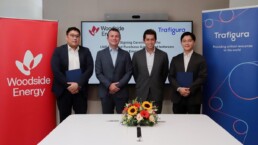
Trafigura signs long-term LNG supply agreement with Woodside Energy
Trafigura Pte Ltd, a global leader in the commodities industry, has signed a sale and purchase agreement with Woodside Energy Trading Singapore Pte…
Inventra by Seafy®, onboard retail that keeps sailing even offline
The new retail platform centralises the management of shops, boutiques and duty free, unifying catalogues, inventories and sales data across the…
Nova Marine Carriers acquires a 25% stake in Terminal Nord S.p.A.
Sider Navi S.r.l., the Italian sub-holding company of the international shipping group Nova Marine Carriers, based in Lugano, has acquired a 25%…
Shipping industry urges governments to agree on global GHG regulations to provide regulatory certainty and incentivize maritime decarbonization
In advance of the UN International Maritime Organization (IMO) Marine Environment Protection Committee (MEPC 85), which meets in London from 30…

The Mission to Seafarers announces winners of 2026 Seafarers Awards
The Mission to Seafarers (MtS), a leading international seafarer welfare charity, is delighted to announce the winners of its 9th International…

NGOs Urge UN Shipping Body – including India – to adopt Crucial Climate Agreement before Year End
Ahead of an upcoming meeting of the International Maritime Organization’s (IMO) Marine Environment Protection Committee (MEPC 85, November…

Allied – Weekly Market Review – Week 46
Please find below the Allied Weekly Report for Week 46 | 2026 ALLIED - Weekly Market Report- Week 46

Intermodal Report – Week 46 2026
Please find below the Intermodal market report for week 46 2026. Intermodal Report Week 46 2026 Market Insight By Vasilis Fousekis, Research…

Gulf Earnings Fall, Atlantic rates retreat faster
In Week 46, freight weakness spread to Gulf routes, following a Week 45 correction that had primarily impacted the Atlantic (where Gulf VLCC…
Subscribe to our newsletter!
if you dont want to swim alone in the ocean of news, sign up for the newsletter, and you will receive daily all the important news of world shipping!
