Gulf Earnings Fall, Atlantic rates retreat faster

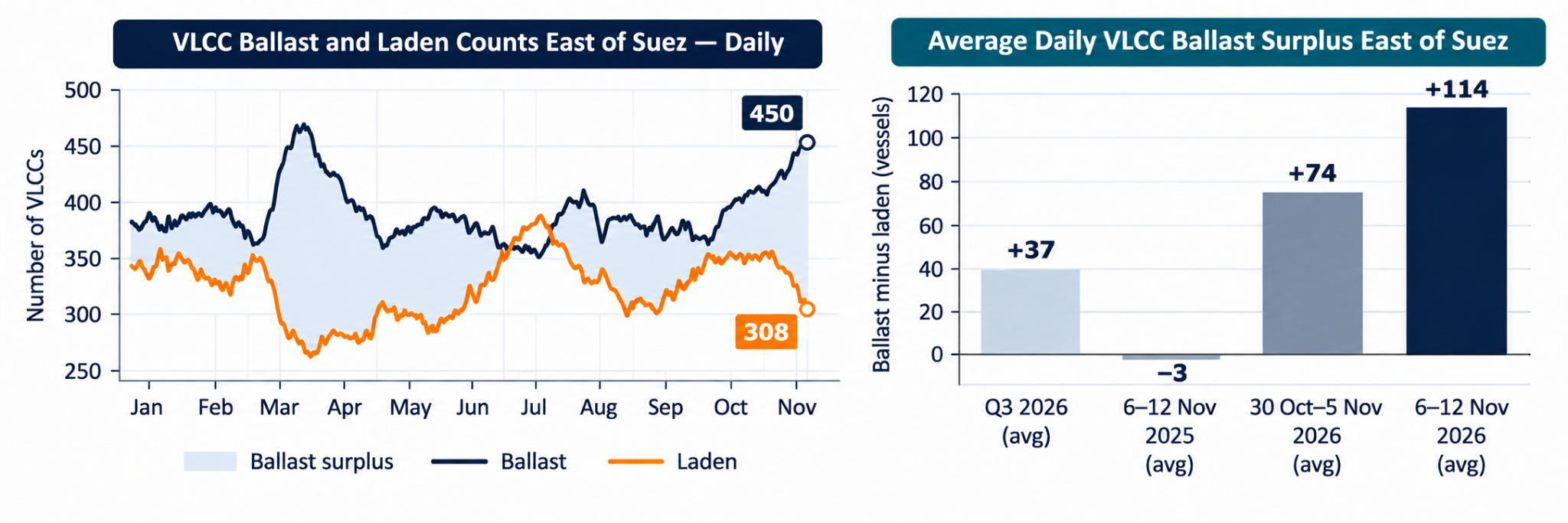
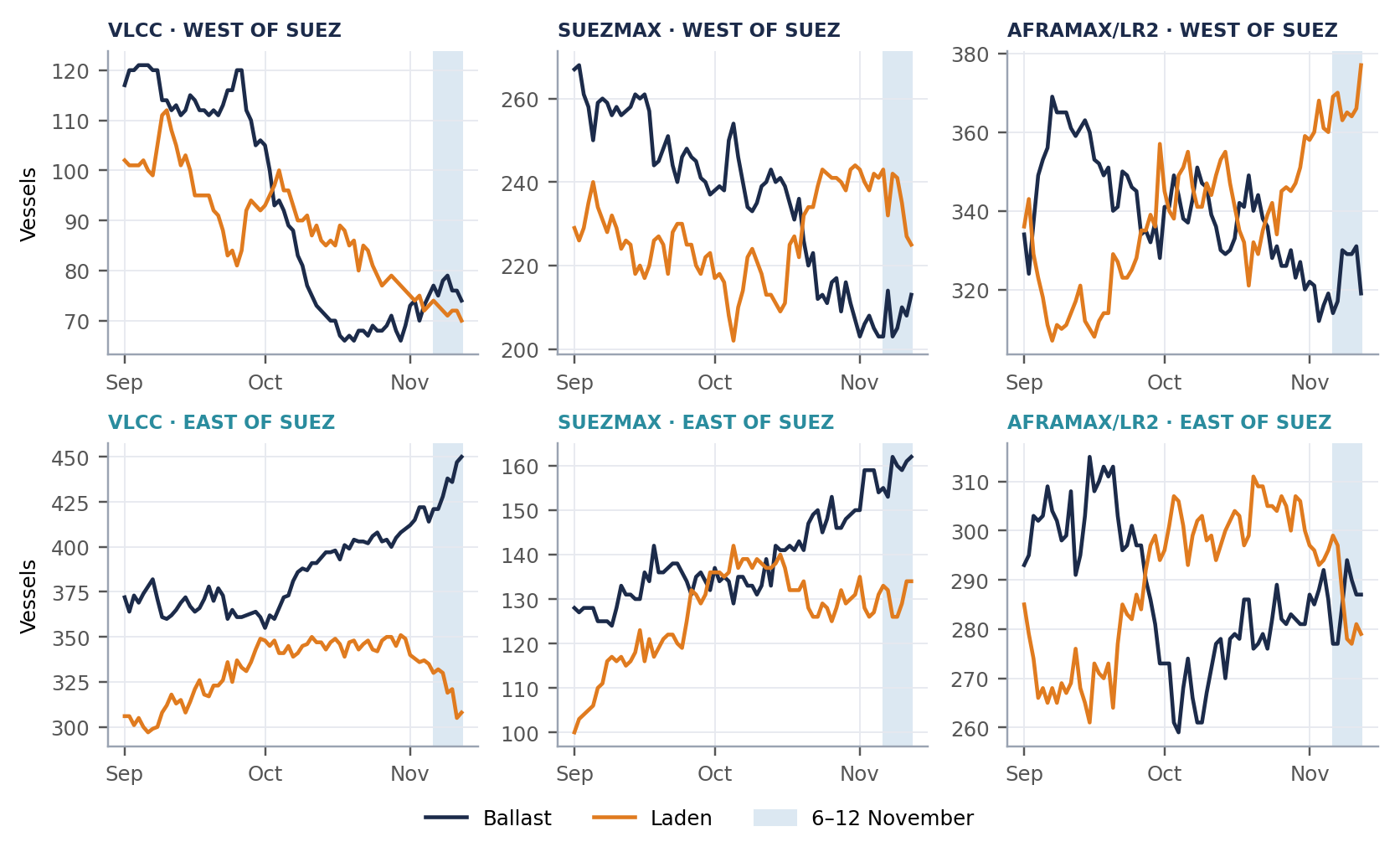
In Week 46, freight weakness spread to Gulf routes, following a Week 45 correction that had primarily impacted the Atlantic (where Gulf VLCC earnings dropped under 5%). East of Suez, average ballast VLCC counts rose from 415 to 434 vessels, while laden VLCC counts fell from 341 to 321. Consequently, the ballast surplus expanded from 74 to 114 vessels, over triple the Q3 2026 average of 37, in sharp contrast to the same period in 2025, when laden vessels held a slight majority over ballasters. Ballast VLCCs East of Suez surged to 450 by 12 November, marking their highest count since late March, against 308 laden vessels.
The rise in ballast VLCCs East of Suez coincided with a 17.9% weekly decline in Middle East Gulf–China (TD3C) earnings to $1.06 million/day on 13 November. However, the growing ballast count does not necessarily mean more vessels are available for prompt Gulf employment. Actual availability remains constrained by vessel positioning, existing charter commitments, and owners’ willingness to accept Gulf voyages.
VLCC Earnings: The Gulf Follows the Atlantic
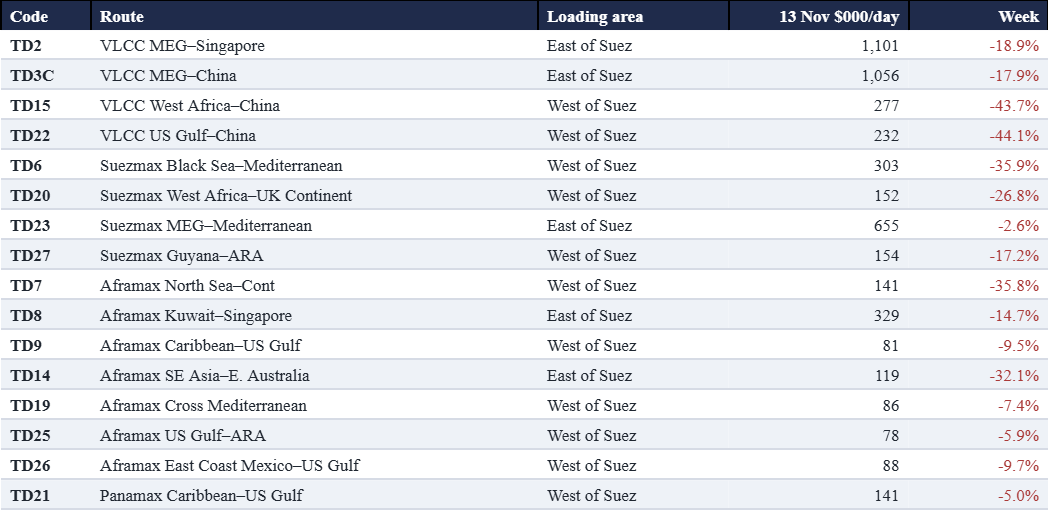
US Gulf–China (TD22) earnings fell 44.1% over the week to $232,000/day on 13 November. TD3C lost about $230,000/day, more than the $183,000/day lost by TD22, but TD22’s larger percentage fall lifted the TD3C/TD22 ratio from 3.10 on 6 November to 4.55, its highest level since 6 May.
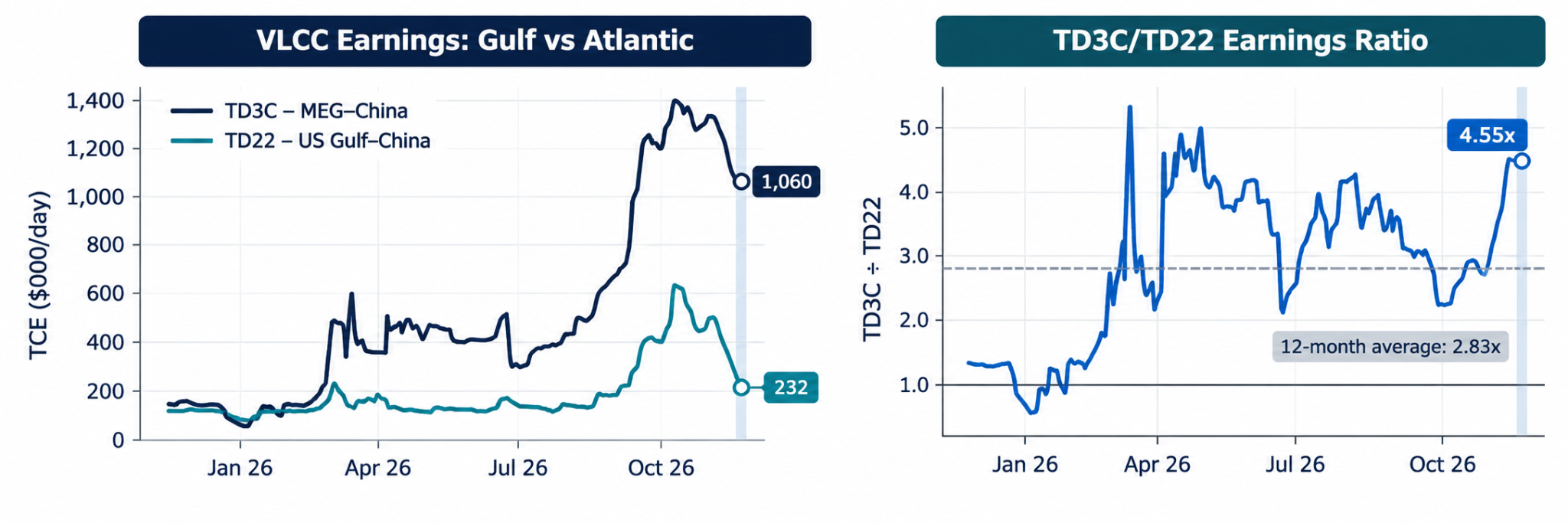
Both VLCC routes have retreated substantially from their 8 October peaks, with TD3C earnings down 25.2% and TD22 down 63.6% by 13 November. TD3C reached its lowest level since 14 September, while TD22 fell to its lowest since 9 September. Despite the sharper percentage decline in Atlantic earnings, the absolute earnings gap between the two routes narrowed to $824,000/day, from $871,000/day on 6 November.

MARKET SIGNAL: Gulf VLCC earnings declined in Week 46, although the correction was sharper on Atlantic routes. The TD3C/TD22 earnings ratio widened to 4.55 on 13 November, driven by the steeper fall in Atlantic earnings rather than stronger Gulf rates. Cargo demand and vessel positioning across both basins will remain key to the direction of freight rates.
Freight: Gulf Routes Join the Largest Declines
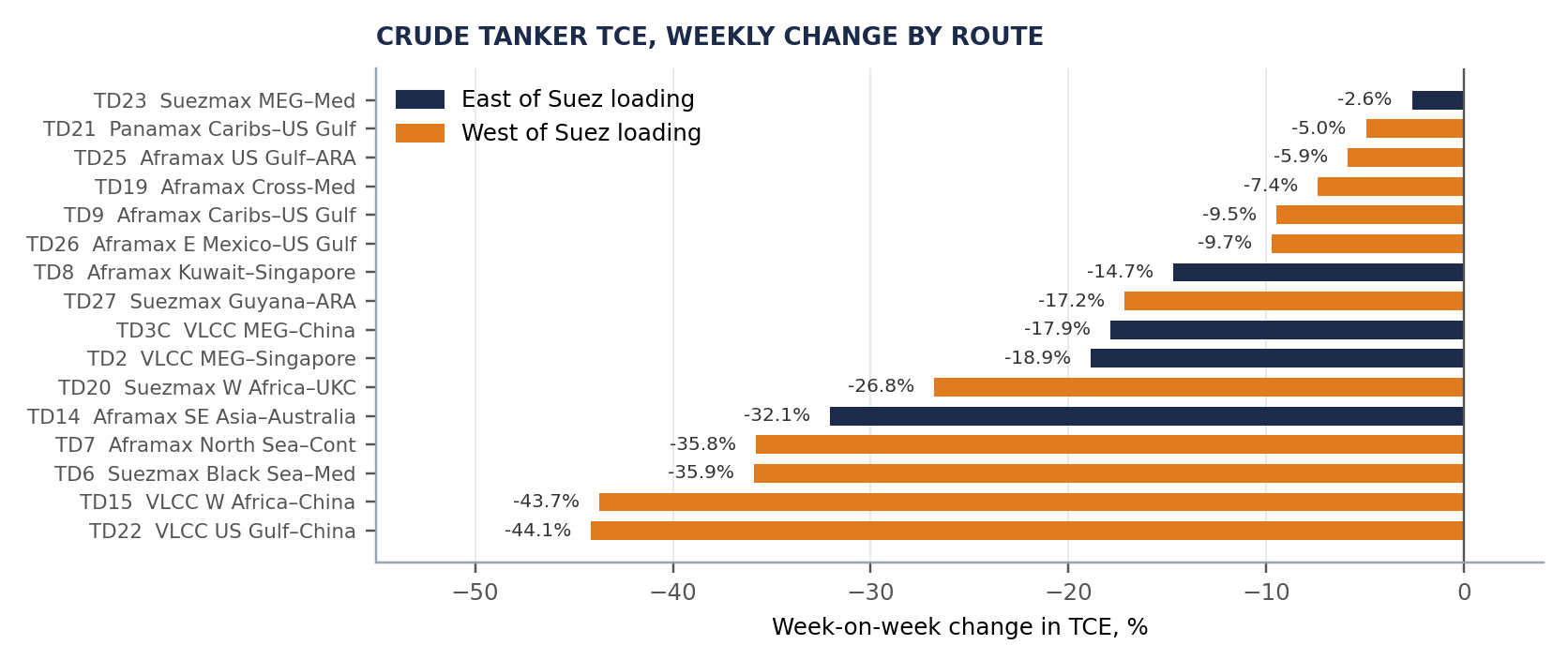
All 16 dirty routes fell between 6 and 13 November. The largest declines were on US Gulf–China VLCC (TD22, -44.1%), West Africa–China VLCC (TD15, -43.7%), Black Sea–Mediterranean Suezmax (TD6, -35.9%) and North Sea–Continent Aframax (TD7, -35.8%). Unlike Week 45, four of the ten largest declines were on routes loading East of Suez: Southeast Asia–East Coast Australia Aframax (TD14, -32.1%), MEG–Singapore VLCC (TD2, -18.9%), MEG–China VLCC (TD3C, -17.9%) and Kuwait–Singapore Aframax (TD8, -14.7%). MEG–Mediterranean Suezmax (TD23) recorded the smallest decline, at 2.6%.
Weekly losses on several Atlantic Aframax routes were smaller than in Week 45, at between 6% and 10% for US Gulf–ARA (TD25), Cross-Mediterranean (TD19), Caribbean–US Gulf (TD9) and East Coast Mexico–US Gulf (TD26). On 13 November alone, TD25 rose 9.2%, TD26 5.6%, TD9 4.9% and West Africa–China VLCC 3.6%; a single assessment day does not establish a change in direction.
Spot Rate Summary: dirty TCE, VLCC, Suezmax, Aframax and Panamax
Supply: Ballast and Laden Positions by Segment
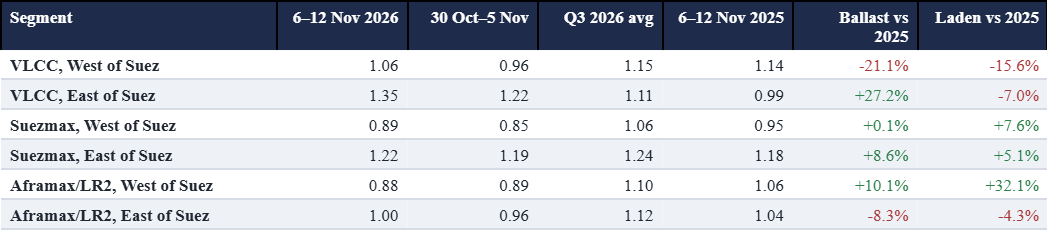
VLCCs. West of Suez, average ballast VLCC counts increased by 7.0% to 76.4 vessels, while laden counts declined by 3.4% to 72.0. The balance shifted from a laden surplus of three vessels to a ballast surplus of four, with the ballast-to-laden ratio rising from 0.96 to 1.06. Ballast VLCCs have outnumbered laden vessels daily since 4 November, although the ratio remains below the Q3 2026 average of 1.15 and the 1.14 recorded a year earlier. Both ballast and laden counts remain 16–21% below the corresponding week of 2025. East of Suez, the ratio increased from 1.22 to 1.35, above the Q3 average of 1.11 and 0.99 a year earlier, with ballast VLCC counts up 27% year-on-year.
Suezmax and Aframax/LR2. West of Suez, laden Suezmaxes continued to outnumber ballasters, although the gap narrowed from 35 to 27 vessels as laden counts declined by 2.7% to 235. The ballast-to-laden ratio stood at 0.89, below the Q3 average of 1.06. East of Suez, Suezmax ballast counts rose 3.0% to 158.9, bringing the ratio to 1.22, close to the Q3 average of 1.24. For Aframax/LR2s West of Suez, laden counts rose by 2.3% to 367.7, up 32% year-on-year, reaching 377 vessels on 12 November, the highest daily level since January 2023. The ballast-to-laden ratio remained at 0.88, below the Q3 average of 1.10. East of Suez, laden Aframax/LR2 counts declined by 4.0% to 285.4, leaving ballast and laden populations virtually equal.
Ballast and laden vessels: week-on-week change

Ballast-to-laden ratio against benchmarks
The wider VLCC fleet remains concentrated East of Suez: the East/West ratio stood at 5.11 on 12 November, slightly below its 2026 high of 5.19 on 3 November, compared with 3.77 in 2025 and 3.25 in 2024.
Fleet Distribution and Repositioning
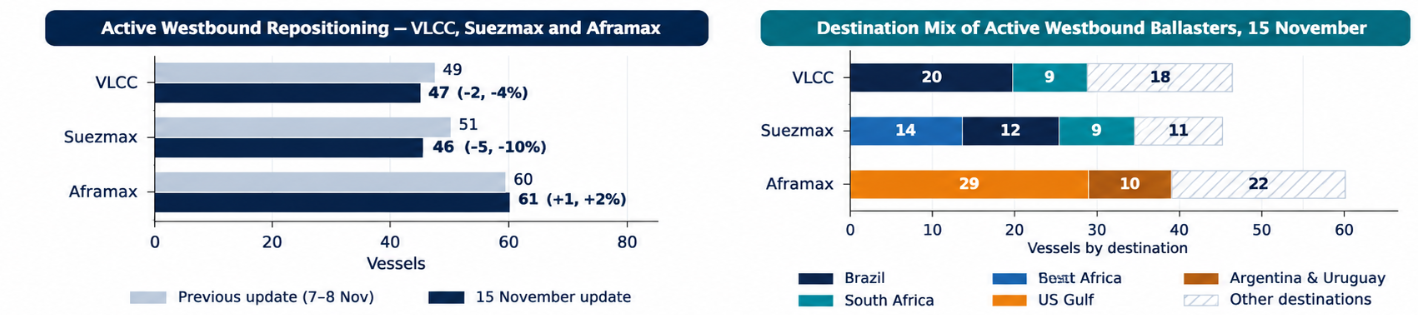
While the ballast VLCC population East of Suez increased during Week 46, the latest fleet distribution shows a modest rise in vessels positioned West of Suez. The western VLCC count increased from 131 to 141 over five days, while the eastern count eased from its 4 November peak of 641 to 629. Nevertheless, about 82% of the fleet remained East of Suez, up from a typical 75%. Active westbound VLCC ballasters declined slightly from 49 to 47, including 39 originating in the Far East. Brazil remained the leading destination with 20 vessels, followed by South Africa with nine.
Suezmax positioning continued to shift East, with the eastern fleet increasing from 232 vessels in mid-October to 264 on 14 November, representing approximately 42% of the fleet against a typical 35%. Active westbound Suezmax ballasters declined from 51 to 46. Aframax ballasters increased marginally from 60 to 61, including 29 heading towards the US Gulf and ten towards Argentina and Uruguay. The US Gulf Aframax tonnage list stood at 39 vessels on 14 November, compared with an average of approximately 50 in September.
US Gulf Loadings and Atlantic Demand
US Gulf crude loadings reached 125.5 million barrels in October, up 18% from September, with the daily average increasing by 14% to approximately 4.0 million b/d. During 1–12 November, tracked loadings averaged 3.1 million b/d, although the figure remains provisional and covers only the first 12 days of the month. The slower pace of US Gulf loadings in early November came alongside an increase in Atlantic ballast tonnage and further declines in VLCC earnings. While fewer cargoes may have contributed to the softer freight market, the growing ballast supply and weaker fixing sentiment also played a role, making it difficult to attribute the correction to cargo demand alone.
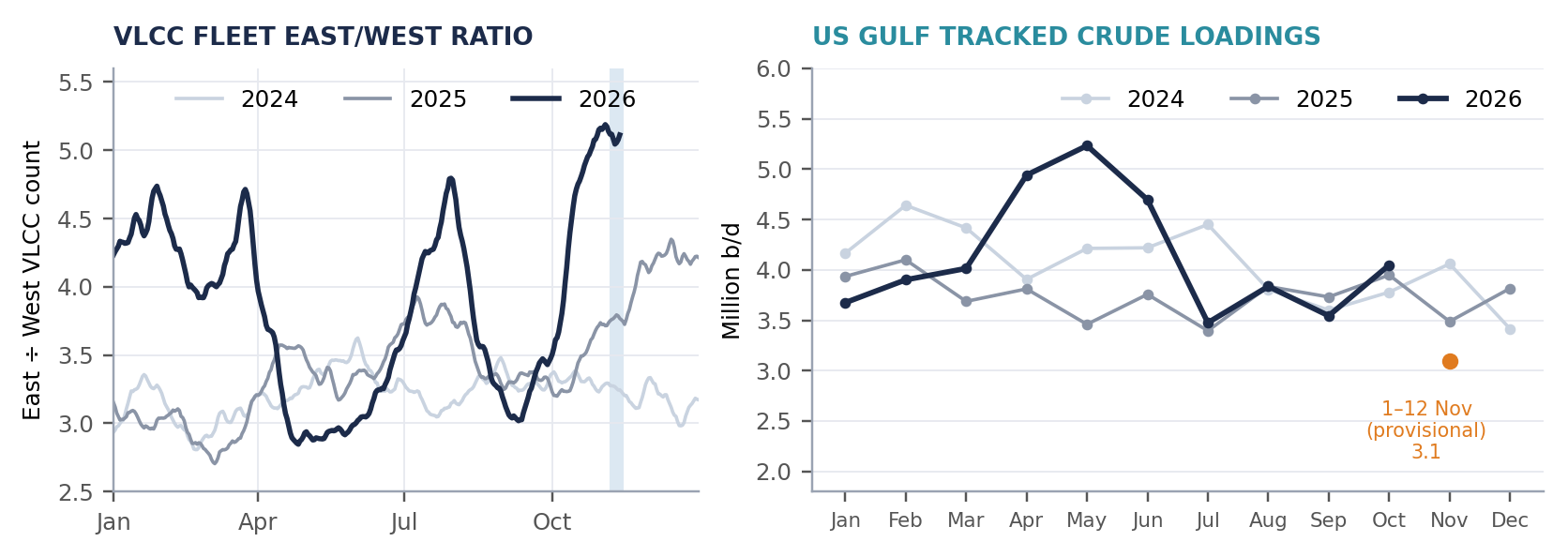
The decline in Atlantic VLCC freight rates has reduced the transportation-cost component of long-haul crude shipments to Asia, potentially improving the relative economics of West African and Brazilian cargoes. However, the extent of any improvement in delivered competitiveness also depends on crude-grade price differentials and refinery demand. The key freight consideration is whether lower voyage costs encourage additional Atlantic-to-Asia cargo movements, providing employment for vessels already positioned in the Atlantic Basin.
Hormuz Freight Watch: Macro Risks
Security risks continue to weigh on tanker operations in the Gulf. The Joint Maritime Information Center’s 12 November advisory recorded further projectile strikes on tankers in the Gulf and Strait of Hormuz on 10–11 November. Repeated attacks continue to restrict the pool of owners willing to accept Gulf employment, while elevated war-risk insurance costs and operational delays add to voyage expenses and limit effective vessel availability. Meanwhile, the recovery in Middle East oil production and exports is changing the cargo outlook. The IEA’s 13 November assessment projects a 1.7 million b/d global oil supply surplus in Q4, the first since the conflict began, although further attacks on shipping could disrupt the recovery. OPEC’s November report places October crude production among participating OPEC+ countries at 41.23 million b/d, up approximately 2.04 million b/d from September, based on secondary sources. Higher Middle East exports could support additional tanker employment, although continued security risks and limited owner participation in Gulf trades may constrain the impact on freight. Seven OPEC+ producers are scheduled to meet on 29 November.
Key Takeaways
The Week 46 correction extended across both Atlantic and Gulf VLCC markets, although Atlantic earnings experienced the sharper percentage decline. East of Suez, the growing ballast population points to a change in vessel positioning, but does not establish an equivalent increase in commercially available Gulf tonnage. The next test will be whether additional cargo requirements absorb vessels repositioning across both basins. The pace of Atlantic long-haul employment, Gulf loading activity and owners’ willingness to accept regional risks will remain central to the freight balance.
Source:Signal Ocean



Related News.

Greenland’s scrubber restrictions – Clean Shipping Alliance response
Greenland scrubber ban – reactive comment We are disappointed to see Greenland announce restrictions on exhaust gas cleaning systems (EGCS, or…

Trafigura signs long-term LNG supply agreement with Woodside Energy
Trafigura Pte Ltd, a global leader in the commodities industry, has signed a sale and purchase agreement with Woodside Energy Trading Singapore Pte…

Inventra by Seafy®, onboard retail that keeps sailing even offline
The new retail platform centralises the management of shops, boutiques and duty free, unifying catalogues, inventories and sales data across the…

Nova Marine Carriers acquires a 25% stake in Terminal Nord S.p.A.
Sider Navi S.r.l., the Italian sub-holding company of the international shipping group Nova Marine Carriers, based in Lugano, has acquired a 25%…
Shipping industry urges governments to agree on global GHG regulations to provide regulatory certainty and incentivize maritime decarbonization
In advance of the UN International Maritime Organization (IMO) Marine Environment Protection Committee (MEPC 85), which meets in London from 30…

The Mission to Seafarers announces winners of 2026 Seafarers Awards
The Mission to Seafarers (MtS), a leading international seafarer welfare charity, is delighted to announce the winners of its 9th International…

NGOs Urge UN Shipping Body – including India – to adopt Crucial Climate Agreement before Year End
Ahead of an upcoming meeting of the International Maritime Organization’s (IMO) Marine Environment Protection Committee (MEPC 85, November…

Allied – Weekly Market Review – Week 46
Please find below the Allied Weekly Report for Week 46 | 2026 ALLIED - Weekly Market Report- Week 46

Intermodal Report – Week 46 2026
Please find below the Intermodal market report for week 46 2026. Intermodal Report Week 46 2026 Market Insight By Vasilis Fousekis, Research…
Sallaum Logistics opens inland customs bonded compound in the Port of Limburg, Genk
The new site extends the Sallaum Terminal in Antwerp inland reachable by river, rail and road Sallaum Logistics is opening an inland customs bonded…
Subscribe to our newsletter!
if you dont want to swim alone in the ocean of news, sign up for the newsletter, and you will receive daily all the important news of world shipping!
