U.S. oil companies spent less on interest over the last decade despite higher rates


Higher oil prices, increased drilling efficiency, and structurally lower debt needs have contributed to lower interest expenses for some publicly traded U.S. oil companies over the past decade, despite the level of interest rates across the economy being relatively high.
Based on the published financial reports of 26 U.S. publicly traded oil companies, interest expenses per barrel of oil equivalent (BOE)—a measure that accounts for crude oil, hydrocarbon gas liquids, and natural gas production—in 2024 were about $1.50/BOE, or around 6% of production expenses. In real dollar terms and as a share of production expenses, interest expenses are lower than they were before the pandemic, even though general interest rates are now higher.

Although interest expenses typically represent a small portion of production expenses—those associated with labor, materials, and the costs of extracting and storing oil and other commodities—their variability can fluctuate with macroeconomic conditions. For example, a rapid decline in crude oil prices might lower some production expenses but not interest expenses, which are often fixed throughout the life of a loan. During these times, interest expenses can represent 15% or more of regular production expenses.
The decline in interest expenses may be counterintuitive as interest rates in the United States have generally increased since 2020 and 2021. Short-term interest rates—designated by the federal funds effective rate, which determines the interest rate on overnight bank loans—have reached as high as 5.3% since 2022 and stayed above 4% since then, compared with nearly 0% five years ago.
The Federal Reserve determines the federal funds rate, and the rate serves as a key monetary policy tool to reach the goals of price stability and maximum employment. The federal funds rate affects other interest rates that are determined from market participants’ supply and demand for loans, including bank loans, government bonds, and corporate bonds. For example, Moody’s Aaa and Baa corporate bond rates represent different bond yields based on creditworthiness.

Oil company interest expense has declined despite higher interest rates because of:
• Relatively high oil prices. Crude oil prices increased in the years after the pandemic. Higher oil prices bring in more revenue, which means oil companies need to borrow less to fund their capital expenditures and can also pay down debt obligations. In addition, higher oil prices increase the value of a company’s proved reserves and reduce the risk of loan default, which may lead to better borrowing terms, such as lower interest rates.
• Increased efficiency and cost reduction. Lowering production expenses and improving efficiency increases company profits, which could result in better borrowing terms and lower borrowing costs.
• Tempered investment growth and strategy. In recent years, companies have implemented strategies that favor modest capital expenditure growth by targeting fewer but more profitable projects. With this approach, the company may generate more profits even if the company’s production growth was small or unchanged. This strategy reduces companies’ needs for outside capital, including borrowing.
Source: EIA



Related News.

Navigating the Multi-Orbit Era: In Conversation with Intellian’s Jon Harrison at SMM 2026
At SMM 2026 in Hamburg, the rapid evolution of maritime satellite communications took centre stage. Across the exhibition halls, discussions among…
Cyprus ports need joint energy and investment strategy, shipping agents chief says
Cyprus needs a coordinated strategy for shipping, energy and environmental protection to support port investment and modernisation, Cyprus shipping…

MASO Public Affairs introduces MASO Regulatory Intelligence
A new subscription service helping businesses understand what is changing and what it means for them MASO Public Affairs introduces MASO Regulatory…
Anglo-Eastern helps turn CMBTECH’s ammonia ambition into an operational reality
From early feasibility study and risk-based design to newbuilding supervision, crew readiness and technical management, Anglo-Eastern drew on its…

Escalation of attacks threatens to derail recovery in Middle East oil exports
World oil demand is forecast to fall by 2.5 mb/d y-o-y in 4Q26 and 2.6 mb/d on average in 2026. As the Iran war manifests itself through restricted…

New study finds shipping pays twice its share to EU ETS earmarked revenues should triple to help build market for sustainable fuels and technologies
Shipping is responsible for around 10% of EU ETS emissions but pays almost 20% of the ETS bill. Unlike other sectors, it has never received free…

MSARC strengthens maritime mass rescue readiness through training and national live exercise off Dakar, Senegal
Joint MSARC–FHAS programme combines three days of SAR training with a national multi-agency live exercise The Maritime Search and Rescue Council ,…
Sogese report deliveries are still being delayed as container freight rates fluctuate
FOR IMPORTERS Spot rates into the Mediterranean are back at January levels, Far East to Europe reliability sits at pandemic lows, and nearly…

Glencore begins trading on Australian Securities Exchange
Glencore has begun trading on the Australian Securities Exchange under the ASX code GLC. Gary Nagle, Glencore’s CEO, said it was an exciting day for…
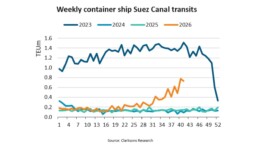
BIMCO Shipping Number of the Week
Suez Canal container ship transits exceed 50% of pre-disruption levels "During the first two weeks of October, weekly container ship capacity…
Subscribe to our newsletter!
if you dont want to swim alone in the ocean of news, sign up for the newsletter, and you will receive daily all the important news of world shipping!
