GravityVibe in action: Real-world validation and system optimisation

Following extensive theoretical studies to verify GravityVibe’s feasibility, MacGregor is now engaged in the real-world validation and optimisation of its pioneering self-unloading system based on in-house testing and customer feedback
Evidence that verifies the advantages of GravityVibe has been accumulating quickly since MacGregor introduced the augmented gravity self-unloading system to market in February 2024.
Developed to allow bulk carriers to deliver a wider variety of cargo in greater volume, GravityVibe eases the discharge of coarse materials from cargo holds. In contrast with a standard gravity self-unloading configuration, where slope angles range from 35 to 60 degrees depending on the material, MacGregor’s system can discharge various cargo types with slope angles of just 15–20 degrees.
The pioneering solution is the result of extensive research and development (R&D) that draws on MacGregor’s decades-long experience in self-unloader design and comprehensive knowledge of material characteristics. Its benefits have also been recognised by renowned third-party specialists in materials handling.
In upholding its commitment to quality and reliability, MacGregor has collaborated with various international institutions and organisations to verify GravityVibe’s feasibility in theoretical studies. In a simulation based on a theoretical model of the system, TUNRA – a wholly owned subsidiary of the University of Newcastle, Australia – found that GravityVibe functioned effectively with the three materials tested: wood chip, manufacturing sand, and gravel.
MacGregor later sought to ascertain the impact of the system’s vibrations and how to minimise their transfer into the vessel’s hull structure. The company worked with leading international sub-suppliers, and separately with the KTH Royal Institute of Technology in Sweden, to conduct thorough vibration and sound analyses. In both studies, vibration and sound readings were comfortably within the class-defined threshold.
Putting theory into practice
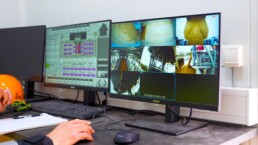
MacGregor is now engaged in efforts to validate the system’s performance in practical analyses using a full-scale test rig in China. Already, the company has confirmed the findings of TUNRA, its sub-suppliers , and KTH: GravityVibe efficiently discharges wood chip, manufacturing sand, and gravel, while both vibration and sound levels fall far below the upper limits stipulated by class.
Building on these encouraging results, MacGregor continues to validate GravityVibe’s performance in real-world tests. According to Mikael Hägglund, Sales Manager for General Cargo, the company has turned its attention to optimising the system based on data gathered from the test facility.
“All the materials we have tested have flowed without any issues, so we know GravityVibe works, which is the first and most important step,” he says. “As our approach to R&D emphasises continuous improvement, we are now working to finetune the system’s performance by adjusting its parameters for even more efficient and reliable cargo discharge.”
Customer-centric development
While theoretical studies and extensive in-house testing are crucial aspects of MacGregor’s R&D process, the company also places great importance on customer demonstrations and feedback.
“By discussing GravityVibe with our customers, showing them its functionality and inviting their input, we gain a deeper understanding of what matters most to their operations,” comments Tomas Wallin, Senior Product Owner, MacGregor. “Customer consultation plays an invaluable role in a product’s validation and optimisation while nurturing confidence among our target audience. It therefore helps us to prepare our systems for a successful market launch.”
Automation and machine learning
Involving customers in the testing phase also enables MacGregor to establish parameters for the programmable logic controller and software on board the vessel, ensuring that GravityVibe executes the complete unloading process as smoothly and intelligently as possible. Ultimately, MacGregor’s objective is to enable the fully automated discharge of all kinds of bulk cargo.
Critical to this aim is GravityVibe’s self-optimisation functionality. Extracting data from built-in sensors, the system ‘learns’ the characteristics of each material and adjusts its vibration frequency accordingly, achieving optimal flow regardless of the cargo being unloaded and without the need for human intervention. As a result, the operator avoids overworking the system, which in turn minimises energy consumption as well as operating and maintenance costs.
In the coming months, MacGregor intends to validate GravityVibe’s performance with a wider range of materials to identify any operational limitations, making technical adjustments and functional improvements as needed ahead of the system’s imminent market launch.
If someone doesn´t know anything about GravityVibe so how to make sure that there is some kind of recap what is GravityVibe to draw the interest and what we have said previously and what could be highlight in short: “In contrast with a standard gravity self-unloading configuration, where slope angles range from 35 to 60 degrees depending on the material, the MacGregor GravityVibeTM can discharge various cargo types with slope angles of just 15–20 degrees”



Related News.

Navigating the Multi-Orbit Era: In Conversation with Intellian’s Jon Harrison at SMM 2026
At SMM 2026 in Hamburg, the rapid evolution of maritime satellite communications took centre stage. Across the exhibition halls, discussions among…

Cyprus ports need joint energy and investment strategy, shipping agents chief says
Cyprus needs a coordinated strategy for shipping, energy and environmental protection to support port investment and modernisation, Cyprus shipping…

MASO Public Affairs introduces MASO Regulatory Intelligence
A new subscription service helping businesses understand what is changing and what it means for them MASO Public Affairs introduces MASO Regulatory…

Anglo-Eastern helps turn CMBTECH’s ammonia ambition into an operational reality
From early feasibility study and risk-based design to newbuilding supervision, crew readiness and technical management, Anglo-Eastern drew on its…

Escalation of attacks threatens to derail recovery in Middle East oil exports
World oil demand is forecast to fall by 2.5 mb/d y-o-y in 4Q26 and 2.6 mb/d on average in 2026. As the Iran war manifests itself through restricted…

New study finds shipping pays twice its share to EU ETS earmarked revenues should triple to help build market for sustainable fuels and technologies
Shipping is responsible for around 10% of EU ETS emissions but pays almost 20% of the ETS bill. Unlike other sectors, it has never received free…

MSARC strengthens maritime mass rescue readiness through training and national live exercise off Dakar, Senegal
Joint MSARC–FHAS programme combines three days of SAR training with a national multi-agency live exercise The Maritime Search and Rescue Council ,…

Sogese report deliveries are still being delayed as container freight rates fluctuate
FOR IMPORTERS Spot rates into the Mediterranean are back at January levels, Far East to Europe reliability sits at pandemic lows, and nearly…

Glencore begins trading on Australian Securities Exchange
Glencore has begun trading on the Australian Securities Exchange under the ASX code GLC. Gary Nagle, Glencore’s CEO, said it was an exciting day for…

BIMCO Shipping Number of the Week
Suez Canal container ship transits exceed 50% of pre-disruption levels "During the first two weeks of October, weekly container ship capacity…
Subscribe to our newsletter!
if you dont want to swim alone in the ocean of news, sign up for the newsletter, and you will receive daily all the important news of world shipping!
