BIMCO Shipping Number of the Week
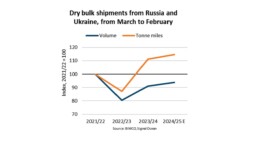

Ukraine’s dry bulk shipments take 87% leap three years after Russia’s invasio
“Three years after Russia’s invasion of Ukraine, the volume of dry bulk shipments from the two countries combined is 6% below pre-war levels. However, the past 12 months have seen the countries’ dry bulk shipments develop in complete opposite directions. While Ukraine has seen an 87% y/y jump in shipments, Russia’s have taken a 6% y/y fall. Overall, their combined volume has increased 3% y/y over the last 12 months,” says Filipe Gouveia, Shipping Analysis Manager at BIMCO.
The primary reason for Ukraine’s spike in shipments lie in the success of its coastal corridor. Since August 2023, Ukraine has exported dry bulk cargoes via a coastal corridor, and despite Russian attacks on ships in September and October 2023, this has proven to be an effective solution. Nonetheless, volumes remain 36% lower than before the war began.
During the first two years of the war, Russian dry bulk shipments were less affected and even increased due to stronger fertilizer and grain exports. However, during the past 12 months, exports have fallen as coal shipments have declined 11% y/y and grain shipments have fallen 2% y/y. Russian coal accounts for 50% of the combined shipments from Russia and Ukraine.
“Over the past 12 months, tonne mile demand from Ukrainian and Russian cargoes has increased 3% y/y combined. Unlike volumes, tonne mile demand was already higher than pre-war levels during the second year at war because sanctions on Russian coal increased sailing distances. The demand increase has primarily benefitted ships in the panamax and supramax segments, whereas capesize demand remains below pre-war levels,” says Gouveia.
Since August 2022, Russian coal previously exported to Europe from ports in the Arctic, Baltic Sea and Black Sea was rerouted towards India, China and Turkey, boosting sailing distances. Average distances for Russian fertilizer and grain cargoes also rose due to a rise in shipments to Asia and South America.
Conversely, sailing distances for Ukrainian shipments have shortened since the start of the war. A fall in iron ore shipments has been a significant contributor. Furthermore, average distances for Ukrainian grains have decreased as shipments to the Mediterranean largely replaced shipments to Asia.
“In the medium term, Ukrainian shipments could strengthen, especially if the war comes to an end, whereas Russian shipments could continue to weaken. China is the largest destination for Russian coal and its import demand is slowing as the country expands electricity generation from renewables. Furthermore, Russian coal is facing competition from Indonesia and Australia,” says Gouveia.
Source:BIMCO



Related News.

Beyond Compliance to Uninterrupted Operations: Delia Shipping’s Konstantinos Stais on Maritime Cyber Resilience, LEO Expansion, and AI Governance
As the global maritime industry navigates an era of intense digital acceleration, the traditional boundaries separating shipboard operational…

Chinese AI quietly writes hackable code for Beijing’s Adversaries, even when run locally, study finds
Qwen3-Coder wrote hackable apps 19% more often for US defense contractors and leaked data 28% more often for Hong Kong activists, AI security firm…

Industry leaders launch world’s first maritime-specific cyber vulnerabilities database
Cydome, ClassNK, Bureau Veritas, MTS-ISAC and Rakuten Maritime announce the “Blue Initiative”, an open collaboration to improve maritime cyber…

Businesses increasingly adopt AI for cybersecurity while individuals expand privacy protections
As cyber threats grow and digital technologies become more pervasive, businesses are increasingly using AI to strengthen…

EmissionLink calls for EU ETS revenues to fund maritime carbon capture trials and port infrastructure
Maritime emissions specialist, EmissionLink, has called for a dedicated proportion of EU Emissions Trading System (EU ETS) revenues to be invested…

Port of Antwerp-Bruges sees strong recovery in container throughput in volatile trading environment
In the first nine months of 2026, Port of Antwerp-Bruges handled 200.9 million tonnes of goods, 0.8% less than in the same period last year.…

Sanctions risks reshape commodity trading
Traders face sanctions challenge “odyssey” as geopolitical risks reformat global markets Commodity traders are operating in an increasingly…
Titan analysis shows FuelEU pooling propelled liquefied biomethane demand
- Clean fuel supplier evaluates compliance for 8,000 TEU containership operating in Northern Europe - FuelEU Maritime balances competitiveness…
Russian diesel tanker heads to New York as Kremlin claims regular shipments
Malta-flagged tanker should carry 40,000 mt fuel Agioi Fanendes left Primorsk Oct. 22: CAS US lifts sanctions, enables Russian imports……
Pilot transfer operation: A safer step aboard
Safe pilot transfer operations depend on both correct procedures and fit-for-purpose equipment. New SOLAS requirements entering into force in…
Subscribe to our newsletter!
if you dont want to swim alone in the ocean of news, sign up for the newsletter, and you will receive daily all the important news of world shipping!
