
HIGHLIGHTS
Iran’s oil logistics face further disruptions with more intermediaries targeted
Crude exports from Iran have trouble reaching end-users in China
US could threaten Malaysian entities with sanctions in later enforcement
The US has started to target tankers responsible for transshipments of Iranian oil with sanctions, which could further disrupt Iran’s cargo logistics at a time when its top customers in China take a cautious stance on sanctioned trades, according to industry data and observers.
With President Donald Trump promising “maximum pressure” on Iran’s oil exports as his second term started, the US Treasury Feb. 6 identified nine crude tankers totaling 2.2 million dwt in the new administration first sanctions enforcement against Iran, targeting companies facilitating the country’s oil shipments to China and their assets.
S&P Global Commodities at Sea data suggests the vessels lifted 26.2 million barrels of Iranian crude or fuel oil via ship-to-ship transfers off Malaysia, China, Iraq, India, Singapore, Greece, Oman and South Korea or from their onshore tanks since the beginning of 2024.
The recent enforcement “underscores the role that transshipment hubs play in Iran’s illicit oil trade” and “reflects an important shift in enforcement strategy,” whereby ships loaded Iranian oil from non-Iranian locations were targeted, said Claire Jungman, chief of staff at nonprofit United Against Nuclear Iran.
Of the Iranian barrels, CAS data shows 19.2 million were transferred via Malaysia — the top transshipment hub of Iranian oil.
“Further sanctions could certainly be directed at Malaysian entities facilitating these transactions, including vessels, storage operators, financial enablers, and intermediaries handling these shipments,” Jungman said.
“Malaysia’s established infrastructure makes it a preferred route, and absent strong enforcement action by regional authorities, it will likely remain central to Iran’s export network.”
In response to tightening sanctions, Iran has recently been engaged in more offshore oil transfers near Egypt and Myanmar as well as in Iranian waters and the Red Sea, according to Windward’s research.
“The West has a lot of sanctions to enforce … It’s definitely going to make trading even more complex,” the analytics firm’s CEO Ami Daniel said.
Top importer
The development comes as companies in China, the world’s largest seaborne crude importer and the predominant Iranian oil buyer, have turned cautious against sanctioned trades following Trump’s election in November.
President Trump, having re-imposed sanctions on Iran’s petroleum sector during his first term in 2016-2020, promised more economic pressure on the country during his campaign trail, and industry participants expected the focus of US sanctions would shift to Iran.
China’s Shandong Port Group, whose terminals are often used by Chinese independent refineries that rely on Iranian crude as feedstock, in early January confirmed a ban of entry by US-sanctioned ships.
Such blacklisted ships transported 1.53 million b/d in 2024, of which Iranian crude accounted for more than 950,000 b/d, according to CAS.
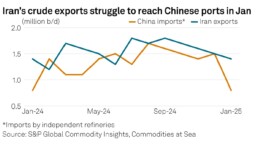
With the sanctions pressure, China’s Iranian crude imports — nearly all by the independent refineries — slumped to a 12-month low of 851,000 b/d in January from 1.48 million b/d in December, S&P Global Commodity Insights data showed.
The sharp drop came despite Iran’s seaborne crude exports remained at a normal level of 1.4 million-1.6 million b/d in November-January, according to CAS figures, suggesting a larger amount of Iranian oil could be stored in third countries, floated at sea, or sold with dubious documents on cargo origin.
Chinese customs data has not shown oil imports from Iran since January 2022, and market sources said Iranian crude has come to China with Malaysia-origin certificates since then.
Based on CAS data for completed voyages, China’s seaborne imports of crude from Malaysia or with unknown origin reached 924,800 b/d last month, up 31% from December and the highest since April. The country’s overall seaborne imports fell 10% to 9.3 million b/d, a low not seen since 2022.
Byron Mckinney, trade finance director at S&P Global Market Intelligence, suggested the Trump administration might hold back from sanctioning more Chinese companies directly since the country already cut purchases of Iranian oil publicly.
Iran’s seaborne crude exports fell from 2.6 million b/d in 2017 to 434,100 b/d in 2020 before recovering to 1.5 million-1.6 million b/d last year under the Biden administration, and President Trump has vowed to bring them down to zero.
But “targeting China’s oil and port infrastructure could be a step too far and too escalatory for the time being,” Mckinney said, as the world’s two largest economies are already in a trade war and have geopolitical conflicts.
Source: Platts
Related News.
September 3, 2026
Cyprus Maritime Innovation takes Centre Stage at SMM Hamburg 2026
Underscoring its expanding role as a premier international hub for cutting-edge maritime technology and sustainable shipping, the Republic of Cyprus…
September 3, 2026
Trump seeks to refill US oil reserve with Venezuela deal but faces long delay
U.S. President Donald Trump said on the 30th (local time) that he would refill the U.S. Strategic Petroleum Reserve, which has been depleted with…
September 3, 2026
US Navy Official visits South Korean Shipyards in private
With U.S. President Donald Trump pushing a plan to allow overseas construction of U.S. warships, attention is focusing on whether the building of…
September 3, 2026
SES and De Boer Marine expand collaboration with FlexMaritime deployment across Global Markets
SES, a leading space solutions company, and De Boer Marine, a leading provider of top-quality marine equipment and maritime connectivity services,…
September 3, 2026
New ESG guidance to help maritime industry turn sustainability into commercial advantage
New framework helps shipowners and ports align ESG strategy with access to capital, charterer expectations and long-term asset value. Maritime…
September 3, 2026
Britannia P&I Club analysis finds four in five crew deaths linked to illness rather than accidents
New report highlights cardiovascular disease as leading cause of fatalities and raises concerns over mental health risks among younger seafarers.…
September 3, 2026
The Swedish Club launches new Loss Prevention podcast, Knot Another Lesson
The Swedish Club has launched Knot Another Lesson, a new podcast exploring the practical lessons, emerging risks and operational challenges shaping…
September 3, 2026
Lloyd’s Register appoints Jens Grunenberg as Senior Representative for Germany
Lloyd’s Register has appointed Jens Grunenberg as its Senior Representative for Germany, effective 1 September. Based in Hamburg, Grunenberg will…
September 3, 2026
Indian Register of Shipping sets sights on Hamburg for European Expansion
Indian Register of Shipping, a leading international classification society and full member of the International Association of Classification…
September 3, 2026
MOL completes Merger of 6 Ship Management Companies
Unifying Management of Over 200 Vessels and Strengthening Safety Mitsui O.S.K. Lines, announced that it has completed the integration of the MOL…
Subscribe to our newsletter!
if you dont want to swim alone in the ocean of news, sign up for the newsletter, and you will receive daily all the important news of world shipping!
Design & Development by P.KAN.DESIGNER
© 2026 Cyprus Shipping News. All rights reserved
Design & Development by P.KAN.DESIGNER
© 2026 Cyprus Shipping News. All rights reserved