Shipowners consider preparing ships for future decarbonising retrofits: MPC Capital

LNG takes over from methanol as most popular fuel
Ammonia has good pricing prospects
US new administration is an example of regulatory risk
With uncertain commercial environments for alternative bunker fuels amid tightening environment regulations, some shipowners with conventional vessel orders are planning to defer the decision on which fuel to use and instead preparing for future retrofits to cut greenhouse gas emissions, Constantin Baack, CEO of German investor MPC Capital, told S&P Global Commodity Insights.
Half of the ships ordered in 2024 were still only capable of running on conventional, oil-based fuels, according to Clarksons data, but shipping professionals said such vessels could still be installed with alternative propulsion or energy-saving device to meet regulatory requirements.
Retrofitting ships, as a way to decarbonize the existing fleet has “picked up dramatically” over the last 24 months, but conversion projects for an old ship built 10-15 years ago is more difficult than for a modern ship.
“Whenever you order a ship now, you should look at optionality; that means dual fuel on board or a clear path to retrofitting to a then compliant technology,” Baack added.
The key is for shipowners to make some sort of investment to their fleets. “Even a new ship with conventional fuels is way more efficient from a consumption standpoint than an old conventional ship,” he said. With new efficiencies, a conventionally-propelled ship may still be compliant over the next 15 years, he added.
Member states of the IMO, a UN agency tasked with maritime transportation, have aimed to cut life-cycle greenhouse gas emissions from international shipping by 20%-30% by 2030 and 70%-80% by 2040, against 2008 levels, before reaching net-zero emissions close to 2050.
Alongside this, European Union rules mandate that ship operators cut the greenhouse gas emissions intensity of fuels used by ships in EU-related trades by 2% against 2020 levels from 2025. Under the FuelEU Maritime regulation, the threshold increases to 6% from 2030, 14.5% from 2035, 31% from 2040, 62% from 2045 and 80% from 2050.
Be that as it may, the short-term outlook for alternative marine fuels remains limited and alternative fuels as part of the overall bunker demand mix, excluding LNG and LPG, will only shift the dial from 0.5% in 2022 to 2.9% by 2030, according to S&P Global Commodity Insights’ Annual Strategic Workbook.
LNG re-emerges as front-runner
Methanol has attracted increasing attention as an alternative bunker fuel, with container giant A. P. Moller-Maersk, making some high-profile orders of methanol-ready vessels.
However, concerns about available infrastructure and the cost of all emerging fuels are encouraging take-up of more established fuels LNG and biofuels. While there are misgivings about the environmental credentials of LNG, the fuel can meet the EU’s FuelEU Maritime GHG reduction threshold up until 2034 and the bloc allows the compliance surpluses — the amount of emissions cut based on fuel usage — to be banked. The fuel will not be compliant from 2035.
“What we have seen is that LNG is taking over on the pole position, at least as far as new orders are concerned,” Baack said. Around two thirds of container ship newbuilds in 2024 were for dual fuel ships, which can be operated with both conventional and alternative fuels. One third of those are capable of running on methanol and two thirds of them running on LNG. Only one third of all container ship newbuilds in 2024 are running solely on conventional fuel, he said.
“This is mainly linked to pricing, in my view, and to the big question around the availability of green methanol regionally,” Baack said.
According to the Platts Global bunker fuel cost calculator, the cost of LNG as a bunker fuel, not including EU emissions allowances, averaged $686.18/mt of very low sulfur fuel oil equivalent at Rotterdam in December, compared to $914.70/mtVLSFOe of gray methanol. Platts is part of S&P Global Commodity Insights. Green methanol could be two to five times more expensive according to industry estimates.
Delivered VLSFO at Rotterdam averaged $506/mt in December.
Future prices
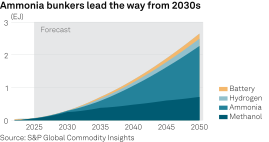
Analysts at Commodity Insights see LNG and biofuels as the main candidates to meet IMO environmental targets up until about 2030, in the absence of fuel availability and appropriate engines for ammonia and hydrogen. Moving toward 2050, Commodity Insights’ current forecast is for ammonia and methanol to be the alternative fuels of choice.
“If you look at the long-term pricing basis, I would think ammonia has a pretty good set of cards in hand, but this is 10 years or more out,” Baack said.
This is still some way off, green ammonia in Northwest Europe averaged $2,039.97/mtVLSFOe in December, the Platts global bunker fuel cost calculator showed.
US showcases regulatory risk
One of the key challenges facing shipping’s decarbonization is global regulation and its scattered nature, Baack said.
While the IMO is developing a global carbon levy, the industry faces regional schemes at present, such as FuelEU Maritime. While this does contribute to reducing emissions in the industry its regional nature makes investment difficult and unpredictable and fails to address the problem on a global scale, Baack said.
Things can change in different regions, for example in the US, where newly inaugurated President Donald Trump is looking to roll back green legislation of his predecessor. “Regulation can change overnight… You are aware of certain US production sites for certain green fuels, which were based on a subsidy scheme, and all of a sudden the tide is turning,” Baack said.
Source: Platts



Related News.

Navigating the Multi-Orbit Era: In Conversation with Intellian’s Jon Harrison at SMM 2026
At SMM 2026 in Hamburg, the rapid evolution of maritime satellite communications took centre stage. Across the exhibition halls, discussions among…

Cyprus ports need joint energy and investment strategy, shipping agents chief says
Cyprus needs a coordinated strategy for shipping, energy and environmental protection to support port investment and modernisation, Cyprus shipping…

MASO Public Affairs introduces MASO Regulatory Intelligence
A new subscription service helping businesses understand what is changing and what it means for them MASO Public Affairs introduces MASO Regulatory…

Anglo-Eastern helps turn CMBTECH’s ammonia ambition into an operational reality
From early feasibility study and risk-based design to newbuilding supervision, crew readiness and technical management, Anglo-Eastern drew on its…

Escalation of attacks threatens to derail recovery in Middle East oil exports
World oil demand is forecast to fall by 2.5 mb/d y-o-y in 4Q26 and 2.6 mb/d on average in 2026. As the Iran war manifests itself through restricted…

New study finds shipping pays twice its share to EU ETS earmarked revenues should triple to help build market for sustainable fuels and technologies
Shipping is responsible for around 10% of EU ETS emissions but pays almost 20% of the ETS bill. Unlike other sectors, it has never received free…

MSARC strengthens maritime mass rescue readiness through training and national live exercise off Dakar, Senegal
Joint MSARC–FHAS programme combines three days of SAR training with a national multi-agency live exercise The Maritime Search and Rescue Council ,…

Sogese report deliveries are still being delayed as container freight rates fluctuate
FOR IMPORTERS Spot rates into the Mediterranean are back at January levels, Far East to Europe reliability sits at pandemic lows, and nearly…

Glencore begins trading on Australian Securities Exchange
Glencore has begun trading on the Australian Securities Exchange under the ASX code GLC. Gary Nagle, Glencore’s CEO, said it was an exciting day for…

BIMCO Shipping Number of the Week
Suez Canal container ship transits exceed 50% of pre-disruption levels "During the first two weeks of October, weekly container ship capacity…
Subscribe to our newsletter!
if you dont want to swim alone in the ocean of news, sign up for the newsletter, and you will receive daily all the important news of world shipping!
