Sweco study regenerative design can increase urban green-blue areas in European cities by 42 percent


A new Sweco study highlights the potential of 22 European cities to enhance liveability, sustainability, and resilience through regenerative design in the built environment. By adopting the principles of regenerative design, these cities can increase the size of their green-blue areas by 42 percent – and align with the new EU nature restoration law related to urban ecosystems.
Currently, 75 per cent of EU citizens reside in urban areas. As cities expand, green-blue spaces tend to be sacrificed for grey infrastructure, thereby negatively impacting biodiversity. By paving over natural surfaces, removing trees, and channelling waterways, urban development has led to ecological “dead zones” and increased vulnerability to floods and heatwaves.

“The decline of biodiversity is progressing at an alarming rate and scale, triggering a chain reaction. This also threatens the essential ecosystem services that citizens rely on, such as clean water and air and pollinating crops,” says Tobias Nauwelaers, a Sweco expert in nature restoration and urban ecology, and one of the authors of the report.
Recent data from the European Environment Agency shows that 81 per cent of protected habitats are in poor condition, with only 9 per cent improving. Under the new EU Nature Restoration Law, which aims to restore degraded ecosystems, member states are required to plan and follow up on their contribution to reversing this trend.
“One solution to Europe’s city biodiversity problem is applying the principles of regenerative design. By incorporating natural systems and semi-natural systems to achieve more green-blue areas, the cities can not only minimise environmental harm, but also start ‘giving back’ by contributing positively to ecosystems and boosting biodiversity. There is EU funding available to address this problem, as at least EUR 20 billion a year will be allocated from the 2021-2027 EU budget for spending on biodiversity,” says Tobias Nauwelaers.
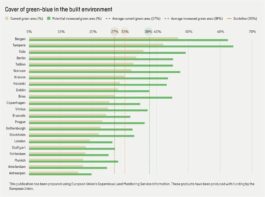
Sweco has studied 22 cities: Amsterdam, Antwerp, Bergen, Berlin, Brno, Brussels, Copenhagen, Dublin, Gothenburg, Helsinki, Krakow, London, Munich, Oslo, Prague, Rotterdam, Stockholm, Stuttgart, Tallinn, Tampere, Vilnius and Warsaw. As seen in the attached graph, Tampere, Bergen and Oslo have the potential to become some of Europe’s greenest cities, while other cities in the study would need to take additional measures to meet the 30 per cent green rule.
Sweco’s report highlights several recommendations for decision makers in European cities and municipalities to consider to become regenerative cities:
1. Use nature-based solutions that utilise green-blue infrastructure to support biodiversity, manage water, and create healthy spaces.
2. Prioritise native plants to boost biodiversity, control invasive species, and restore degraded areas for a healthier ecosystem.
3. Establish green corridors to connect natural areas, enabling species movement and supporting biodiversity.
4. Use permeable surfaces, rainwater harvesting, and wetlands to absorb rain, prevent flooding, and support water quality and wildlife.
5. Engage residents in planning and projects to foster inclusivity, collaboration, and shared responsibility.
6. Establish closed-loop systems to minimise waste, recycle resources, and generate renewable energy.
7. Promote urban agriculture with community gardens to boost local food production, cut transport emissions, and support the local economy.
8. Create resilient, net-zero infrastructure that adapts to climate change and supports health, sustainability, and future needs.
9. Promote 15-minute access to key services, sustainable transit, and walkable, bike-friendly, car-free neighbourhoods.



Related News.

Navigating the Multi-Orbit Era: In Conversation with Intellian’s Jon Harrison at SMM 2026
At SMM 2026 in Hamburg, the rapid evolution of maritime satellite communications took centre stage. Across the exhibition halls, discussions among…

Cyprus ports need joint energy and investment strategy, shipping agents chief says
Cyprus needs a coordinated strategy for shipping, energy and environmental protection to support port investment and modernisation, Cyprus shipping…

MASO Public Affairs introduces MASO Regulatory Intelligence
A new subscription service helping businesses understand what is changing and what it means for them MASO Public Affairs introduces MASO Regulatory…

Anglo-Eastern helps turn CMBTECH’s ammonia ambition into an operational reality
From early feasibility study and risk-based design to newbuilding supervision, crew readiness and technical management, Anglo-Eastern drew on its…

Escalation of attacks threatens to derail recovery in Middle East oil exports
World oil demand is forecast to fall by 2.5 mb/d y-o-y in 4Q26 and 2.6 mb/d on average in 2026. As the Iran war manifests itself through restricted…

New study finds shipping pays twice its share to EU ETS earmarked revenues should triple to help build market for sustainable fuels and technologies
Shipping is responsible for around 10% of EU ETS emissions but pays almost 20% of the ETS bill. Unlike other sectors, it has never received free…

MSARC strengthens maritime mass rescue readiness through training and national live exercise off Dakar, Senegal
Joint MSARC–FHAS programme combines three days of SAR training with a national multi-agency live exercise The Maritime Search and Rescue Council ,…

Sogese report deliveries are still being delayed as container freight rates fluctuate
FOR IMPORTERS Spot rates into the Mediterranean are back at January levels, Far East to Europe reliability sits at pandemic lows, and nearly…

Glencore begins trading on Australian Securities Exchange
Glencore has begun trading on the Australian Securities Exchange under the ASX code GLC. Gary Nagle, Glencore’s CEO, said it was an exciting day for…

BIMCO Shipping Number of the Week
Suez Canal container ship transits exceed 50% of pre-disruption levels "During the first two weeks of October, weekly container ship capacity…
Subscribe to our newsletter!
if you dont want to swim alone in the ocean of news, sign up for the newsletter, and you will receive daily all the important news of world shipping!
