
The new Regulation provides flexibility mechanisms which may assist shipowners to significantly reduce their fleet compliance costs, writes Stamatis Fradelos, VP Regulatory Affairs, ABS
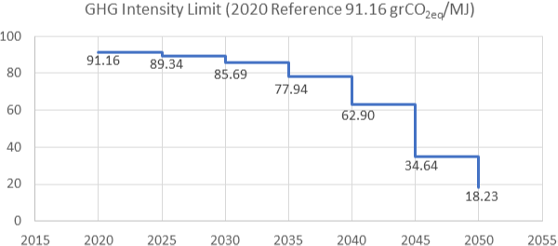
Starting from 2025, ships operating in the EU must fulfil their energy needs with fuels of GHG intensity measured on a Well to Wake basis (gCO₂ₑ/MJ) below a sliding scale threshold value which is subject to a five-year percentage reduction with respect to a reference value (91.16 gCO₂ₑ/MJ).
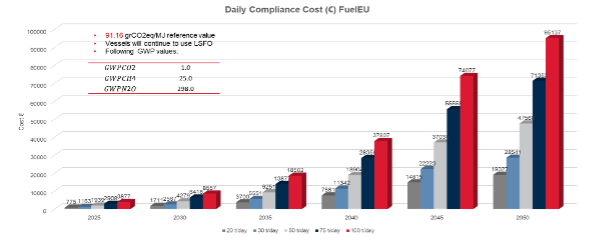
Ships with a higher GHG intensity than the threshold must pay a remedial penalty proportional to their compliance deficit. The compliance deficit is the difference between the reference GHG intensity and the actual one, multiplied by the energy consumption. The graphbelow shows the daily compliance costfor a ship using LSFO based on its daily fuel oil consumption.
If a ship has a compliance deficit for two consecutive reporting periods or more, the remedial penalty will beincreased by 10% in every consecutive reporting period until the ship achieves a compliance surplus and the increase factor is reset.
The entity responsible for ensuring compliance of the ship with FuelEU Maritime Regulation is the entity responsible for compliance of the ship with the International Safety Management Code (ISM Manager).
Flexibility mechanisms
Compliance with the Regulation may depend on elements that are beyond the control of the Company (for the purposes of the regulation, the Manager under the ISM Code), such as issues related to fuel availability or fuel quality. Furthermore, in order to avoid technology lock-in and continue supporting the deployment of the best performing solutions, the Regulation provides three flexibility mechanisms:
- Banking: In the case that a ship has a compliance surplus, the Company may ‘bank’ and use it for the same ship in the following reporting period.
- Borrowing: In the case that the vessel has a compliance deficit, the Company may borrow an advance compliance surplus of the corresponding amount from the next reporting period. However, in the next reporting period, the borrowed compliance surplus must be multiplied by 1.1 and be subtracted from the same ship’s balance.
- Pooling: In the case that a ship has a compliance surplus, the Company may use it to compensate the under-performance of other ships, provided that the total pooled compliance is positive.
Pooling creates the possibility to reward over-compliance and provides incentives for investment in more advanced technologies. The possibility to opt for pooled compliance is voluntary, is subject to agreement of the Companies concerned and introduces some additional challenges.
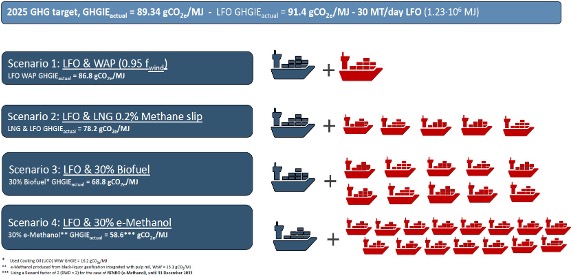
Depending on the WtW GHG intensity of the fuel used or if Wind Assistance Propulsion (WAP) technology is installed on board, a ship may balance several vessels within a pool. In particular a ‘multiplier’ for Renewable Fuels of Non-Biological Origin (RFNBOs) until the end of 2033, will allow their energy to count twice, thus balancing additional ships.
Pooling Rules
Pooling must meet specific preconditions, and the rules provided in Article 21 of the regulation,
- The ship must fall within the scope of FuelEU Maritime Regulation.
- The ship hasn’t borrowed compliance in the current verification period.
- The sum of the initial compliance balance of the ships included in the pool is positive (including banking and borrowing of previous periods).
- Ships in the pool must have a valid Document of Compliance, if they were in the scope of FuelEU in previous verification period.
- A ship cannot participate in another pool.
- Ships which had a compliance deficit may not have a higher compliance deficit after the allocation.
- Ships with a compliance surplus may not have a compliance deficit after the allocation.
- Two separate pools may be used for the GHG intensity target and the RFNBO sub-target.
Pooling Timeline and Process
By 31 January each year Companies will need to submit the FuelEU report to their verifier.
By 31 March verifiers will need to verify submitted data for each ship and to record in the FuelEU database the FuelEU report, the verification report and additional information including the ship’s compliance balance.
Although there is no fixed deadline, once the Company receives the verification report by the verifier must register as soon as possible in the FuelEU database:
- its intention to include the ship’s compliance balance in a pool,
- the allocation of the total pool compliance balance to each individual ship,
- the choice of the verifier selected for verifying that allocation.
To initiate the pooling process the Company will need to request pooling through the EMSA/Thetis platform and to identify the ships to be included in the pool and the responsible Companies. The lead Company will also indicate the allocation of the total compliance balance of the pool to each individual ship and will identify the verifier for the pool.
Once the participating Companies receive the notification through the Thetis system, they will need to verify and accept the pool details, including the compliance balance allocation for the ships under their management.
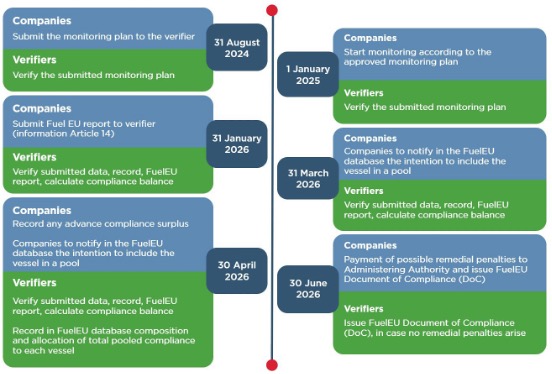
By 30 April, the selected verifier for the pool shall record in the FuelEU database the definitive composition of the pool and allocation of the total pool compliance balance to each individual ship.
By 30 June, the verifier of each individual ship shall issue a FuelEU Document of Compliance for the ship concerned, provided that the ship does not have a compliance deficit further to the pool allocation or company has proceeded with payment of any remedial penalties to Administering Authority.
Pooling contractual arrangements
While the Company will remain responsible paying the FuelEU penalties, the Regulation, in line with the ‘polluter pays’ principle, provides in Article 23 that the entity responsible for purchasing the fuel or for taking operational decisions that affect the GHG intensity of the energy used by the ship (e.g. Charterer) could, through contractual agreements with the Company, be put under the obligation to reimburse the Company with respect to the cost of the FuelEU penalties resulting from the operation of the ship.
The Regulation does not specify the financial arrangements between the Companies, charterers or shipowners. This will be defined by private agreements between these parties which become more complicated when a ship participates in a pool or there is a change of owner, Company or charterer within the verification period.
Relevant charter party clauses are expected to provide that in the case where the vessel has a compliance deficit, the charterer shall pay the surcharge to the owner. The charterer may however be entitled to instruct the Company to register the ship in a pool and if this brings the vessel into compliance, the owner will need to reimburse the charterer for the surcharge paid during that reporting period.
Furthermore, agreements between the owner and the Company would provide the appropriate form and amount of security, which may be adjusted from time to time, to cover the corresponding ISM Managers’ exposure, with regards to FuelEU responsibilities.



Related News.

ISLAND OIL: Unveiling of the Sculpture “Cyprus’s Journey Through the Ages” in Protaras – A Tribute and Landmark to Cyprus’s Historical Memory and Cultural Heritage
In a modest ceremony marked by a moving atmosphere, the sculpture “Cyprus’s Journey Through the Ages”, created by acclaimed Cypriot sculptor…

World Maritime Day 2026 from Policy to Practice – powering Maritime Excellence
Global regulations will deliver safer, more resilient shipping when they are implemented worldwide. The international maritime community marks…

Diana Shipping announces Time Charter Contract for m/v DSI Polaris with Dai An Ocean Shipping
Diana Shipping , a global shipping company specializing in the ownership and bareboat charter-in of dry bulk vessels, announced that, through a…

Chief Economists Expect Global Economy to Stabilize, but Fiscal Constraints, Rising Living Costs and AI Investment Uncertainty Threaten Growth
The global economy is stabilizing, but the fiscal support that cushioned successive shocks since 2020 is unlikely to play the same role in the year…

V. welcomes its new graduate cohort as programme expands across the group
Twelve graduates from nine nationalities join 11th year of V.’s expanded international management programme. V., the global ship manager and marine…

From Policy to Practice: Why Seafarers Are the Key to Maritime Excellence
The shipping industry is no stranger to regulation. Seafarers and ship operators work within a vast framework of international conventions, national…

Intermodal Report – Week 38 2026
Please find below the Intermodal market report for week 38 2026. Intermodal Report Week 38 2026 Market Insight By Nikos Tagoulis, Head of…

Allied – Weekly Market Review – Week 38
Please find below the Allied Weekly Report for Week 38 | 2026 ALLIED - Weekly Market Report- Week 38

Record year on the Northeast Passage but Arctic shipping remains very limited
In 2025, a record 103 transit voyages were made via the Northeast Passage. However, this is still equivalent to only around a day and a half of…

[xclusiv] S&P Report 21th September 2026
Please find below the [xclusiv] latest Weekly S&P Report [xclusiv] 2026_09_21 Market Commentary: VLCCs: Freight Boom Reprices the Fleet The VLCC…
Subscribe to our newsletter!
if you dont want to swim alone in the ocean of news, sign up for the newsletter, and you will receive daily all the important news of world shipping!
