Chinese shipbuilders seek transition towards clean energy
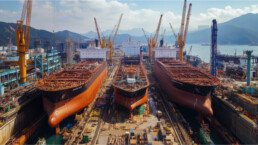

In a bustling shipyard of Haixi Bay, located in the Xihai’an (West Coast) New Area of Qingdao, east China’s Shandong province, workers were welding steel plates on the production line.
“Our order books are full until 2028. With tight schedules and heavy workloads, we have to keep production going non-stop,” said Chen Zhihua, deputy director of the planning department at China State Shipbuilding Corporation Qingdao Beihai Shipbuilding Co., Ltd. (Beihai Shipbuilding).
Although the company now sees so many orders, it once went through a painful transition period.
For a long time, the international shipping industry primarily relied on diesel fuel, and the company’s previous ship models were diesel-powered. However, in recent years, the market has undergone significant changes, with increasingly stringent emissions standards for ships in international shipping.
“Nowadays, it’s nearly impossible to secure orders from international shipowners if you don’t develop clean energy vessels,” Chen explained.
As the market presented new demands, the company’s transformation became imperative.
“Liquefied natural gas (LNG) is currently the safest and most effective ship fuel for reducing emissions under existing economic and technological conditions,” said Li Zhonggang, head of Beihai Shipbuilding’s design team.
After extensive research, the team decided to introduce LNG-fueled vessels as their first low-carbon ships. They chose to develop a 210,000-ton bulk carrier, a vessel type in high demand and the backbone of the global bulk shipping fleet.
During the designing process, controlling evaporated gas and maintaining proper pressure in the ship’s LNG fuel tanks posed as significant challenges for the team.
Using boilers to burn excess evaporated gas would increase energy consumption and emissions while raising operational costs. On the other hand, it would be inefficient to use dual-fuel generator sets to consume the evaporated gas.
To address the technical bottleneck, the team independently developed a simulation system. In early 2021, after hundreds of simulations and multiple rounds of water tank model tests, Beihai Shipbuilding finally overcame the technical hurdles and successfully developed the 210,000-ton LNG dual-fuel bulk carrier.
A foreign shipowner, intrigued by the news, examined the design and promptly ordered three vessels. Compared to transport ships powered by traditional fuels, this new vessel reduces daily fuel consumption by 1.9 tons, nitrogen oxide emissions by over 25 percent, carbon monoxide emissions by over 30 percent, and carbon dioxide emissions by about 20 percent. Besides, it emits almost no sulfur oxide. The economic and ecological benefits are significantly increased.
So far, Beihai Shipbuilding have received orders for 64 vessels, with a total value reaching nearly 35.44 billion yuan ($4.98 billion). In particular, seven of these 64 vessels are 210,000-ton LNG dual-fuel bulk carriers. Besides, new energy ships powered by ammonia and methanol account for 87.5 percent of the orders.
With orders pouring in, Beihai Shipbuilding is confident in its production capabilities. Haixi Bay, home to a cluster of shipbuilding, marine engineering, and various supporting enterprises, now boasts an annual capacity of 6.68 million tons of shipbuilding, over 200 ship repairs, and 500,000 tons of marine engineering steel processing.
As a zero-carbon clean energy source with great development potential, ammonia emits no carbon dioxide during combustion. This presents a new goal for the shipbuilding base.
In recent years, China’s shipbuilding industry has continued to improve overall, maintaining a leading share in the international market and steadily enhancing its competitiveness. The structure of new ship orders has been continuously optimized, with an accelerated push towards green and low-carbon solutions.
In 2023, China ranked first globally in new orders for 14 out of 18 major ship types. Orders for green vessels, such as those powered by LNG and methanol, have grown rapidly. Breakthroughs have been made in orders for zero-carbon ships, including those using hydrogen fuel cells. The country took 57 percent of new orders for green ships around the world.
Source: People’s Daily



Related News.

Navigating the Multi-Orbit Era: In Conversation with Intellian’s Jon Harrison at SMM 2026
At SMM 2026 in Hamburg, the rapid evolution of maritime satellite communications took centre stage. Across the exhibition halls, discussions among…

Cyprus ports need joint energy and investment strategy, shipping agents chief says
Cyprus needs a coordinated strategy for shipping, energy and environmental protection to support port investment and modernisation, Cyprus shipping…

MASO Public Affairs introduces MASO Regulatory Intelligence
A new subscription service helping businesses understand what is changing and what it means for them MASO Public Affairs introduces MASO Regulatory…

Anglo-Eastern helps turn CMBTECH’s ammonia ambition into an operational reality
From early feasibility study and risk-based design to newbuilding supervision, crew readiness and technical management, Anglo-Eastern drew on its…

Escalation of attacks threatens to derail recovery in Middle East oil exports
World oil demand is forecast to fall by 2.5 mb/d y-o-y in 4Q26 and 2.6 mb/d on average in 2026. As the Iran war manifests itself through restricted…

New study finds shipping pays twice its share to EU ETS earmarked revenues should triple to help build market for sustainable fuels and technologies
Shipping is responsible for around 10% of EU ETS emissions but pays almost 20% of the ETS bill. Unlike other sectors, it has never received free…

MSARC strengthens maritime mass rescue readiness through training and national live exercise off Dakar, Senegal
Joint MSARC–FHAS programme combines three days of SAR training with a national multi-agency live exercise The Maritime Search and Rescue Council ,…

Sogese report deliveries are still being delayed as container freight rates fluctuate
FOR IMPORTERS Spot rates into the Mediterranean are back at January levels, Far East to Europe reliability sits at pandemic lows, and nearly…

Glencore begins trading on Australian Securities Exchange
Glencore has begun trading on the Australian Securities Exchange under the ASX code GLC. Gary Nagle, Glencore’s CEO, said it was an exciting day for…

BIMCO Shipping Number of the Week
Suez Canal container ship transits exceed 50% of pre-disruption levels "During the first two weeks of October, weekly container ship capacity…
Subscribe to our newsletter!
if you dont want to swim alone in the ocean of news, sign up for the newsletter, and you will receive daily all the important news of world shipping!
