Celebrating the Olympic Zeus a pioneer in AHTS hybrid propulsion
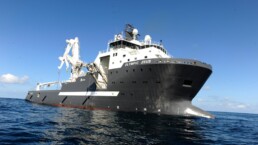

The Olympic Zeus, launched in 2009, introduced a hybrid power system, reducing fuel consumption by up to 70%. After reaching its 15th anniversary in 2024, it continues to set new fuel efficiency and environmental performance standards
AHTS market stunned by innovation
The Olympic Zeus marked a significant advancement in maritime technology and a disruptive step into reduced environmental footprints upon its delivery in 2009. It gained tremendous attention in the Anchor-Handling Tug Supply (AHTS) market by adopting a hybrid Diesel-Electric/Diesel-Mechanical (DE/DM) power system, unlike its predecessors that relied on solely Diesel-Mechanical (DM) propulsion. This innovation resulted in an impressive reduction in fuel consumption by up to 70% in specific modes, and astonishing clients. “The Olympic Zeus was the best! Today, 15 years later, she is still among the best,” comments the shipowner, Olympic Shipping.
In 2024, this groundbreaking vessel celebrates its 15th anniversary.

We create tomorrow’s solutions for sustainable marine operations
The vessel is based on the ULSTEIN A122 design by Ulstein Design & Solutions AS and constructed at Ulstein Verft. It is state-of-the-art in multiple ways, including the hybrid machinery, deep-water capabilities, excellent seakeeping, and performance characteristics that ensure outstanding fuel economy and low emissions. Already 15 years ago, Olympic Shipping and Ulstein had a strong focus on reducing the environmental footprint of the vessels.
It is still an excellent vessel with a very relevant setup, and there are not many other vessels around even today that can compete with it.
Hybrid propulsion innovation revolutionised the AHTS market
The Olympic Zeus was the first anchor handling/construction vessel with a diesel-mechanical/diesel-electric hybrid propulsion solution designed to primarily operate in diesel-electric mode. This groundbreaking innovation was nominated for the Green Ship Technology Award.
Runar Stave, Chief Technical Officer of Olympic Shipping, states,
It is still an excellent vessel with a very relevant setup, and there are not many other vessels around even today that can compete with it. From our experiences in the North Sea, we have noticed that the Olympic Zeus runs diesel-electric 80% of the time. Figures show that fuel consumption with a mix of different operations are, on average, about 50% lower than for most competing vessels due to the hybrid solution. We had quite clear ideas, and the results, after discussing and maturing these with Ulstein’s skilled professionals, were unmatched. The technology developed set a standard for future vessels.
He continues:
After a number of jobs, we have proved to the market that we can, on average, run the ship with significantly lower fuel consumption than a conventional diesel anchor handler, and save up to 70% in dynamic positioning operation compared to a conventional, diesel-mechanical ship.
The propellers can be driven directly by the diesel engines or by electric motors powered by generator sets, and the two modes can also be combined in hybrid mode for maximum performance. The system is tailor-made to fit the vessels’ dynamic and versatile work operations.

A hybrid vessel has high fuel-saving potentials
Given that an AHTS vessel only require low or medium propulsion power most of the time, a hybrid vessel has high fuel-saving potential, as it can run on fewer engines, with higher load and optimum fuel efficiency. Only a few operations require the extra power from the hybrid solution, leading to thousands of litres of reduced fuel consumption every day.
After analysing data from vessel operations during rig moves, we noticed that during the operations the majority of the time was spent on waiting and idling. The remaining time was spent on low power activities with some few very short bursts up to 130ton bollard pull.
Developing an AHTS focused on energy efficiency at low power loads was a comprehensive task. Traditional design thinking prioritised massive bollard-pull at low cost. After analysing data from vessel operations during rig moves, we noticed that during the operations the majority of the time was spent on waiting and idling. The remaining time was spent on low power activities with some few very short bursts up to 130 ton bollard pull. This led to a new design with slow-rotating, high-torque propellers in diesel-electric mode and a scalable power station with five smaller generators. This setup allowed the vessel to operate in electric mode up to 80% of the time, resulting in up to 70% fuel savings in low power operations and significantly reduced emissions,
says Frode Sollid, system architect at Ulstein Design & Solutions.
The feedback of the Olympic Zeus was overwhelmingly positive.
Many expressed amazement at the vessel’s remarkably low power requirements, stating they couldn’t believe such low power consumption was possible,
said the Captain of the Olympic Zeus.

Cutting-edge design and capabilities
Olympic Zeus measures 93.8m in length, 23m in width, and 10m from the main deck to the keel. With a bollard pull of approximately 270 tonnes, the vessel is equipped with a 250-tonne heave-compensated offshore crane and can be equipped with A-frame on the stern. Its large dimensions and additional onboard power makes it particularly well-suited for deepwater operations.
We chose Ulstein because we had great faith that it could deliver a ship of this complexity. The decision was based on the excellent performance of the previous Ulstein-designed and built ships, the ULSTEIN A101 anchor handlers, Olympic Hercules and Olympic Pegasus, delivered in 2002,
said CEO Stig Remøy, Olympic.
The Olympic Zeus represents a significant advancement in hybrid propulsion technology and has set new standards for fuel efficiency and environmental performance in the maritime industry. It is an innovation worth celebrating.



Related News.

Navigating the Multi-Orbit Era: In Conversation with Intellian’s Jon Harrison at SMM 2026
At SMM 2026 in Hamburg, the rapid evolution of maritime satellite communications took centre stage. Across the exhibition halls, discussions among…

Cyprus ports need joint energy and investment strategy, shipping agents chief says
Cyprus needs a coordinated strategy for shipping, energy and environmental protection to support port investment and modernisation, Cyprus shipping…

MASO Public Affairs introduces MASO Regulatory Intelligence
A new subscription service helping businesses understand what is changing and what it means for them MASO Public Affairs introduces MASO Regulatory…

Anglo-Eastern helps turn CMBTECH’s ammonia ambition into an operational reality
From early feasibility study and risk-based design to newbuilding supervision, crew readiness and technical management, Anglo-Eastern drew on its…

Escalation of attacks threatens to derail recovery in Middle East oil exports
World oil demand is forecast to fall by 2.5 mb/d y-o-y in 4Q26 and 2.6 mb/d on average in 2026. As the Iran war manifests itself through restricted…

New study finds shipping pays twice its share to EU ETS earmarked revenues should triple to help build market for sustainable fuels and technologies
Shipping is responsible for around 10% of EU ETS emissions but pays almost 20% of the ETS bill. Unlike other sectors, it has never received free…

MSARC strengthens maritime mass rescue readiness through training and national live exercise off Dakar, Senegal
Joint MSARC–FHAS programme combines three days of SAR training with a national multi-agency live exercise The Maritime Search and Rescue Council ,…

Sogese report deliveries are still being delayed as container freight rates fluctuate
FOR IMPORTERS Spot rates into the Mediterranean are back at January levels, Far East to Europe reliability sits at pandemic lows, and nearly…

Glencore begins trading on Australian Securities Exchange
Glencore has begun trading on the Australian Securities Exchange under the ASX code GLC. Gary Nagle, Glencore’s CEO, said it was an exciting day for…

BIMCO Shipping Number of the Week
Suez Canal container ship transits exceed 50% of pre-disruption levels "During the first two weeks of October, weekly container ship capacity…
Subscribe to our newsletter!
if you dont want to swim alone in the ocean of news, sign up for the newsletter, and you will receive daily all the important news of world shipping!
