Dry bulk freight market poised for fragmentation as environmental regulations reshape trends in supply


The dry bulk freight market is expected to become increasingly fragmented as decarbonisation regulations tighten and capex increases. Shifts in supply trends have been significant, driven by global and regional environmental policies that are altering vessel movements. Drewry has examined trends across vessels of different age categories, identifying the root causes and potential long-term effects of these regulatory changes. The varying impact on the utilisation and speed of vessels by age indicates a growing preference for newer ships, a trend that is anticipated to persist with the introduction of further regional regulations in 2025.
Key changes in vessel supply
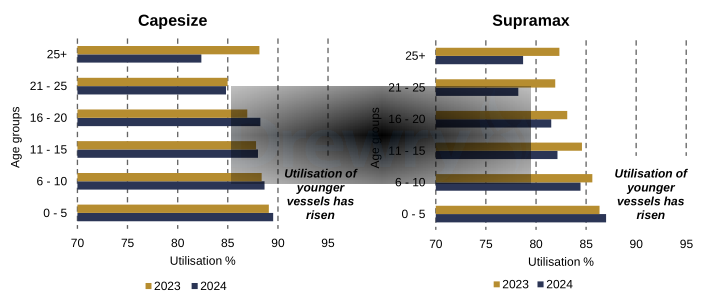
Drewry’s AIS data identifies a marked shift in speed and utilisation levels between vessels of different age categories due to environmental regulations. While utilisation of younger vessels has historically been higher, on average, the trend has largely been consistent every year for different age categories. A key change in 2024 has been the contrasting trends between older and younger vessels.
Figure 1: Utilisation of Dry Bulk vessels by age category, Jan-Sep 2024
Source: Drewry AIS
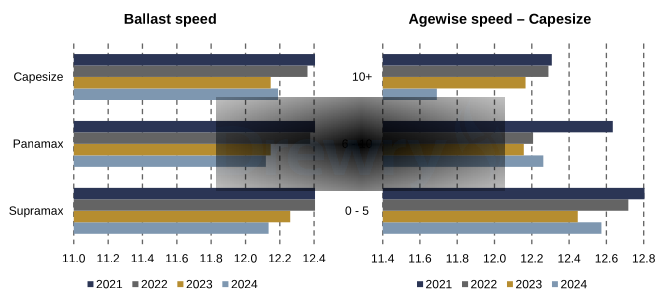
Similarly, a contrasting trend is observed in the speed of vessels of different age categories. While the average ballast speed for all vessel segments has been trending downwards since 2019, the decline was substantial from 2023 after the CII and EEXI regulations came into force as slow steaming is the easiest and most economical way of complying with these regulations.
The speed of Capesize vessels rose marginally in 2024 (Jan-Sept) in response to the heated freight market, even though vessel speeds remain lower than the 2019-22 average. Interestingly, the speed has edged up for vessels younger than 10 years while older vessels have slowed down to a large extent.
Figure 2: Dry Bulk vessel speed, Jan-Sep 2024
Source: Drewry AIS
The surge in preference for younger vessels is corroborated by the higher premiums for younger second-hand vessels than their older counterparts. Drewry’s analysis shows a higher premium for a five-year old eco-engine vessel in 2024 compared to the 20-year-old non-eco engine vessel.
In addition, the differential on the 1-year TC rates of eco and non-eco vessels has widened, with an average difference of $2,000 in 2023-24 compared to $1,500 in 2021-22.
Environmental regulations to drive market changes
The IMO’s emission reduction regulations have been driving the supply of vessels with shipowners and charterers undertaking the following measures to comply, such as:
- Reduction in vessel speed
- Use of Energy Saving Technologies
- Use low-/zero-carbon fuels to reduce emissions
- Onboard carbon capture technologies
Way forward: Renewal of fleet
Shipping companies need to strategise for the decarbonisation trend in the industry. The measures mentioned above are beneficial for a vessel owner to reduce emissions from their vessels, but looking at the bigger picture, shipping companies that have to manage more than one vessel should consider bringing down the average age of their fleet. Newer vessels are equipped with engines that are more efficient and thus consume less fuel to generate the same amount of power.
Future implications: Freight market segmentation to intensify due to regional regulations
With the IMO regulations and regional regulations (such as EU ETS) that are in place as well as some that are on the drawing board (such as FuelEU maritime), shipowners will need to take additional measures to comply, thereby impacting supply.
Younger vessels towards Europe (AIS)
Drewry analysed the MRV data of ships that called European ports in 2022 and 2023, and the corresponding AIS data of these vessels.
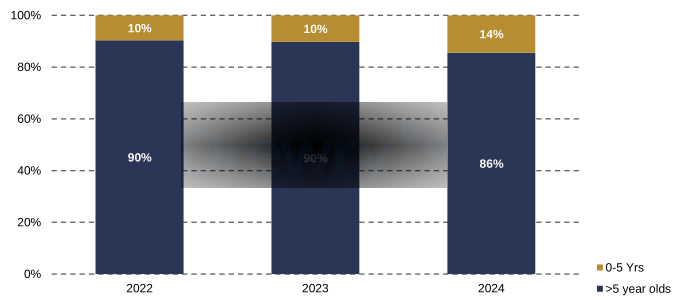
Shipowners are now sailing younger and more efficient vessels to save costs on carbon-related emissions. Based on AIS tracking of vessel movements, of all the ships that called European ports in 2023, 1,644 have not called at any port in the region in January-July 2024, and none of these vessels are 0-5 years old.
Figure 3: Age profile of vessels calling European ports, Jan-Aug 2024
Source: Drewry AIS
The share of younger vessels calling European ports has edged up in 2024 after EU ETS came into force. This will raise the freight bill of traders in the region, in line with the premium on eco vessels. When the impact of EU ETS intensifies in 2025 and 2026, the trend of operating more efficient vessels in Europe will expedite.
FuelEU Maritime Regulation
The EU is also introducing the FuelEU Maritime (FEM) Regulation under its Fit-for-55 package from 1 January 2025. FuelEU Maritime aims to increase the uptake of low-/zero-carbon fuels by creating the demand for such fuels.
Conclusion
The charter market is poised to become more fragmented as the demand for younger and more efficient fleet is on an uptrend, as corroborated by the differential trends in utilisation and speed across different age categories. Given that the global regulations are in place, stakeholders will lean towards younger and more efficient vessels, juxtaposed with a modest tonnage in the dry bulk orderbook, there is potential for a short-term upside in the charter market. As the EU ETS will encourage the movement of younger fleet in the European region and the FEM regulation will attract low-/zero-carbon fuel-capable vessels, freight bills are set to rise in Europe, fragmenting the market further.
Source: Drewry



Related News.

Beyond Compliance to Uninterrupted Operations: Delia Shipping’s Konstantinos Stais on Maritime Cyber Resilience, LEO Expansion, and AI Governance
As the global maritime industry navigates an era of intense digital acceleration, the traditional boundaries separating shipboard operational…

Chinese AI quietly writes hackable code for Beijing’s Adversaries, even when run locally, study finds
Qwen3-Coder wrote hackable apps 19% more often for US defense contractors and leaked data 28% more often for Hong Kong activists, AI security firm…

Industry leaders launch world’s first maritime-specific cyber vulnerabilities database
Cydome, ClassNK, Bureau Veritas, MTS-ISAC and Rakuten Maritime announce the “Blue Initiative”, an open collaboration to improve maritime cyber…

Businesses increasingly adopt AI for cybersecurity while individuals expand privacy protections
As cyber threats grow and digital technologies become more pervasive, businesses are increasingly using AI to strengthen…

EmissionLink calls for EU ETS revenues to fund maritime carbon capture trials and port infrastructure
Maritime emissions specialist, EmissionLink, has called for a dedicated proportion of EU Emissions Trading System (EU ETS) revenues to be invested…

Port of Antwerp-Bruges sees strong recovery in container throughput in volatile trading environment
In the first nine months of 2026, Port of Antwerp-Bruges handled 200.9 million tonnes of goods, 0.8% less than in the same period last year.…

Sanctions risks reshape commodity trading
Traders face sanctions challenge “odyssey” as geopolitical risks reformat global markets Commodity traders are operating in an increasingly…
Titan analysis shows FuelEU pooling propelled liquefied biomethane demand
- Clean fuel supplier evaluates compliance for 8,000 TEU containership operating in Northern Europe - FuelEU Maritime balances competitiveness…

Russian diesel tanker heads to New York as Kremlin claims regular shipments
Malta-flagged tanker should carry 40,000 mt fuel Agioi Fanendes left Primorsk Oct. 22: CAS US lifts sanctions, enables Russian imports……

Pilot transfer operation: A safer step aboard
Safe pilot transfer operations depend on both correct procedures and fit-for-purpose equipment. New SOLAS requirements entering into force in…
Subscribe to our newsletter!
if you dont want to swim alone in the ocean of news, sign up for the newsletter, and you will receive daily all the important news of world shipping!
