

Maritime trade is a cornerstone of the global economy, with the European Union standing as one of the world’s largest trading blocs. However, the vast expanse of the seas and the intricate nature of international shipping networks provide fertile ground for financial crimes, including money laundering, tax evasion, and sanctions evasion. Recognizing these challenges, the EU has developed a complex legal framework aimed at ensuring maritime trade compliance and combating financial crimes at sea.
This article provides a critical examination of the EU’s approach, assessing its strengths, weaknesses, and overall effectiveness in addressing the multifaceted challenges of maritime trade compliance. By analyzing key regulations, directives, and initiatives, we aim to provide a comprehensive understanding of the EU’s strategy and its implications for global maritime security.
- The EU’s Regulatory Landscape
The EU’s approach to maritime trade compliance is characterized by a web of regulations and directives that collectively aim to create a comprehensive framework for monitoring, control, and enforcement. Key elements of this framework include:
- Regulation (EU) 2015/757 on the monitoring, reporting, and verification of carbon dioxide emissions from maritime transport
- Directive 2009/16/EC on port State control
- Regulation (EU) No 952/2013 laying down the Union Customs Code
- Regulation (EC) No 725/2004 on enhancing ship and port facility security
- Council Regulation (EC) No 428/2009 on dual-use items
While this regulatory landscape demonstrates the EU’s commitment to addressing maritime security challenges, it also raises questions about the potential for overlapping jurisdictions, regulatory burden on legitimate businesses, and the effectiveness of implementation across member states.
- Addressing Key Risk Factors
3.1 Phantom Ships and Vessel Identification
The EU’s approach to combating phantom ships primarily relies on indirect measures such as emissions monitoring and the SafeSeaNet system. While these initiatives contribute to improved vessel tracking, they may not be sufficient to fully address the sophisticated methods employed by those operating phantom ships. The lack of a dedicated “Know Your Vessel” program, as implemented in some other jurisdictions, represents a potential gap in the EU’s framework.
3.2 Illicit Shipping Routes and Port Security
The EU’s multi-faceted approach to port security and monitoring of shipping routes, encompassing port State control, customs risk management, and maritime transport security measures, is commendable. However, the effectiveness of these measures is heavily dependent on the consistent implementation and cooperation among member states. The varying capacities and resources of different EU ports may lead to inconsistencies in enforcement, potentially creating vulnerabilities that could be exploited by those engaged in illicit activities.
3.3 Dual-Use Goods and Technologies
The EU’s regime for controlling dual-use goods, primarily governed by Council Regulation (EC) No 428/2009, provides a comprehensive framework for monitoring and controlling the trade of sensitive items. However, the rapid pace of technological advancement poses ongoing challenges to this framework. The EU must continually update its list of controlled items and adapt its control mechanisms to address emerging technologies with potential dual-use applications.
- Implementation of International Best Practices
4.1 Know Your Vessel (KYV) Programs
While the EU has implemented measures that serve purposes similar to KYV programs, such as the European Maritime Single Window environment and EUROSUR, the lack of a dedicated KYV initiative may limit the EU’s ability to comprehensively assess vessel-related risks. A more structured approach to vessel due diligence could enhance the EU’s capacity to identify and mitigate maritime security threats.
4.2 Transaction Monitoring and Sanctions Screening
The EU’s approach to transaction monitoring and sanctions screening in maritime trade, primarily based on anti-money laundering directives and specific sanctions regulations, provides a solid foundation for combating financial crimes. However, the effectiveness of these measures is heavily dependent on the implementation capabilities of individual financial institutions and the coordination between financial intelligence units across member states. The complex nature of maritime trade transactions may pose challenges in achieving comprehensive and timely monitoring.
4.3 Enhanced Due Diligence in High-Risk Scenarios
The EU’s emphasis on enhanced due diligence in high-risk scenarios, as outlined in the Fifth Anti-Money Laundering Directive, is a positive step towards a risk-based approach to maritime trade compliance. However, the identification of high-risk sectors and the implementation of enhanced measures may vary across member states, potentially leading to inconsistencies in the application of due diligence standards.
- Challenges and Future Directions
5.1 Technological Advancements and Emerging Threats
The EU’s exploration of blockchain technology, artificial intelligence, and big data analytics for enhancing monitoring and enforcement capabilities is promising. However, the regulatory framework must evolve rapidly to keep pace with these technological advancements. There is a risk that the EU’s regulatory processes may lag behind the speed of technological change, potentially creating regulatory gaps that could be exploited by those engaged in illicit activities.
5.2 Balancing Security and Trade Facilitation
The EU faces an ongoing challenge in striking the right balance between robust security measures and the facilitation of legitimate trade. While stringent controls are necessary to combat financial crimes, overly burdensome regulations can impede commerce and increase costs for businesses. The EU must continually assess and refine its approach to ensure that security measures do not disproportionately impact legitimate trade activities.
5.3 International Cooperation and Harmonization
The global nature of maritime trade necessitates strong international cooperation for effective compliance. While the EU actively participates in international forums such as the Financial Action Task Force (FATF) and the World Customs Organization (WCO), significant challenges remain in achieving a truly harmonized global approach to maritime trade compliance. Differences in legal systems, enforcement capabilities, and political priorities among nations continue to create potential vulnerabilities in the global maritime security framework.
- Recommendations
Based on this critical analysis, several recommendations can be proposed to enhance the EU’s maritime trade compliance regime:
- Develop a dedicated Know Your Vessel program to complement existing vessel monitoring initiatives.
- Enhance coordination mechanisms among member states to ensure consistent implementation of maritime security measures across all EU ports.
- Establish a more agile process for updating the dual-use items list to keep pace with technological advancements.
- Invest in capacity building for financial institutions and regulatory bodies to improve transaction monitoring and sanctions screening capabilities.
- Develop EU-wide standards for enhanced due diligence in high-risk maritime trade scenarios to ensure consistency across member states.
- Foster closer collaboration with key international partners to promote global harmonization of maritime trade compliance standards.
- Conclusion
The European Union’s legal framework for maritime trade compliance represents a comprehensive approach to addressing the complex challenges of financial crimes at sea. While the EU has implemented a range of measures to combat phantom ships, monitor shipping routes, and control dual-use goods, significant challenges remain. The rapidly evolving technological landscape, the need to balance security with trade facilitation, and the imperative of international cooperation all pose ongoing challenges to the effectiveness of the EU’s regime.
By addressing the identified gaps and implementing the proposed recommendations, the EU can further strengthen its maritime trade compliance framework. This will not only enhance the security of EU waters but also contribute significantly to global efforts in combating financial crimes in the maritime domain. As the maritime trade landscape continues to evolve, the EU’s ability to adapt its regulatory approach while maintaining a commitment to security and trade facilitation will be crucial in shaping the future of maritime trade compliance.
By Angelina Alyabyeva, Legal Associate at Symeon Pogosian LLC, LLB (Hons), LLM, CYSEC AML Officer, ICA, Commercial Mediator and Arbitrator



Related News.

Navigating the Multi-Orbit Era: In Conversation with Intellian’s Jon Harrison at SMM 2026
At SMM 2026 in Hamburg, the rapid evolution of maritime satellite communications took centre stage. Across the exhibition halls, discussions among…
Cyprus ports need joint energy and investment strategy, shipping agents chief says
Cyprus needs a coordinated strategy for shipping, energy and environmental protection to support port investment and modernisation, Cyprus shipping…

MASO Public Affairs introduces MASO Regulatory Intelligence
A new subscription service helping businesses understand what is changing and what it means for them MASO Public Affairs introduces MASO Regulatory…
Anglo-Eastern helps turn CMBTECH’s ammonia ambition into an operational reality
From early feasibility study and risk-based design to newbuilding supervision, crew readiness and technical management, Anglo-Eastern drew on its…

Escalation of attacks threatens to derail recovery in Middle East oil exports
World oil demand is forecast to fall by 2.5 mb/d y-o-y in 4Q26 and 2.6 mb/d on average in 2026. As the Iran war manifests itself through restricted…
New study finds shipping pays twice its share to EU ETS earmarked revenues should triple to help build market for sustainable fuels and technologies
Shipping is responsible for around 10% of EU ETS emissions but pays almost 20% of the ETS bill. Unlike other sectors, it has never received free…

MSARC strengthens maritime mass rescue readiness through training and national live exercise off Dakar, Senegal
Joint MSARC–FHAS programme combines three days of SAR training with a national multi-agency live exercise The Maritime Search and Rescue Council ,…
Sogese report deliveries are still being delayed as container freight rates fluctuate
FOR IMPORTERS Spot rates into the Mediterranean are back at January levels, Far East to Europe reliability sits at pandemic lows, and nearly…
Glencore begins trading on Australian Securities Exchange
Glencore has begun trading on the Australian Securities Exchange under the ASX code GLC. Gary Nagle, Glencore’s CEO, said it was an exciting day for…
BIMCO Shipping Number of the Week
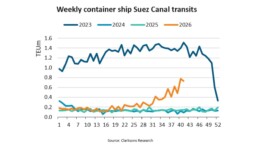
Suez Canal container ship transits exceed 50% of pre-disruption levels "During the first two weeks of October, weekly container ship capacity…
Subscribe to our newsletter!
if you dont want to swim alone in the ocean of news, sign up for the newsletter, and you will receive daily all the important news of world shipping!
