Ports, BWMS, and challenging waters overcoming hurdles in ballast water management

This past spring, the IMO Marine Environment Protection Committee met for its 81st session where important discussions around ballast water management took place. One of the key topics addressed was the challenges faced by ships operating in areas with dirty or difficult-to-treat water, often referred to as “challenging water quality.”
While ballast water management systems (BWMS) have proven effective in most situations, some ports present unique challenges due to their water quality. These ports, known as ports with challenging water quality (PCWQ), often have high levels of suspended solids, turbidity, or other factors that can get in the way of the effectiveness of certain BWMS.
Operators report that BWMS using filtration as part of the treatment process can experience difficulties with repeated clogging of filter units leading to excessively long ballasting operations.
In other cases treatment may be incomplete or ineffective due to turbidity or high organic loads.
For example, UV-based BWMSs work by exposing the water to UV light, which disrupts the DNA of organisms and prevents them from reproducing. However, the presence of suspended solids, dissolved organic matter or other substances in the water can absorb or scatter the UV light, reducing its effectiveness in inactivating organisms. As a result, ship’s operating in these challenging waters using UV based BWMS may struggle to meet the required discharge standards.
MEPC 81: Addressing the Concerns
During MEPC 81, the Committee continued working on the challenges faced by ships operating in dirty waters and discussed potential solutions. One of the key outcomes was the adoption of the Interim Guidance on the Application of the BWM Convention to Ships Operating in Ports with Challenging Water Quality (Resolution MEPC.387(81) which has taken years of work for all stakeholders to reach consensus.
The PCWQ guidance provides procedures for ships to follow when operating in challenging waters and offers guidance to Administrations, port States and BWMS manufacturers on how to support and oversee ships in these situations. One goal of the guidance is to have standardized steps for crew and port States to follow, and reduce administrative burden when a PCWQ presents BWMS operational issues.
Importantly, the PCWQ guidance is built on the principle that bypassing the BWMS should be the last resort in all cases. This approach emphasizes the need for ships to exhaust all available options before considering a bypass, ensuring that the environmental objectives of the BWM Convention are supported. Further, should a bypass be deemed necessary, the guidance includes procedures that are implemented to decontaminate the vessels ballast tanks and piping system to support returning to D-2 compliance.
Case Study: Adapting to Challenging Waters by using Ecochlor’s EcoOne® Hybrid BWMS
To illustrate how ships can overcome the challenges posed by dirty waters, let’s look at a recent case study involving our team at Ecochlor. We recently completed a project on an articulated tug-barge (ATB) that required the replacement retrofit of an installed UV BWMS. The vessel’s frequent operations in shallow, muddy water conditions presented significant technical challenges for their existing UV-based system.
We addressed these challenges by installing our EcoOne® hybrid BWMS, utilizing ClO2 treatment, which offers the option of automatically disengaging the filter when not in a PCWQ and reengaging it when the water conditions improve. This feature allows the system to adapt to the ship’s trade route, which includes ports with varying water types, without compromising performance.
Additionally, given the crew’s large number of responsibilities at port and their limited expertise in operating this type of heavy equipment, it was crucial that the system was easy to use and had reduced operational demands. Our BWMS met these requirements, ensuring that the crew could operate the system effectively without adding unnecessary complexity to their workload.
The Way Forward: Collaboration and Innovation
Moving forward, collaboration and innovation are going to be key in tackling these PCWQ. BWMS manufacturers, like Ecochlor, are working hard to continually improve their systems and offer alternative solutions to better suit different ship’s needs. But it’s not just up to the makers – shipowners, operators, port authorities, and regulators all need to work together to implement effective ballast water management strategies.
Most important, by sharing our knowledge, experiences, and best practices, we can overcome these challenges together. So, let’s keep those lines of communication open and work towards better, more efficient operations for the vessel and a cleaner, safer maritime environment for everyone!



Related News.
Navigating the Multi-Orbit Era: In Conversation with Intellian’s Jon Harrison at SMM 2026
At SMM 2026 in Hamburg, the rapid evolution of maritime satellite communications took centre stage. Across the exhibition halls, discussions among…
Cyprus ports need joint energy and investment strategy, shipping agents chief says
Cyprus needs a coordinated strategy for shipping, energy and environmental protection to support port investment and modernisation, Cyprus shipping…

MASO Public Affairs introduces MASO Regulatory Intelligence
A new subscription service helping businesses understand what is changing and what it means for them MASO Public Affairs introduces MASO Regulatory…
Anglo-Eastern helps turn CMBTECH’s ammonia ambition into an operational reality
From early feasibility study and risk-based design to newbuilding supervision, crew readiness and technical management, Anglo-Eastern drew on its…

Escalation of attacks threatens to derail recovery in Middle East oil exports
World oil demand is forecast to fall by 2.5 mb/d y-o-y in 4Q26 and 2.6 mb/d on average in 2026. As the Iran war manifests itself through restricted…
New study finds shipping pays twice its share to EU ETS earmarked revenues should triple to help build market for sustainable fuels and technologies
Shipping is responsible for around 10% of EU ETS emissions but pays almost 20% of the ETS bill. Unlike other sectors, it has never received free…
MSARC strengthens maritime mass rescue readiness through training and national live exercise off Dakar, Senegal
Joint MSARC–FHAS programme combines three days of SAR training with a national multi-agency live exercise The Maritime Search and Rescue Council ,…
Sogese report deliveries are still being delayed as container freight rates fluctuate
FOR IMPORTERS Spot rates into the Mediterranean are back at January levels, Far East to Europe reliability sits at pandemic lows, and nearly…
Glencore begins trading on Australian Securities Exchange
Glencore has begun trading on the Australian Securities Exchange under the ASX code GLC. Gary Nagle, Glencore’s CEO, said it was an exciting day for…
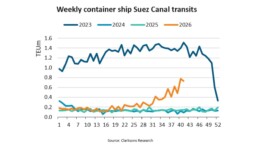
BIMCO Shipping Number of the Week
Suez Canal container ship transits exceed 50% of pre-disruption levels "During the first two weeks of October, weekly container ship capacity…
Subscribe to our newsletter!
if you dont want to swim alone in the ocean of news, sign up for the newsletter, and you will receive daily all the important news of world shipping!
