

Russia state carrier lifts shipments despite multiple Western sanctions
China, India remain willing to receive Sovcomflot tankers
Frontline CEO expects sanctioned tanker markets to face oversupply
Russian state carrier Sovcomflot made a strong return to its home turf to transport crude in August, keeping the share of Russia’s shipments outside of the G7 price cap above 80%.
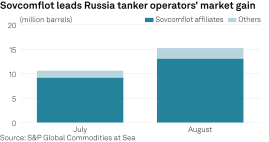
Data from S&P Global Commodities at Sea and Maritime Intelligence Risk Suite showed tankers owned by the company, sanctioned by various Western authorities, loaded 20.9 million barrels of Russian crude last month compared with 12.8 million barrels in July.
Sovcomflot’s low volume in July came as the EU and UK backlisted 32 “shadow” tankers transporting Russian crude above the price cap of $60/b in recent months, many of which linked to the company, a development some industry observers and data suggested would disrupt its operations.
But CAS figures showed Sovcomflot could increase loadings from Russia last month even though just one of the recently sanctioned ships resumed trading, displaying the company’s capacity with multinational operations.
Of the 23 Sovcomflot-owned tankers lifting from Russia in August, six were operated by the company’s affiliates based in the UAE and the rest by its affiliates in Russia.
Most of the shipments were Urals to India and the Eastern Siberia-Pacific Ocean blend to China.
Some analysts, including Nikesh Shukla at S&P Global Commodity Insights, have suggested any disruptions to Russian crude exports by sanctions could prove temporary if top buyers — India and China — are willing to receive Sovcomflot tankers.
China has vocally opposed sanctions against Russia since the war between Russian and Ukraine broke out in February 2022. The Financial Times reported Russia has been buying critical electronics, components for its war efforts, in India after amassing rupees from oil sales.
Platts, part of Commodity Insights, assessed the price for Urals on an FOB Primorsk basis at $67.204/b on average in August, and front-month loading ESPO (Singapore) on an FOB Kozmino basis at $71.625/b. Both were above the G7 cap.
“I lost all faith in enforcing sanctions,” said Lars Barstad, CEO of Frontline, one of the world’s largest tanker operators, in a recent conference call.
Going by nationality, CAS and MIRS data suggested UAE-based tanker operators lifted their shipments to 19.2 million barrels in August from 11.1 million barrels in July while Russia-based operators increased shipments to 15.2 million barrels from 10.6 million barrels, largely due to the Sovcomflot volumes.
High share
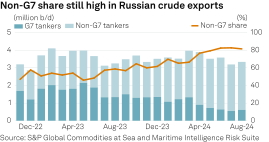
The CAS and MIRS data suggested 81.5% of Russian crude exports in August were lifted by tankers not flagged, owned or operated by companies based in the G7, the EU, Australia, Switzerland and Norway, and not insured by Western protection and indemnity clubs.
This was lower than 82.7% in July, but still the third-highest monthly reading since December 2022, when G7 members and their allies banned maritime services firms subject to their jurisdictions from Russian crude exports unless the oil was sold below the cap.
Russia’s total seaborne crude exports rose to over 3.3 million b/d last month from 3.2 million b/d in July, still below the usual level of 3.5 million b/d due to Moscow’s improved compliance with OPEC+ output cuts.
US officials said the price cap had forced Russia to make a hefty investment in obtaining shadow tonnage with state interests and opaque operators, but Frontline’s Barstad suggested freight costs for shipping sanctioned oil could fall due to increased supply.
“This kind of dark or gray fleet is growing. It’s supplied by the aging of the overall tanker fleet,” Barstad said. “Because we have zero scrapping, at some point…We will actually start to have an overcrowded, kind of oversupplied sanctioned market.”
Since the price cap came into force, the average age of tankers transporting Russian crude outside of the cap is 16.5 years, while that of tankers within the G7 cap is 13.3 years, according to CAS and MIRS data.
Frontline estimates about 6% of the global VLCC, Suezmax and Aframax tanker fleet is sanctioned by the US Office of Foreign Asset Control. Those ships are expected to find Russia as their largest demand source.
Source: Platts



Related News.

ISLAND OIL: Unveiling of the Sculpture “Cyprus’s Journey Through the Ages” in Protaras – A Tribute and Landmark to Cyprus’s Historical Memory and Cultural Heritage
In a modest ceremony marked by a moving atmosphere, the sculpture “Cyprus’s Journey Through the Ages”, created by acclaimed Cypriot sculptor…

World Maritime Day 2026 from Policy to Practice – powering Maritime Excellence
Global regulations will deliver safer, more resilient shipping when they are implemented worldwide. The international maritime community marks…

Diana Shipping announces Time Charter Contract for m/v DSI Polaris with Dai An Ocean Shipping
Diana Shipping , a global shipping company specializing in the ownership and bareboat charter-in of dry bulk vessels, announced that, through a…

Chief Economists Expect Global Economy to Stabilize, but Fiscal Constraints, Rising Living Costs and AI Investment Uncertainty Threaten Growth
The global economy is stabilizing, but the fiscal support that cushioned successive shocks since 2020 is unlikely to play the same role in the year…

V. welcomes its new graduate cohort as programme expands across the group
Twelve graduates from nine nationalities join 11th year of V.’s expanded international management programme. V., the global ship manager and marine…

From Policy to Practice: Why Seafarers Are the Key to Maritime Excellence
The shipping industry is no stranger to regulation. Seafarers and ship operators work within a vast framework of international conventions, national…

Intermodal Report – Week 38 2026
Please find below the Intermodal market report for week 38 2026. Intermodal Report Week 38 2026 Market Insight By Nikos Tagoulis, Head of…

Allied – Weekly Market Review – Week 38
Please find below the Allied Weekly Report for Week 38 | 2026 ALLIED - Weekly Market Report- Week 38

Record year on the Northeast Passage but Arctic shipping remains very limited
In 2025, a record 103 transit voyages were made via the Northeast Passage. However, this is still equivalent to only around a day and a half of…

[xclusiv] S&P Report 21th September 2026
Please find below the [xclusiv] latest Weekly S&P Report [xclusiv] 2026_09_21 Market Commentary: VLCCs: Freight Boom Reprices the Fleet The VLCC…
Subscribe to our newsletter!
if you dont want to swim alone in the ocean of news, sign up for the newsletter, and you will receive daily all the important news of world shipping!
