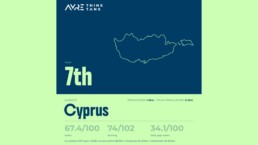

Cyprus beats India and New Zealand to come SEVENTH in major AI study – with potential €1.1 billion GDP boost and youth jobs opportunity
Some 86% of young Cypriots surveyed report using AI for study or work as country invests in technology to bring education and employment closer together.
- Cyprus ranks seventh out of 56 Commonwealth countries, behind Malaysia in sixth place and ahead of Mauritius in eighth, scoring 67.4 out of 100 against the study’s youth AI readiness benchmark of 53.
- Researchers calculate a potential €1.09 billion AI-related increase in the level of Cyprus’s GDP after ten years, rising to €1.62 billion in the optimistic case.
- Cyprus scores 9.2 out of 10 for access to technology and 8.0 for AI use and creation, helping explain its position among the Commonwealth’s leading countries.
- Drawing on 1,128 research sources, the Ayre Index examines the conditions affecting approximately 732 million young people across all the Commonwealth’s countries.
St John’s, 5 November 2026: Cyprus has beaten New Zealand, India and South Africa to rank seventh out of 56 Commonwealth countries in a major new study of youth AI readiness, which also identifies a potential €1.1 billion boost to the country’s economy after ten years.
Cyprus is among the 15 Commonwealth countries at or above the study’s youth AI readiness benchmark of 53, scoring 67.4 out of 100. The Ayre Index, launched at the Commonwealth Heads of Government Meeting in Antigua and Barbuda, compares the environment facing 732 million young people across 56 countries.
Cyprus has one of the strongest results for reported AI use, with 86% of young respondents in the European survey examined by researchers saying they had used the technology for their studies or work. Other reported uses included seeking advice and translation. Only 4.6% of businesses reported an interrupted internet connection, one of the better results in the Commonwealth.
The potential economic advantage is considerable. Applying economic scenarios developed by the International Monetary Fund to Cyprus’s GDP, the researchers calculate that AI could increase the level of the country’s GDP by €1.09 billion after ten years under the moderate scenario. This falls to €553 million in the conservative case – and rises to €1.62 billion in the optimistic scenario.
Research by the Ayre Think Tank, founded by Antiguan-Canadian philanthropist Calvin Ayre, also identifies areas where Cyprus can build on its impressive performance. Although AI use is widespread, a separate survey found that just 8.4% of young people had written a computer programme and 26.8% had changed their privacy settings. Furthermore, just 31.5% of teachers reported using AI in their teaching.
The findings highlight the importance of strengthening practical digital skills and helping young people use AI confidently and responsibly. For Cyprus’s approximately 230,000 young people aged 15 to 29, strengthening these skills will help turn widespread AI adoption into better jobs, growing businesses and higher incomes.
Calvin Ayre, founder of the Ayre Think Tank, said: “I’ve spent my life in businesses where new technology changes everything, and I know you can’t stand still. AI is going to change how we work, how we do business and how wealth is created. But this is not a race that only the biggest or richest countries can win. What matters is giving young people the skills and the chance to get ahead – whether to start businesses, find jobs or build something for themselves. Some Commonwealth countries are ahead, others have catching up to do. Nobody can afford to be complacent. That’s why we created this Index. It shows countries where they stand, what they’re getting right and where they need to do better. Governments now have to decide what they’re going to do about it.”
Cyprus is already taking steps to turn its technological strengths into employment opportunities. In March 2026, it launched CySKILLS-AI, a government-backed initiative using artificial intelligence to identify the skills employers need and help schools and universities prepare young people for the jobs market. The Education Ministry is also expanding AI training, with more than 220 education officials participating in workshops in August and September. Together, these initiatives will help young Cypriots acquire the skills needed to find better jobs, develop successful businesses and contribute to economic growth.
The White Paper identifies five priorities: affordable and reliable access to technology; education that develops practical skills; stronger routes from training into employment and enterprise; AI tools suited to local languages and needs; and safeguards that enable young people to question automated decisions.
It calls on governments, educators and development partners to better understand the particular barriers young people face in each country before deciding where investment can make the greatest impact.
Professor C. Justin Robinson, Pro Vice-Chancellor and Campus Principal of the University of the West Indies, Five Islands Campus, said: “We need to make sure that the next generation will be able to do more than just consume AI products made elsewhere. Access must come with its own agency and a real equitable stake in how these systems are governed. Young people need to be equipped to question these new tools, to improve them and to be supported in building alternatives suited to their own needs. Whether that happens, will depend on choices made now. This index gives us a clearer view of where those choices are most urgent. We should use it.”
Published ranking, out of 100. The study’s readiness benchmark is 53 points, between Nigeria (15th) and Seychelles (16th).
| Rank | Commonwealth country | Index score | Scoring coverage (of 102) | Data Gap Index (of 100) |
| 1 | Singapore | 77.6 | 75 | 37.7 |
| 2 | Malta | 75.0 | 68 | 41.4 |
| 3 | Australia | 71.0 | 76 | 26.2 |
| 4 | United Kingdom | 70.8 | 84 | 20.1 |
| 5 | Canada | 70.2 | 76 | 31.8 |
| 6 | Malaysia | 69.0 | 72 | 29.0 |
| 7 | Cyprus | 67.4 | 74 | 34.1 |
| 8 | Mauritius | 64.4 | 61 | 49.4 |
| 9 | New Zealand | 63.9 | 55 | 50.1 |
| 10 | Brunei Darussalam | 62.3 | 57 | 56.3 |
| 11 | India | 60.6 | 80 | 20.7 |
| 12 | Fiji | 56.9 | 60 | 47.9 |
| 13 | South Africa | 56.8 | 75 | 32.0 |
| 14 | Trinidad and Tobago | 56.5 | 58 | 56.6 |
| 15 | Nigeria | 54.5 | 82 | 17.4 |
| 16 | Seychelles | 51.8 | 39 | 73.1 |
| 17 | Ghana | 51.2 | 73 | 31.7 |
| 18 | Jamaica | 50.7 | 61 | 51.2 |
| 19 | Sri Lanka | 49.9 | 54 | 52.7 |
| 20 | Zambia | 48.8 | 65 | 40.5 |
| 21 | Bangladesh | 48.7 | 84 | 14.4 |
| 22 | Kenya | 48.7 | 66 | 42.9 |
| 23 | Uganda | 47.0 | 61 | 50.0 |
| 24 | Pakistan | 46.4 | 84 | 15.7 |
| 25 | Tanzania | 45.5 | 63 | 41.0 |
| 26 | Gabon | 45.3 | 43 | 67.1 |
| 27 | Antigua and Barbuda | 45.2 | 41 | 70.6 |
| 28 | Maldives | 44.9 | 41 | 71.4 |
| 29 | Cameroon | 44.9 | 54 | 53.9 |
| 30 | The Bahamas | 44.7 | 35 | 78.5 |
| 31 | Guyana | 44.5 | 49 | 65.5 |
| 32 | Papua New Guinea | 44.1 | 38 | 67.9 |
| 33 | Sierra Leone | 43.6 | 64 | 46.5 |
| 34 | Barbados | 43.0 | 43 | 70.5 |
| 35 | Belize | 42.8 | 50 | 65.2 |
| 36 | Namibia | 42.7 | 52 | 56.2 |
| 37 | Togo | 42.6 | 58 | 51.8 |
| 38 | Grenada | 41.7 | 45 | 66.2 |
| 39 | Nauru | 41.6 | 44 | 69.2 |
| 40 | Dominica | 41.3 | 37 | 75.1 |
| 41 | Samoa | 41.0 | 47 | 65.1 |
| 42 | Saint Vincent and the Grenadines | 39.5 | 38 | 72.1 |
| 43 | Saint Kitts and Nevis | 39.0 | 37 | 75.1 |
| 44 | Mozambique | 38.9 | 53 | 58.1 |
| 45 | Botswana | 38.9 | 63 | 53.8 |
| 46 | Kiribati | 38.4 | 44 | 66.9 |
| 47 | Rwanda | 38.1 | 60 | 50.2 |
| 48 | Tonga | 37.9 | 49 | 62.8 |
| 49 | Saint Lucia | 37.5 | 52 | 61.6 |
| 50 | The Gambia | 37.3 | 63 | 41.9 |
| 51 | Vanuatu | 37.1 | 48 | 64.7 |
| 52 | Eswatini | 36.9 | 51 | 62.7 |
| 53 | Solomon Islands | 32.0 | 36 | 75.6 |
| 54 | Tuvalu | 31.6 | 42 | 69.1 |
| 55 | Lesotho | 27.8 | 55 | 54.9 |
| 56 | Malawi | 26.3 | 59 | 53.0 |
Scoring coverage is the number of the 102 scored indicators with a usable value, including permitted estimates. The Data Gap Index is a separate weighted measure of missing qualifying evidence across all 111 indicators.
The White Paper, The Ayre Index: The 2026 Commonwealth Youth AI Readiness Index, can be downloaded here:
Source: THE AYRE INDEX: 56 COMMONWEALTH COUNTRIES



Related News.

Global shipping’s trillion dollar climate bill according to Zero Carbon Analytics
A new study by Zero Carbon Analytics finds that emissions from international shipping cost the global economy around USD 963 billion between 1990…

Keeping Children Safe Online at Sea Seafy® earns friendly WiFi Certification across 26 vessels
Seafy becomes Friendly WiFi’s first partner in the maritime sector, helping protect kids from harmful content online. Friendly WiFi is delighted…

ShipManager joins Star Information Systems to accelerate the maritime industry’s transition to cloud
CFARER, a DNV Company selects Star Information Systems as the longterm home for ShipManager and its cloud future Star Information Systems (Star)…
Seafarer experience must shape maritime technology, initial STEER Project report finds
New research finds technology can shift rather than remove risk as The Nautical Institute, with support from Lloyd’s Register Foundation, calls for…

New LR service targets cargo disruption when trade routes fail
New LR Advisory service helps ports, governments and logistics operators respond to disruption, protect critical cargo flows and strengthen trade…

DORIC WEEKLY INSIGHT 06 NOVEMBER 2026
Please find below the DORIC Market Insight for the week ending 06th November 2026. Weekly Report 06.11.2026
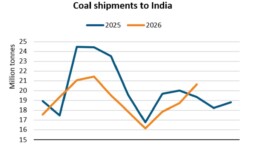
BIMCO Shipping Number of the Week
Coal shipments to India drop 7%, but limited recovery may lie ahead "Between January and October, coal shipments to India dropped 7% y/y due to the…

Hapag-Lloyd marks 20 years in South Africa and targets further growth
South Africa has become a cornerstone of Hapag-Lloyd's business in Africa Hapag-Lloyd surpasses 1 million TEU in Africa for the first time in its…
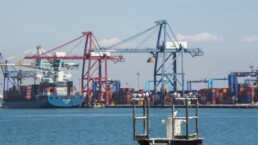
The APV is putting its ValenciaportPCS technology platform out to tender for 7.9 million euros
The tender covers the management and technical operation of the platform where members of the port community exchange information on processes…
Subscribe to our newsletter!
if you dont want to swim alone in the ocean of news, sign up for the newsletter, and you will receive daily all the important news of world shipping!
