

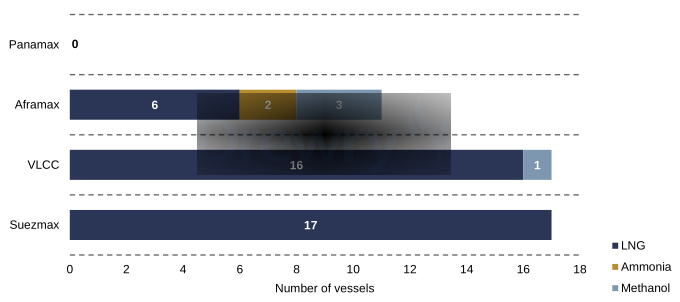
As long as the scrubber economics are favourable, we will see the domination of scrubber-fitted crude-carrying vessels in the orderbook. Currently, the orderbook comprises 201 tankers with the majority being Suezmaxes (as of July 2024). A substantial number of the ships being built (i.e. ~59%) will run on HSFO (IFO 380) as their primary fuel and will be fitted with scrubbers to manage their SOx emissions as per IMO 2020 regulations. Of the vessels running on HSFO, 44% will be “ready” to run on either of the cleaner fuels – LNG, methanol, or ammonia.
Shipowners are inclined towards keeping their vessels “LNG-ready” should it become economical in the future, considering price and availability.
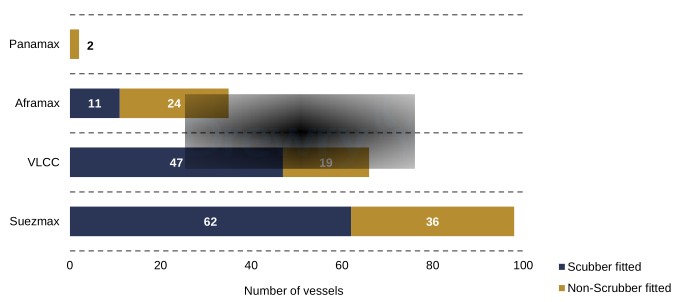
Analysing the orderbook, we find that about 60% of the vessels are scrubber-fitted, indicating the reluctance of the shipping industry to move away from HSFO to VLSFO. Shipowners are rather preferring to invest in scrubber devices.
Figure 2: Orderbook categorisation by primary fuel
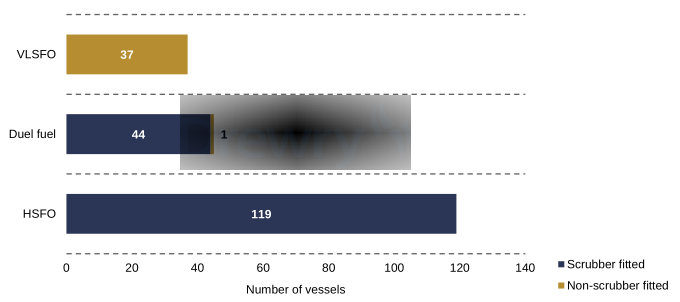
Note: Dual fuel represents a vessel that can run on both – traditional fuel and a cleaner fuel like LNG, methanol and ammonia.
Source: Drewry Maritime Research, Clarksons WFR
Figure 3: Orderbook categorisation of dual-fuel vessels by type of cleaner fuel
Source: Drewry Maritime Research, Clarksons WFR
We believe the future will unfold in either of the following three scenarios – S1, S2, and S3, where S1 denotes the low-case scenario, S2 base-case and S3 high-case. We assume the price differential between VLSFO and HSFO is at $50 per tonne in S1, $100 per tonne in S2 and $200 per tonne in S3. S1, being the low-case scenario, has crude oil prices on the lower side of the spectrum due to which the spread between VLSFO and HSFO prices narrows. Coming to S2, it is a business-as-usual scenario with future prices remaining similar to the present values. The price differential at present ranges from $100 per tonne to $150 per tonne; we assume it to be $100 per tonne for our calculations ahead. Meanwhile, in S3, we assume crude oil prices will go much higher than the current prices. When crude oil prices increase, VLSFO prices increase more sharply than HSFO, widening the price gap between the two.
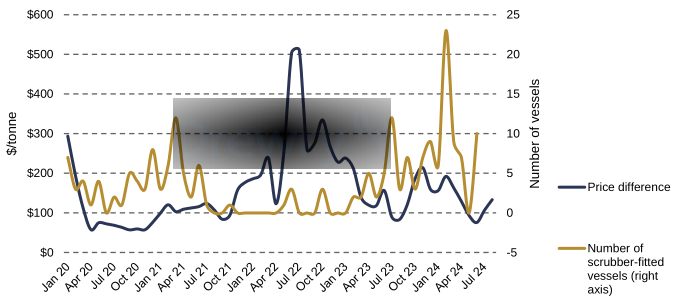
The figure below shows the monthly average price differential between VLSFO and HSFO and the corresponding number of scrubber-fitted vessels ordered every month.
Figure 4: Historical monthly average price differential between VLSFO and HSFO; the monthly trend of scrubber-fitted vessels ordered
Source: Drewry Maritime Research, Clarksons WFR
From the above figure, Drewry infers that whenever the price differential between VLSFO and HSFO increases, the shipping industry reacts to it by ordering a higher number of scrubber-fitted vessels, albeit with a lag of 6-12 months.
Economics of scrubber technology
The cost of installing a scrubber device in a new vessel ranges from $2-$5 million.
Assumptions by Drewry:
- Cost of installing a scrubber device in a new vessel: ~ $3 million
- Vessel utilisation: 80%
1. Voyage charter:
- Fuel consumption of a vessel on an average assumed to be: 80 tonnes per day
Corresponding annual savings and payback periods that will be achieved under the three different scenarios in a voyage charterare tabulated below:

2. Time charter:
In the case of a time charter, TC rates will affect the payback period. The figure below depicts the TC rates for a VLCC Eco vessel with a scrubber compared to a VLCC Eco vessel without a scrubber:
Figure 5: Price differential in TC rates due to scrubber for 1-year charter period
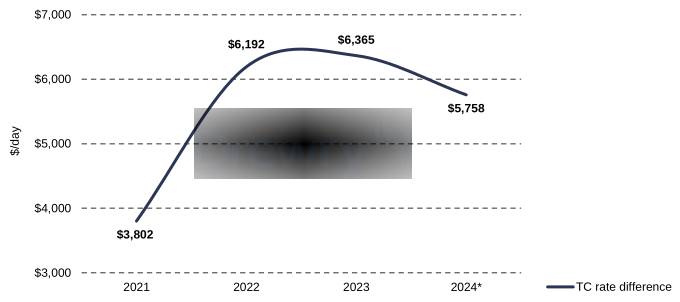
* Denotes the average of months from January 2024 to July 2024 for the current year.
Source: Drewry Maritime Research, Clarksons
The difference in TC rates between scrubber-fitted and non-scrubber-fitted vessels (VLCC Eco) ranges from $3,500 to $6,500 per day.
- TC rate difference between vessels due to scrubber presence assumed to be: $5,000 per day
Corresponding annual revenue and payback period that will be achieved is tabulated below:

After a span of 2 years, shipowners can continue to benefit from the differential between TC rates for scrubber-fitted and non-scrubber-fitted crude tankers until the end of the scrubber’s lifespan.
Conclusion
From the above analysis, Drewry considers scrubbers’ payback period attractive. Hence, it would be prudent for shipowners to opt for scrubber-fitted vessels. Besides having an attractive payback period, scrubbers can also be adapted to capture carbon emissions from ships. With mounting pressure from regulations governing emissions from the shipping industry, it is best for the stakeholders to be prepared to manage carbon emissions as well. This adds to the financial attractiveness of scrubbers.
Source: Drewry



Related News.

ISLAND OIL: Unveiling of the Sculpture “Cyprus’s Journey Through the Ages” in Protaras – A Tribute and Landmark to Cyprus’s Historical Memory and Cultural Heritage
In a modest ceremony marked by a moving atmosphere, the sculpture “Cyprus’s Journey Through the Ages”, created by acclaimed Cypriot sculptor…

World Maritime Day 2026 from Policy to Practice – powering Maritime Excellence
Global regulations will deliver safer, more resilient shipping when they are implemented worldwide. The international maritime community marks…

Diana Shipping announces Time Charter Contract for m/v DSI Polaris with Dai An Ocean Shipping
Diana Shipping , a global shipping company specializing in the ownership and bareboat charter-in of dry bulk vessels, announced that, through a…

Chief Economists Expect Global Economy to Stabilize, but Fiscal Constraints, Rising Living Costs and AI Investment Uncertainty Threaten Growth
The global economy is stabilizing, but the fiscal support that cushioned successive shocks since 2020 is unlikely to play the same role in the year…

V. welcomes its new graduate cohort as programme expands across the group
Twelve graduates from nine nationalities join 11th year of V.’s expanded international management programme. V., the global ship manager and marine…

From Policy to Practice: Why Seafarers Are the Key to Maritime Excellence
The shipping industry is no stranger to regulation. Seafarers and ship operators work within a vast framework of international conventions, national…

Intermodal Report – Week 38 2026
Please find below the Intermodal market report for week 38 2026. Intermodal Report Week 38 2026 Market Insight By Nikos Tagoulis, Head of…

Allied – Weekly Market Review – Week 38
Please find below the Allied Weekly Report for Week 38 | 2026 ALLIED - Weekly Market Report- Week 38

Record year on the Northeast Passage but Arctic shipping remains very limited
In 2025, a record 103 transit voyages were made via the Northeast Passage. However, this is still equivalent to only around a day and a half of…

[xclusiv] S&P Report 21th September 2026
Please find below the [xclusiv] latest Weekly S&P Report [xclusiv] 2026_09_21 Market Commentary: VLCCs: Freight Boom Reprices the Fleet The VLCC…
Subscribe to our newsletter!
if you dont want to swim alone in the ocean of news, sign up for the newsletter, and you will receive daily all the important news of world shipping!
