WinGD takes hundredth order for VCR technology for dual-fuel X-DF engines
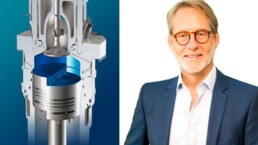

Swiss marine power company WinGD has received its hundredth order for Variable Compression Ratio technology, which further optimises combustion for X-DF dual-fuel engines depending on the fuel used and engine load. The innovative solution was launched in June 2023 and has already become a favoured option for dual-fuel engine orders, especially in the LNG carrier segment.
The milestone order came via a series of four LNG carriers to be built for a Middle Eastern shipowner at a Korean shipyard. These join several other orders that have made X-DF engines and VCR technology the standard choice for the LNG carrier segment over the past year, with further orders coming from the pure car and truck carrier, bulk carrier and container ship segments. Overall, nearly 10 owners have selected the new technology as an option with their X-DF engines.
WinGD Director Sales Volkmar Galke said: “Surpassing a hundred orders for our variable compression technology called VCR in the first year is a phenomenal achievement and indicates the strong market interest in technologies that can both reduce the environmental impact of gas-fuelled engines and
eliminate any compromise in diesel performance. We’re grateful to those early adopters and see even greater opportunities for the industry to benefit from this unique engine technology in the future.”
VCR technology enables the engine’s compression ratio to be dynamically adjusted for the fuel type being used, engine load and combustion behaviour. This means higher compression ratios can be used when running on diesel, improving efficiency, while compression can also be tweaked during LNG use to optimise efficiency and reduce emissions. The simple hydraulic solution represents the first application of dynamic compression ratio adjustment in a marine engine.
VCR is the second X-DF2.0 technology introduced by WinGD as an enhancement to its well-established X-DF dual-fuel engine platform. The first addition, Intelligent Control by Exhaust Recycling (iCER), has also been well received and has been deployed on most orders for LNG carriers over the past two years.
In recent tests, WinGD has established that X-DF engines with iCER and VCR achieve lower fuel
consumption and emissions than rival low-pressure engine technologies. Compared on a system-level,
including main and auxiliary engines as well as fuel supply, vessels can achieve a similar fuel
consumption and emissions profile as those powered by high-pressure, Diesel cycle two-stroke engines, while maintaining a capex advantage due to the low cost of the auxiliary system required.
The new technology, combined with a reliable in-service record of more than 7.5 million running hours for the X-DF engine platform, make X-DF engines the clear market choice for the LNG carrier segment and competitive against high-pressure engines in other vessel segments.



Related News.

Navigating the Multi-Orbit Era: In Conversation with Intellian’s Jon Harrison at SMM 2026
At SMM 2026 in Hamburg, the rapid evolution of maritime satellite communications took centre stage. Across the exhibition halls, discussions among…

Cyprus ports need joint energy and investment strategy, shipping agents chief says
Cyprus needs a coordinated strategy for shipping, energy and environmental protection to support port investment and modernisation, Cyprus shipping…

MASO Public Affairs introduces MASO Regulatory Intelligence
A new subscription service helping businesses understand what is changing and what it means for them MASO Public Affairs introduces MASO Regulatory…

Anglo-Eastern helps turn CMBTECH’s ammonia ambition into an operational reality
From early feasibility study and risk-based design to newbuilding supervision, crew readiness and technical management, Anglo-Eastern drew on its…

Escalation of attacks threatens to derail recovery in Middle East oil exports
World oil demand is forecast to fall by 2.5 mb/d y-o-y in 4Q26 and 2.6 mb/d on average in 2026. As the Iran war manifests itself through restricted…

New study finds shipping pays twice its share to EU ETS earmarked revenues should triple to help build market for sustainable fuels and technologies
Shipping is responsible for around 10% of EU ETS emissions but pays almost 20% of the ETS bill. Unlike other sectors, it has never received free…

MSARC strengthens maritime mass rescue readiness through training and national live exercise off Dakar, Senegal
Joint MSARC–FHAS programme combines three days of SAR training with a national multi-agency live exercise The Maritime Search and Rescue Council ,…

Sogese report deliveries are still being delayed as container freight rates fluctuate
FOR IMPORTERS Spot rates into the Mediterranean are back at January levels, Far East to Europe reliability sits at pandemic lows, and nearly…

Glencore begins trading on Australian Securities Exchange
Glencore has begun trading on the Australian Securities Exchange under the ASX code GLC. Gary Nagle, Glencore’s CEO, said it was an exciting day for…

BIMCO Shipping Number of the Week
Suez Canal container ship transits exceed 50% of pre-disruption levels "During the first two weeks of October, weekly container ship capacity…
Subscribe to our newsletter!
if you dont want to swim alone in the ocean of news, sign up for the newsletter, and you will receive daily all the important news of world shipping!
