Increased ripple effects from Equinor in Norway
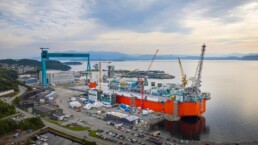

A new report shows that deliveries for exploration, development projects and operation of Equinor-operated fields and onshore facilities in Norway had a value of more than NOK 134 billion in 2023, 94 per cent of which were invoiced by Norwegian suppliers.
Equinor plans to maintain its oil and gas production of around 1.2 million barrels per day from the Norwegian continental shelf towards 2035. At the same time, emissions will be halved by 2030 in line with the Paris Agreement. This results in a high level of activity in Norway and the ripple effect report shows increased activity. The largest increase is in exploration, of 26 per cent, which reflects increased exploration activity on the Norwegian shelf.
The report has been prepared by Kunnskapsparken Bodø (KPB), which has analyzed actual purchases of goods and services for Equinor-operated fields and onshore facilities, development projects and exploration activity from Hammerfest LNG in the north to the Sleipner field in the south. This is the first time development projects have been included, and the third time such a report has been made.
“We have operations along the entire coast of Norway that have major ripple effects. The Norwegian supplier industry has developed its expertise and competitiveness together with us for over 50 years. A total of 81,500 man-years worked in connection with assignments from Equinor last year. The level of activity and value creation is high. We have plans to further develop our operations in Norway so that this will continue in the future,” says Kjetil Hove, Equinor’s executive vice president for Exploration & Production Norway (DPN).

“This year’s report shows that deliveries to this industry come from the majority of Norwegian municipalities and are spread across the country. Our industry makes it possible for employees to live in places where they would not otherwise have the same job opportunities. The fact that there is activity in so many municipalities illustrates how the oil and gas industry benefits the whole country. Europe is completely dependent on energy from the Norwegian continental shelf, so it is important to maintain production,” says Per Steinar Stamnes in Industri Energi on behalf of the five unions in Equinor; Industri Energi, SAFE, Lederne, NITO and Tekna.

Equinor is the largest purchaser of goods and services from the Norwegian supplier industry. After oil and gas operators, the supplier industry to the petroleum sector is Norway’s second largest industry in terms of turnover and is thus very important for the Norwegian economy.
Development projects in the implementation phase are included in this year’s ripple effect report from KPB. In 2023, Norwegian deliveries of goods and services amounted to NOK 24.9 billion. This represents a Norwegian share of 89.5 per cent, which is somewhat higher than normal.
“Equinor has a large project portfolio and it is important to us that our activity creates ripple effects in Norway. Johan Castberg, which we plan to put on stream at the end of the year, accounts for a large share of this. We also see significant ripple effects in Norway from the electrification portfolio and projects tied back to existing infrastructure,” says Trond Bokn, Equinor’s senior vice president for project development.
Direct equipment and service deliveries from the Norwegian supplier industry to the operation of Equinor-operated petroleum installations and onshore facilities, development projects and exploration activity amounted to NOK 127 billion. Deliveries to other operational tasks are not included in this study.
Equinor purchased goods and services from the Norwegian supplier industry for the operation of fields on the Norwegian continental shelf for NOK 83 billion in 2023*. In connection with exploration activity, Norwegian deliveries amounted to NOK 7.7 billion. Norwegian deliveries to onshore facilities operated by Equinor amounted to NOK 10.6 billion.

The report is limited to spin-off effects from exploration, development projects, operations and modifications of Equinor-operated fields and onshore facilities in Norway. The total ripple effects and value creation to society from Equinor’s Norwegian operations are even greater. The values realized for the owners and society when the products from the fields are sold as well as the payment of tax are not included.
Equinor paid NOK 280 billion in tax to the Norwegian state in 2023 and expects to pay over 210 billion in tax in 2024. Including dividends and share buybacks, the company expects to transfer more than NOK 310 billion to the state this year.
Environmental taxes and property taxes are not included in the report
* The electrification projects that were in the implementation phase at the turn of the year will reduce C02 emissions with just under two million tonnes when they are completed. In addition, there are projects in the process of maturing, which are yet to be decided.



Related News.

Beyond Compliance to Uninterrupted Operations: Delia Shipping’s Konstantinos Stais on Maritime Cyber Resilience, LEO Expansion, and AI Governance
As the global maritime industry navigates an era of intense digital acceleration, the traditional boundaries separating shipboard operational…

Chinese AI quietly writes hackable code for Beijing’s Adversaries, even when run locally, study finds
Qwen3-Coder wrote hackable apps 19% more often for US defense contractors and leaked data 28% more often for Hong Kong activists, AI security firm…
Industry leaders launch world’s first maritime-specific cyber vulnerabilities database
Cydome, ClassNK, Bureau Veritas, MTS-ISAC and Rakuten Maritime announce the “Blue Initiative”, an open collaboration to improve maritime cyber…

Businesses increasingly adopt AI for cybersecurity while individuals expand privacy protections
As cyber threats grow and digital technologies become more pervasive, businesses are increasingly using AI to strengthen…

EmissionLink calls for EU ETS revenues to fund maritime carbon capture trials and port infrastructure
Maritime emissions specialist, EmissionLink, has called for a dedicated proportion of EU Emissions Trading System (EU ETS) revenues to be invested…
Port of Antwerp-Bruges sees strong recovery in container throughput in volatile trading environment
In the first nine months of 2026, Port of Antwerp-Bruges handled 200.9 million tonnes of goods, 0.8% less than in the same period last year.…
Sanctions risks reshape commodity trading
Traders face sanctions challenge “odyssey” as geopolitical risks reformat global markets Commodity traders are operating in an increasingly…
Titan analysis shows FuelEU pooling propelled liquefied biomethane demand
- Clean fuel supplier evaluates compliance for 8,000 TEU containership operating in Northern Europe - FuelEU Maritime balances competitiveness…
Russian diesel tanker heads to New York as Kremlin claims regular shipments
Malta-flagged tanker should carry 40,000 mt fuel Agioi Fanendes left Primorsk Oct. 22: CAS US lifts sanctions, enables Russian imports……
Pilot transfer operation: A safer step aboard
Safe pilot transfer operations depend on both correct procedures and fit-for-purpose equipment. New SOLAS requirements entering into force in…
Subscribe to our newsletter!
if you dont want to swim alone in the ocean of news, sign up for the newsletter, and you will receive daily all the important news of world shipping!
