The Impact of Red Sea challenges on Maritime Business in India


The Red Sea, a vital maritime corridor connecting the most patrornised Indian Ocean to the Mediterranean Sea via the Suez Canal, has long been an essential artery for global tradeFor centuries, it has served as a conduit for trade, enabling movement of goods between Europe, Asia, and Africa. However, the region has been fraught with numerous challenges that have significantly impacted maritime business, particularly for a nation like India, which heavily relies on this route for its import and export activities.
Geopolitical Tensions and Piracy
One of the primary challenges in the Red Sea has been the persistent geopolitical tensions. The region borders several countries with complex political landscapes, including Yemen, Saudi Arabia, Egypt, and Sudan. The ongoing conflict in Yemen has significantly threatened maritime operations. The Bab-el-Mandeb Strait, a narrow passage between Yemen on the Arabian Peninsula and Djibouti and Eritrea in the Horn of Africa, serves as a crucial chokepoint. Any disruptions in this area can lead to widespread effects on global trade.
Piracy has also been a significant concern. Although international naval coalitions have managed to curb the threat to some extent, the risk remains. Pirates operating from the Somali coast have, in the past, targeted vessels transiting the Red Sea, causing apprehensions among shipping companies. The increased insurance premiums and the necessity for enhanced security measures have added to operational costs, impacting the profitability of maritime businesses.
Environmental and Navigational Hazards
The Red Sea is known for its challenging navigation conditions. The presence of coral reefs, narrow straits, and limited deep-water channels requires precise navigation. Environmental factors such as strong winds, high temperatures, and occasional sandstorms further complicate maritime operations.
Oil spills and other environmental hazards pose a substantial danger. Due to the high capacity of oil transported through this region, any incident can result in severe ecological damage and significant economic repercussions. The Indian maritime sector, which relies heavily on the import of crude oil, is particularly vulnerable to such disruptions.
Impact on Indian Maritime Business
India’s maritime industry has felt the impact of these challenges acutely. India’s reliance on maritime trade is immense as a nation with a burgeoning economy. The Red Sea route is crucial for transporting crude oil from the Middle East and shipping goods to Europe and beyond. Any disruption along this route can cause delays, increase costs, and create a ripple effect throughout the economy.
Increased Operational Costs
The necessity to navigate through a region fraught with risks has led to increased operational costs. Shipping companies have had to invest in advanced navigation systems, employ armed security personnel, and pay higher insurance premiums. These additional expenses are often passed on to the end consumers, leading to increased prices of goods and commodities.
Supply Chain Disruptions
Disruptions in the Red Sea can lead to significant delays in the supply chain. For instance, the Ever Given blockage of the Suez Canal in 2021 highlighted the vulnerabilities of global trade routes. Such incidents underscore the importance of having alternative routes and contingency plans. For Indian businesses, delays in the arrival of raw materials or the shipment of finished goods can lead to production halts and financial losses.
Strategic Shifts and Policy Measures
In response to these challenges, Indian maritime businesses and policymakers have had to adapt strategically. Diversification of trade routes has become a priority. The International North-South Transport Corridor (INSTC), which targets to connect India with Europe through other countries, is one such initiative aimed at reducing dependency on the Suez Canal and the Red Sea route.
Investment in port infrastructure has also been ramped up. Ports like Mundra, Jawaharlal Nehru Port Trust (JNPT), and the upcoming Vizhinjam port are being developed to handle larger cargo volumes efficiently. Additionally, there is a push towards enhancing the coastal shipping and inland waterways network to reduce congestion and improve the supply chain’s resilience.
The Role of Technology and Innovation
Technological inventions play a crucial role in mitigating the challenges the Red Sea poses. Adopting advanced maritime technologies, such as AI-driven navigation systems, autonomous vessels, and blockchain for supply chain transparency, can significantly enhance the efficiency and safety of marine operations.
Indian maritime companies are increasingly leveraging these technologies to improve their operational capabilities. For instance, real-time tracking and predictive analytics can help in better route planning and risk management. Moreover, using drones and satellite descriptions for monitoring and surveillance can enhance the security of vessels transiting through high-risk areas.
The challenges of the Red Sea are multifaceted, encompassing geopolitical tensions, piracy, environmental hazards, and navigational difficulties. These challenges have significant implications for India, a nation with a rapidly rising economy and a heavy reliance on maritime trade.
However, the Indian maritime sector has shown resilience and adaptability in these challenges. Through strategic shifts, investment in infrastructure, and the adoption of advanced technologies, the industry is well-positioned to traverse the complexities of the Red Sea region.
As the global trade landscape evolves, Indian maritime businesses and policymakers must remain vigilant and proactive. By fostering international collaborations, enhancing security measures, and continuously innovating, India can mitigate the risks associated with the Red Sea and ensure its maritime industry’s sustained growth and competitiveness.
Author- Captain Alok Kumar, Chairman, Alphard Group



Related News.

Predicting the Future or Preparing for It? Cyprus Marine Club Explores the Power of Adaptability with Natasa Pilides
In a world where uncertainty has become the new normal, is predicting the future really the best strategy, or is the ability to adapt the greater…

Greece and Egypt in talks to extend EEZ Eastwards towards Cyprus following Libya’s move on Turkish Maritime Pact
Athens and Cairo have agreed to advance bilateral consultations aimed at extending the geographical scope of their 2020 Exclusive Economic Zone (EEZ)…
Seafarers face widening competency gap as digital shipping accelerates, recent research finds
Eighty two per cent of maritime professionals surveyed say current training does not adequately prepare crews for the realities of modern,…

Wärtsilä and WinGD sign new Service Framework Agreement to ensure long-term continuity and support for the global fleet
Technology groups Wärtsilä and WinGD have entered into a new long-term Service Framework Agreement, reaffirming their shared commitment to supporting…
Seatrium and Karpowership sign contract for a series of whale class Powership Conversion and Integration Projects
Seatrium and its strategic partner, floating power leader Karpowership, have strengthened their longstanding collaboration with the award of a…
ClassNK releases Handbook Supporting Consideration of Onboard Carbon Capture “Onboard Carbon Capture Systems Implementation Framework”
Bringing together technical, infrastructure, regulatory and emissions assessment considerations across the OCCS value chain - ClassNK has released a…
HHLA lowers earnings forecast for the 2026 financial year
Based on the business development to date and updated estimates for the fourth quarter of 2026, the Executive Board of Hamburger Hafen und…
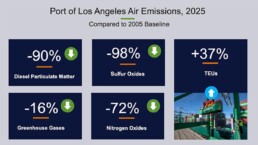
Port of Los Angeles reports lowest emissions per Container on Record
The Port of Los Angeles continued to make clean air gains in 2025, recording its lowest emissions per container on record, according to the Port's…
Drewry World Container Index – 22 Oct
WCI increased for the second consecutive week, the highest in 15 weeks. See detailed commentary below. Drewry World Container Index…
Mammoet, Port of Argentia and Argentia Capital Partner to Advance Floating Dry Dock and Marine Repair Facility
Partnership builds on Mammoet’s established presence at Port of Argentia and shared confidence in the growing market for ship repair and marine…
Subscribe to our newsletter!
if you dont want to swim alone in the ocean of news, sign up for the newsletter, and you will receive daily all the important news of world shipping!
