Pioneering the Decarbonisation Transition – An exclusive interview from Cyprus Shipping News with ERMA FIRST at Posidonia
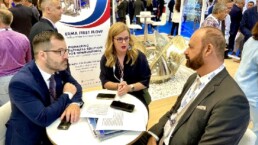

Interview between Adonis Violaris of CSN and Efi Tsolaki, Chief Scientific Officer & Nikos Drimalas, Sales Director
Nikos – Can you provide an overview of ERMA FIRST mission and its core focus within the maritime industry?
ERMA FIRST is positioned at the forefront of environmental technologies. Our mission is to safeguard the environment, our planet and most importantly our oceans.

Nikos – And how does ERMA FIRST technology or solution contribute to the sustainability and efficiency goals of the maritime sector, mainly coming nearer to 2030 already?
We have always focused on the requirements of maritime regulations. We make a very positive contribution when it comes to environmentally related technologies.
ERMA FIRST has been offering ballast water treatment solutions for the last 15 years and our systems are installed on over 2,500 vessels.
In recent years, the company has extended its capabilities to develop a portfolio of solutions to support owners in key environmental goals, including shore power for ships (BLUE Connect), carbon capture (Carbon Fit) and the energy saving device for propellers, ERMA FIRST FLEXCAP.

Efi – Can you discuss the importance of environmental protection and compliance with international maritime regulations and how ERMA FIRST is helping the industry in this regard?
We are a company designing and manufacturing products for ships and that brings an obligation across the vessel’s lifetime. We supply and support equipment on the basis that choosing our technology will allow ship and system compliance through-life. We consider the vessel as the basis for our partnership with the ship owner and our role as safeguarding the ocean and the planet. Through the years we have worked tirelessly to translate what it says in the legislation into products that stay well ahead of it and offer owners cost effectiveness and efficiency. Even when regulators are only working on the basis of guidance or interim guidance, we take those developments into consideration as if they were mandatory and as guidance for our planning for manufacturing. The success of ERMA FIRST has largely been based on staying one step ahead.

Efi – How does ERMA FIRST ensure the reliability and effectiveness of its technology for maritime applications?
Expectations for the lifecycle of the ship need to be factored into early stage design work. When we say we work in partnership with the ship owner and the vessel, we mean we design with performance, compliance andfull maintenance services in mind.
Efi – You mentioned before about the metal protection compliance international maritime regulations.Can you elaborate a little bit more on that?
Yes, as ERMA FIRST we are consulted as technical advisors by the representatives of the Greek administration attending IMO meetings. It is part of our business to liaise with maritime regulators and ensure that our product development responds to and anticipates legislation.
Efi – You have a representative of ERMA FIRST participating?
Yes, we are called to offer technical advice and we have been honoured to participate – especially in the Ballast Water Working Group. We are also part of BAWA, the Ballast Water Association. Actually, we were one of the first members of the association and I was its President for six years. Now my colleague Stelios Kyriakou is the vice president and we continue to keep conversations open with Flag States and competitors on how to maintain momentum when it comes to ballast water management.
Efi – Can you share a success story or a significant project where ERMA FIRST technology made a notable impact in the maritime industry?
That’s a tough question, because I’d rather concentrate on the totality of the projects we’ve accomplished.Where ballast water is concerned, for example, it’s a global challenge that needs to be overcome; finding the technology that works with regulations and goes hand in hand with common maritime engineering practices is more important than showcasing a specific project. We have been doing that since the foundation of the company, and I want to say the success and the impact has come from prudent analysis of water treatment technologies, and through developing practical solutions that really work on organisms or pathogens.
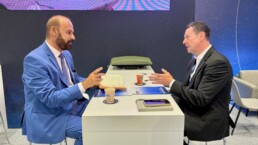
Nikos – Can you share a success story or a significant project where ERMA FIRST technology made a notable impact in the maritime industry?
If you start talking about balanced water treatment, of course… Obviously, balanced water treatment is the story that we have to speak about. I would not concentrate on a single project.
I would concentrate on all the projects we’ve done. The technology and how the technology has been structured from day one, hand in hand with the maritime regulations and hand in hand with the most common maritime engineering practice. We have been doing, since the foundation of the company, I have to admit that we have been doing very prudent analysis on the technologies, on how our system should work, to have the best possible results and to excel in the effluent of the organisms or the pathogens.
And we pride ourselves on that, knowing all the available systems in the market. So I would not concentrate on a single project. I would say that our technology is a very robust technology, which for sure covers beyond and above the regulations.
Efi – In addition to Nikos, I would like to mention that I think the success is also covered by the fact that we are very adaptive. So it’s not that you are selling a system and you are done. Every time that, for example, the sales team has a new requirement from a customer, we are able to adapt.
And we are able to adapt only also on certifying the system and be able to cover the installation work. So it’s a collaborative approach because it starts even from the purchase department, sales department. So there is a flow of actions that we would like to have a free flow in every department.
We have information that is shared across the company. So this brings us to, I think, to the success of the whole story. It is open.
Nikos – What are the main trends or challenges that you observe in the maritime industry and how ERMA FIRST is positioned to address these?
Well, we have always been proactive on that because we have a very powerful team of specialists. It’s for this reason we expanded our portfolio from ballast water to include solutions covering decarbonisation.
ERMA FIRST FLEXCAP is a boss cap fin installed at the hub of a ship’s propeller to reduce energy loss by weakening the propeller hub vortex and thus boost thrust and improve efficiency. Its innovative modular design effectively makes 22 different models available through various fin-cap-flange combinations. With efficiency gains estimated as 2-3%, return on investment is achievable within less than 12 months.
Our alternative marine power system ERMA FIRST BLUE CONNECT enables vessels to connect to a port’s electrical grid to run onboard services, systems and equipment. Meeting all latest international standards for cabling and connections, the solution means a ship can switch off its diesel generator to reduce both emissions and noise while in port. The first installation of BLUE CONNECT will be made this Fall, while ERMA FIRST has received orders for six to eight units to be delivered by the end of the year.
At sea, another focus has been carbon capture and storage (OCCS) as a method of reducing ship emissions. There are two versions of ERMA FIRST CARBON FIT – an Amine Absorption version for deepsea ships and a simpler Calcium Hydroxide-based version aimed at shortsea vessels. We aim to install pilot units in August 2024, with commercial sales following in 2025. Under normal operating conditions OCCS systems cut emissions by 15% to 30%.
Efi – I think the most challenging part is to have the ship owner embark in this journey for saving our ocean and saving our planet. Because it’s not just install or buy a system.
Efi – How does the Greek market respond to that? Slow?
Well, we are all facing the same challenge and our job is to offer our clients options when they consider those challenges. Carbon capture is one of the hottest topics around, not only in the sea but also on land, so I think it’s an advantage that ErmaFirst has focused on flexibility in marinizing applications that are established onland.
Yes, we know about cutting edge technology, but our specialty is also making technology work for ships. As anyone serving the market knows, this has the most challenging part of the ballast water issue, and we can say that overcoming that challenge has been central to our success story. Because we know the vessels, we know the sea and we know the hidden challenges that brings for any systems provider.
Nikos – How does ERMA FIRST plan to stay at the forefront of the maritime innovation and what new developments can expect from the company? Looking ahead, what are the long-term goals for ErmaFirst and how do you envision your company growing the shipping in the future of the maritime industry?
If we have to look at the big picture, we are here to preserve and safeguard the oceans – that is our long-term goal as a company and as individuals. This is our guiding principle throughout the group, and every one of mycolleagues makes the contribution that they can according to their position.
We all know that we are talking about what we will leave to our children – to the next generation, and that the evidence on emissions is compelling.
For me though – and I think for a lot of my colleagues – unrealistic targets like 2030 or even 2050 should not be the focus. Instead, we should put our efforts into developing coherent, logical and workable regulations that steer us to the right destination by 2100. In my view, while interests in the maritime market in Greece and Cyprus can be a bit cautious in the beginning, once a path has been laid out, they can be relied on to follow itwith commitment.
I think that would be a maritime legacy we could all be proud of – that we took effective action, that we workedtowards a common goal that we all believed in partnership with ships and shipping.
Efi – I think for me it is not just envisioning what will happen in the regulation in 2030, this fast. Not even in 2050. My perspective and I think a lot of my colleagues are to think about what will happen in 2100.
We are talking about what we will leave to our children, to the next generation. Because the timeline of preservation of our air now is limited. So I think we need to convince our partners because the vessel is our partner that is sailing on the ocean.
We need to make it compliant to 2100. We will not be here, but we need to find a legacy. I think the legacy is to make all the appropriate actions in order to find partners, associations, friends of ErmaFirst in order to embark on that journey. 2100 and onwards.
Nikos – Anything you want to share with the Cyprus and the Greek market?
Well, Cyprus is a very supportive market. In general, I would say that ErmaFirst stands strong. We are a long-time player in the market. We have never seen our business opportunistic. We have been always running marathons on sprints, but we are here to stay. We are expanding our portfolio, we are expanding our services.
And I’m sure both markets feel that we are a very strategic partner when it comes to decarbonization and solutions that we provide.



Related News.
Navigating the Multi-Orbit Era: In Conversation with Intellian’s Jon Harrison at SMM 2026
At SMM 2026 in Hamburg, the rapid evolution of maritime satellite communications took centre stage. Across the exhibition halls, discussions among…
Cyprus ports need joint energy and investment strategy, shipping agents chief says
Cyprus needs a coordinated strategy for shipping, energy and environmental protection to support port investment and modernisation, Cyprus shipping…

MASO Public Affairs introduces MASO Regulatory Intelligence
A new subscription service helping businesses understand what is changing and what it means for them MASO Public Affairs introduces MASO Regulatory…
Anglo-Eastern helps turn CMBTECH’s ammonia ambition into an operational reality
From early feasibility study and risk-based design to newbuilding supervision, crew readiness and technical management, Anglo-Eastern drew on its…
Escalation of attacks threatens to derail recovery in Middle East oil exports
World oil demand is forecast to fall by 2.5 mb/d y-o-y in 4Q26 and 2.6 mb/d on average in 2026. As the Iran war manifests itself through restricted…
New study finds shipping pays twice its share to EU ETS earmarked revenues should triple to help build market for sustainable fuels and technologies
Shipping is responsible for around 10% of EU ETS emissions but pays almost 20% of the ETS bill. Unlike other sectors, it has never received free…

MSARC strengthens maritime mass rescue readiness through training and national live exercise off Dakar, Senegal
Joint MSARC–FHAS programme combines three days of SAR training with a national multi-agency live exercise The Maritime Search and Rescue Council ,…
Sogese report deliveries are still being delayed as container freight rates fluctuate
FOR IMPORTERS Spot rates into the Mediterranean are back at January levels, Far East to Europe reliability sits at pandemic lows, and nearly…
Glencore begins trading on Australian Securities Exchange
Glencore has begun trading on the Australian Securities Exchange under the ASX code GLC. Gary Nagle, Glencore’s CEO, said it was an exciting day for…
BIMCO Shipping Number of the Week
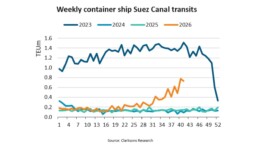
Suez Canal container ship transits exceed 50% of pre-disruption levels "During the first two weeks of October, weekly container ship capacity…
Subscribe to our newsletter!
if you dont want to swim alone in the ocean of news, sign up for the newsletter, and you will receive daily all the important news of world shipping!
