KBR and KIMM sign a Technology Licensing Agreement
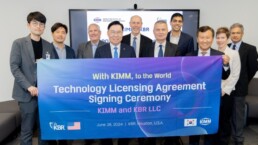

KBR and KIMM sign a licensing agreement for KIMM’s “CPOx®” technology –
– Applicable to the catalytic NCC process, this economical technology can help reduce carbon dioxide emissions
KBR, and the Korea Institute of Machinery and Materials announced that they have signed an licensing agreement to allow KBR to license KIMM’s “Catalytic Partial Oxidation” technology. This technology allows the reduction in carbon dioxide emissions by diversifying fuels for the catalyst regenerator of the catalytic NCC process.
* NCC process: The NCC process is a process for producing olefin compounds, which are used for making plastic, by thermally decomposing naphtha extracted during the crude oil refining process. Whereas the NCC process operates at a high temperature of 850℃, the catalytic NCC process can be operated at a relatively low temperature of around 650℃, which can help to save energy.
Under the terms of the agreement, KBR and KIMM intend to consider an on-going relationship for the purpose of licensing KIMM’s CPOx® technology to KBR and allowing KBR to sub-license the right to use the CPOx® technology to KBR’s clients, and to further develop and improve the CPOx technology for use in conjunction with KBR’s existing technologies.
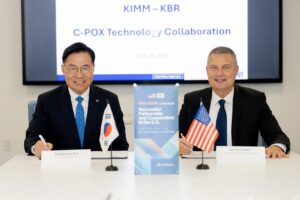
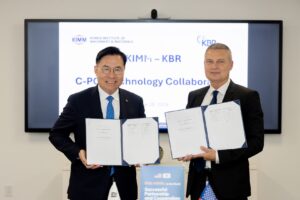
President Seog-Hyeon Ryu of KIMM visited the headquarter of KBR located in Houston, Texas, and met with top executives of KBR including Vice President Henrik Larsen (Head of KBR’s Clean Ammonia and Hydrogen Division) on June 28, 2024, to discuss further cooperation among the parties. The representatives of KIMM and KBR had extensive discussions on the diversification of the fields to which the transferred technology can be applied, as well as the possibility of expanding areas of mutual collaboration in the near future.
“Various issues associated with carbon emissions, such as the carbon border tax, are jeopardizing the competitiveness of corporations. In this context, our latest achievement is very meaningful in that KIMM, a government funded research institute in Korea, had successfully transferred the technology for reducing carbon emissions to KBR, a globally renowned engineering company headquartered in the United States, to remedy such issues,” said President Seog-Hyeon Ryu of KIMM. “KIMM and KBR will expand our cooperation so that the use of our excellent technologies can make tangible accomplishments globally and increase global competitiveness for both parties.”
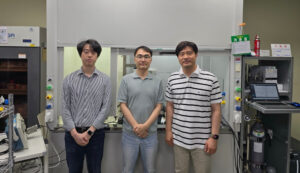
KIMM’s CPOx® technology, first devised by the research team led by Principal Researchers Dae-Hoon Lee and Seong-Kwon Cho of the Semiconductor Manufacturing Research Center of the KIMM’s Research Institute of Autonomous Manufacturing, helps to reduce carbon dioxide emissions by providing the catalytic regenerator of the catalytic NCC process with methane, generated during the process, as the heat source in lieu of fuel oils.
To reduce carbon dioxide emissions and improve economic feasibility, it has become increasingly necessary to replace fuel oil with methane as the heat source required for the catalyst regenerator in the NCC process. However, with KBR’s “K-COT (KBR Catalytic Olefins Technology)®” process, the use of methane as the heat source became limited because of the problem of “after-burn*” that occurs in the course of supplying methane, the process by-product gas, as the heat source.
* After-burn: After-burn refers to an abnormal operation in which the fuel is burned at the top where there is no catalyst, instead of being burned in the catalyst layer.
The CPOx® technology developed by KIMM allows methane to react with the catalyst in the decomposes it into carbon monoxide and hydrogen, and then supplies it to the K-COT® catalyst regenerator as fuel. Thus this technology can supplement KBR’s technology in dealing with the issue of after-burn and also can reduce the cost of olefin* production by securing carbon emissions rights.
*Olefin: Olefin is the basic raw material for manufacturing petrochemical products, and is the most fundamental raw material used in almost every sector including automobiles, electronics, construction, pharmaceuticals, and textiles.
Principal Researcher Dae-Hoon Lee of KIMM remarked, “From the initial stage of our research, our research team strived to identify problems, develop solutions, and secure process applicability by on-demand goals.” He added, “Starting with the cooperation on the CPOx® technology, KIMM and KBR will together contribute to enhancing the technological competitiveness by developing a wide range of world-class process technologies.”
The research on the CPOx® technology, for which the latest technology licensing agreement was signed, was conducted with the support of the convergence research project for developing “large-scale integrated plant technologies for securing energy and chemical raw materials (lead organization: the Future-Leading Convergence Research Center of the Korea Research Institute of Chemical Technology (KRICT), led by Dr. Yong-Ki Park).”



Related News.
Navigating the Multi-Orbit Era: In Conversation with Intellian’s Jon Harrison at SMM 2026
At SMM 2026 in Hamburg, the rapid evolution of maritime satellite communications took centre stage. Across the exhibition halls, discussions among…
Cyprus ports need joint energy and investment strategy, shipping agents chief says
Cyprus needs a coordinated strategy for shipping, energy and environmental protection to support port investment and modernisation, Cyprus shipping…

MASO Public Affairs introduces MASO Regulatory Intelligence
A new subscription service helping businesses understand what is changing and what it means for them MASO Public Affairs introduces MASO Regulatory…
Anglo-Eastern helps turn CMBTECH’s ammonia ambition into an operational reality
From early feasibility study and risk-based design to newbuilding supervision, crew readiness and technical management, Anglo-Eastern drew on its…

Escalation of attacks threatens to derail recovery in Middle East oil exports
World oil demand is forecast to fall by 2.5 mb/d y-o-y in 4Q26 and 2.6 mb/d on average in 2026. As the Iran war manifests itself through restricted…
New study finds shipping pays twice its share to EU ETS earmarked revenues should triple to help build market for sustainable fuels and technologies
Shipping is responsible for around 10% of EU ETS emissions but pays almost 20% of the ETS bill. Unlike other sectors, it has never received free…
MSARC strengthens maritime mass rescue readiness through training and national live exercise off Dakar, Senegal
Joint MSARC–FHAS programme combines three days of SAR training with a national multi-agency live exercise The Maritime Search and Rescue Council ,…
Sogese report deliveries are still being delayed as container freight rates fluctuate
FOR IMPORTERS Spot rates into the Mediterranean are back at January levels, Far East to Europe reliability sits at pandemic lows, and nearly…
Glencore begins trading on Australian Securities Exchange
Glencore has begun trading on the Australian Securities Exchange under the ASX code GLC. Gary Nagle, Glencore’s CEO, said it was an exciting day for…
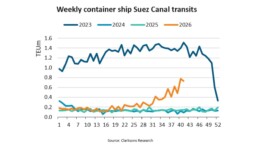
BIMCO Shipping Number of the Week
Suez Canal container ship transits exceed 50% of pre-disruption levels "During the first two weeks of October, weekly container ship capacity…
Subscribe to our newsletter!
if you dont want to swim alone in the ocean of news, sign up for the newsletter, and you will receive daily all the important news of world shipping!
