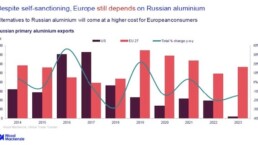

The war in Ukraine has triggered a dramatic shift in the geopolitical landscape for Russia, a major supplier of various commodities. Western sanctions targeting Russia’s economy aim to cripple its access to crucial markets and hinder its war effort. However, the global response has been far from uniform, creating a complex situation for both Russia and the world.The US, EU, UK, and G7 have imposed a series of sanctions on Russia’s metals and mining sector, including key products like aluminium, copper, nickel, and steel. These sanctions create trade barriers through additional tariffs or outright bans, impacting the profitability of Russian metals and deterring some traditional buyers. This disrupts established trade flows and forces a recalibration of global supply chains for these essential commodities.
Energy research consultancy Wood Mackenzie unpacked the impact of Western sanctions on global metals, mining, and coal markets in a recent webinar, highlighting some key takeaways.
First, Ying Lu, Wood Mackenzie’s energy transition and battery raw materials principal analyst, noted that the impact of sanctions on critical battery raw materials has been uneven. Copper, aluminium, and nickel have experienced price volatility due to tighter market balances caused by restricted Russian supplies. Manufacturers involved in the burgeoning electric vehicle (EV) industry are particularly concerned about potential disruptions to the supply of these battery metals. However, the global markets for cobalt and lithium have remained relatively stable as Russia plays a minimal role in their production.
EU’s ‘precarious position’
Turning to aluminium, Uday Patel, Wood Mackenzie’s research manager for aluminium, pointed out that Russian primary aluminium is a significant player in the global supply chain, particularly for low-carbon aluminium, where it accounts for a substantial portion outside of China. Sanctions have limited the profitability of selling Russian metal, dissuading some consumers from buying outside of China. This has placed the European Union in a precarious position, he noted. If they consider a full ban on Russian aluminium, they may be forced to rely on alternative sources, potentially increasing their dependence on higher-carbon aluminium production. This would be a setback for the EU’s ambitious green initiatives.
For coal, senior research analyst Duman Baimbetov, observed that the EU and UK’s bans on Russian coal imports have forced Russian producers to redirect their exports eastward. Despite challenges with infrastructure limitations, Russia managed to increase coal exports to key Asian markets like China, South Korea, and India by over 80% in 2023, according to Wood Mackenzie figures.
However, recent US sanctions against major Russian coal producers are expected to impact around 8%-10% of Russian coal exports in the near future, tightening the market for high-quality thermal and metallurgical coal, he said. Non-Russian producers are expected to fill the gap, potentially leading to short-term price increases.
Steel, meanwhile, is suffering from a patchwork of policies. Steel markets senior analyst Charvi Trivedi noted that the impact of sanctions on the Russian steel industry has varied depending on the country. The US has completely cut off Russian steel imports, while the EU has adopted a more nuanced approach. Initial sanctions in 2022 caused a sharp decline in Russian steel imports to the EU, which were replaced by increased imports from Asia. The EU has also implemented additional bans on semi-finished steel products like billets and slabs, but these have been met with resistance from some European companies, Trivedi said. This lobbying effort resulted in extended import grace periods included in the EU’s 12th sanctions package in December 2023. Overall, significant changes in trade flows for steel products are not expected until the latter half of this decade.
Balancing act
Sanctions on Russian iron ore have been less stringent compared with other commodities. This reflects the EU’s balancing act of maintaining sanctions pressure on Russia while safeguarding its domestic steel industry, which relies heavily on Russian iron ore. Wood Mackenzie’s iron ore markets senior analyst Chris Bandmann noted that while there are currently no explicit bans on Russian iron ore, targeted sanctions and self-sanctioning by EU importers have significantly concentrated Russian iron ore exports into China. By 2024, the Chinese market’s share of Russian exports has surged from 38% to 90%, “indicating a high dependency on China and an increased vulnerability to any protectionist measures that might arise,” said Wood Mackenzie.
“Russian iron ore exporters are exporting to fewer countries. In 2021, 28 countries reported imports from Russia, In 2023, this fell to only 12 – and to only three in Q1 2024,” said Bandmann. “Russian miners will be eager to find new markets, given the risk of such an undiversified set of export destinations.”
Source: Baltic Exchange



Related News.

Register Now for the CSN London Maritime Forum “Shipping: Predicting an Unpredictable Future”, 13 October – Two Weeks Left
“Shipping: Predicting an Unpredictable Future” REGISTER HERE Date: 13 September 2026 Time: 09:00-16:00 Venue: Marriott Hotel Regent's Park Following…

Working visit of the Shipping Deputy Minister of Cyprus to Brussels
The Shipping Deputy Minister to the President, Ms. Marina Hadjimanolis, departed on Monday, 28 September 2026, for Brussels, following an official…

Navigating the S-100 Transition: Real-World Trials and the Future of Digital Navigation
As the maritime industry prepares for the implementation of the S-100 data standard, the shift from traditional Electronic Navigational Charts (S-57)…

Electronic evidence is transforming maritime casualty investigations, says The Nautical Institute
New edition of Guidelines for Collecting Maritime Evidence Volume 2 addresses electronic records, AI, digital reconstruction and the changing…

Xeneta freight rates set to climb in early October
“For the high-flying spot rates from Far East to US East and West Coasts, we may just begin to see the end of that rising trend as we get into the…
A new gateway to Turkey – Stolthaven Terminals and Rönesans Holding on the DAPEK Ceyhan Terminal
Stolthaven Terminals and Rönesans Holding are building a new chemical and industrial terminal at Ceyhan, on Turkey’s Mediterranean coast. The…

KME & KMSM Family Day 2026 held in Singapore
Promoting Business Understanding and Employee Engagement Through Interaction Between Employees and Their Families K LINE MARINE & ENERGY a…
Maritime Coastguard Agency celebrates World Maritime Day 2026
Transport Secretary Heidi Alexander has written to the International Maritime Organization on World Maritime Day. On Thursday 24 September,…

Paracel Carbon Forestry Project verifies first carbon removal credits
Paracel, a large-scale carbon removals project in Paraguay backed by Trafigura, has verified its first carbon removal credits, totalling over 190,000…

When the Levee Breaks
The weakest June for Chinese crude imports in a decade did not cost a single barrel of throughput. Imports fell 41.3% on the year, runs held above…
Subscribe to our newsletter!
if you dont want to swim alone in the ocean of news, sign up for the newsletter, and you will receive daily all the important news of world shipping!
