New Sweco report major gaps in European cities’ resilience to extreme heat – vulnerable groups in danger as the continent enters summer season


Europe, as the fastest warming continent, faces rising temperatures and heat-related mortalities due to climate change. 2023 saw a record number of days with extreme heat. Sweco’s new analysis of 24 European cities* highlights the urgent need for heat wave mitigation and resilience — through digital innovation, nature-based solutions and green-blue infrastructure as well as through designing high-performing buildings.
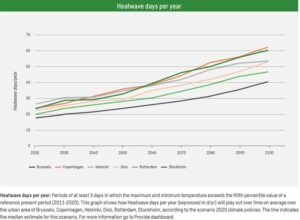
Europe is experiencing temperatures rising at twice the global average rate, and heat-related mortality has increased around 30% in the past 20 years. Heatwaves pose significant risks to public health and have a negative effect on infrastructure and economic productivity in urban areas.
“Europe is rapidly becoming both hotter and more urbanised at the same time, and its cities need to transform to combat this — it is not a problem that will go away. Sweco’s new report studying 24 European cities shows that heat-related concerns are often overlooked in climate plans, and that cities in Northen Europe specifically need to prepare better, as they are still designed to protect populations from the cold, not heat. Authorities and policy makers need to look at regulations and act to address heatwaves, this must be included as a key component in the green transition of our urban areas,” says Dr. Katherine Maxwell, Technical Director, Net Zero Cities, Asset Management at Sweco, and one of the main authors behind the report.

Today, around 70% of Europeans live in cities and, due to the ongoing urbanisation, this figure is expected to increase to 84% in 2050. Urban areas are now experiencing increasingly higher temperatures compared with rural areas due to climate change and the “urban heat island effect” (UHI). Sweco’s report shows that some European cities are taking steps in the right direction to combat the heat, but major gaps still have to be addressed.
“European cities’ climate plans need to focus more on protecting vulnerable groups, by improving the cooling of facilities such as preschools, assisted living facilities and care homes. EUR 680 billion of the EU’s budget is allocated for climate-relevant measures during the 2021–2027 period, so there is funding available. It is now time for European cities to level up by implementing new methods that help cool cities. It can be done, and there is an array of solutions for this,” says Séverine Hermand, Climate resilience planning expert at Sweco, and one of the main authors behind the report.

Sweco’s key recommendations in the report:
- Invest in granular data: Increase vulnerability mapping across cities, with better monitoring and evaluation. This can be done by creating “digital twins” making use of GIS spatial mapping, and other digital solutions, for better heat assessment and management.
- Enable innovation and co-creation: Design solutions at the building and neighbourhood scale to adapt urban spaces. More nature-based solutions, more green-blue infrastructure and updates of regulations for new and existing buildings.
- Pursue transparent and collaborative governance: Cities must work together more to address heatwaves effectively. This requires investments in knowledge, data-driven heat management and joint planning for the organisation of dedicated team structures in a heatwave crisis.
- Decide on a long-term vision: Authorities and policy makers must establish more efficient, modern strategies to protect vulnerable populations from extreme heat, to safeguard overall public health in general and to increase climate equality between groups in particular.
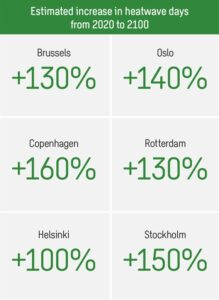
Examples of figures from the report
Sweco’s analysis of 24 European cities and their resilience policies and heatwave data includes in-depth case studies of six cities, and is showing how temperatures are expected to rise for each city from 2020–2100:
- Copenhagen +160% estimated increase in heatwave days
- Stockholm +150%
- Oslo +140%
- Rotterdam +130%
- Brussels +130%
- Helsinki +100%
*Sweco has studied 24 cities: Brussels, Copenhagen, Helsinki, Oslo, Rotterdam, Stockholm, Amsterdam, Edinburgh, Madrid, Glasgow, Seville, London, Rome, Lisbon, Paris, Vienna, Barcelona, Geneva, Prague, Istanbul, Toulouse, Gdansk, Warsaw and Athens.



Related News.

Navigating the Multi-Orbit Era: In Conversation with Intellian’s Jon Harrison at SMM 2026
At SMM 2026 in Hamburg, the rapid evolution of maritime satellite communications took centre stage. Across the exhibition halls, discussions among…
Cyprus ports need joint energy and investment strategy, shipping agents chief says
Cyprus needs a coordinated strategy for shipping, energy and environmental protection to support port investment and modernisation, Cyprus shipping…

MASO Public Affairs introduces MASO Regulatory Intelligence
A new subscription service helping businesses understand what is changing and what it means for them MASO Public Affairs introduces MASO Regulatory…

Anglo-Eastern helps turn CMBTECH’s ammonia ambition into an operational reality
From early feasibility study and risk-based design to newbuilding supervision, crew readiness and technical management, Anglo-Eastern drew on its…

Escalation of attacks threatens to derail recovery in Middle East oil exports
World oil demand is forecast to fall by 2.5 mb/d y-o-y in 4Q26 and 2.6 mb/d on average in 2026. As the Iran war manifests itself through restricted…
New study finds shipping pays twice its share to EU ETS earmarked revenues should triple to help build market for sustainable fuels and technologies
Shipping is responsible for around 10% of EU ETS emissions but pays almost 20% of the ETS bill. Unlike other sectors, it has never received free…

MSARC strengthens maritime mass rescue readiness through training and national live exercise off Dakar, Senegal
Joint MSARC–FHAS programme combines three days of SAR training with a national multi-agency live exercise The Maritime Search and Rescue Council ,…

Sogese report deliveries are still being delayed as container freight rates fluctuate
FOR IMPORTERS Spot rates into the Mediterranean are back at January levels, Far East to Europe reliability sits at pandemic lows, and nearly…
Glencore begins trading on Australian Securities Exchange
Glencore has begun trading on the Australian Securities Exchange under the ASX code GLC. Gary Nagle, Glencore’s CEO, said it was an exciting day for…
BIMCO Shipping Number of the Week
Suez Canal container ship transits exceed 50% of pre-disruption levels "During the first two weeks of October, weekly container ship capacity…
Subscribe to our newsletter!
if you dont want to swim alone in the ocean of news, sign up for the newsletter, and you will receive daily all the important news of world shipping!
