All ships should be built to a seawater lubricates sterntubeless ship design says Leontopoulos


Future newbuild ships of all types should be built without a sterntube and with a seawater-lubricated propeller shaft bearing arrangement, according to Blue Ocean Alliance’s Chris Leontopoulos.
Speaking at a recent maritime industry forum in Hamburg, Mr. Leontopoulos said the sterntubeless ship design – jointly developed by Blue Ocean Alliance members ABS, Thordon Bearings, Shanghai Merchant Ship Design and Research Institute (SDARI), Wärtsilä, and the National Technical University of Athens (NTUA) – is so commercially, operationally and environmentally attractive that “I personally hope that in the future all ships are built like this”.
Kick-starting his presentation with the startling statistic that more than eight million litres of sterntube lubricating oil is polluting the oceans annually, Mr. Leontopoulos, ABS’ Vice President, Technology, EMEA, said the design interventions proposed by the group can deliver a commercially and environmentally optimal vessel capable of saving hundreds of thousands of dollars in operational costs. This, without changing hull lines or existing class rules and regulations.
“We decided to remove the sterntube, and by shortening propeller shaft length and moving the prime mover further aft, we no longer needed a forward sterntube bearing. This places less friction on the shaft, resulting in lower power loss, improved fuel efficiency and reduced emissions. A sterntubeless ship also results in a bigger cargo space for the same vessel length,” he said.
Mr. Leontopoulos went on to say that the use of a seawater-lubricated bearing with a tapered key design – the principal component that makes the sterntubeless ship possible – also removes the need for an aft seal and a shaft coating system. The sterntubeless design features a seawater-lubricated bearing, a Wärtsilä forward shaft seal, a Water Quality Package and a bulkhead seal.
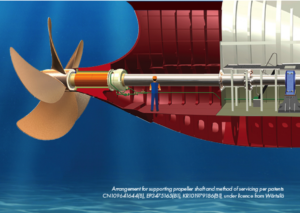
The technical differences were immediately obvious when a graphic was shown comparing a ship with and without a sterntube.
Essentially, the design presents a dry internal inspection chamber aft of the engine room, in the space normally given to the sterntube. This new space, big enough for engineers to stand up in to maintain or replace propeller shaft components while the ship is afloat, has been created by trimming stiffeners and cutting an opening into the bulkhead.
“This is a very a big advantage because you don’t have to drydock the ship and withdraw the shaft or propeller to monitor and maintain seawater-lubricated bearings and seals. We can now do this from inside the ship while the vessel is operational,” said Mr. Leontopoulos.
The sterntubeless ship, he said, also negates the need to realign the shaft throughout the vessel’s lifetime, mitigating the risk of shaft damage or indentation, which can result in substantial downtime and expenditure.
Going on to reveal the cost benefits of a sterntubeless ship, Mr. Leontopoulos acknowledged that although the estimated CAPEX for additional components could add about US$10,000 to $30,000 to the cost of a newbuild depending on shaft diameter, the ROI is quick given the reduced operational expenditure. This is where the real financial gain is to be made.
He told conference delegates that aside from immediate savings of US$350,000 in lubricating oil, operators could save more than US$1 million in through-life operational costs.
This is based on reduced fuel consumption, reduced drydocking and maintenance costs, and associated loss of earnings; shaft alignment optimization, lower bearing wear rates, better EEDI; and an increase in cargo carrying capacity. The arrangement also reduces to zero the risk of environmental fines related to sterntube oil pollution.
Summing up he said: “There’s no pollution risk, no oil changes, and no need to drydock to change the bearing. A shorter shaft line and smaller engine room space increases cargo space and improves EEDI ratings; there is no barred speed range and no fatigue concerns. It complies completely with all existing class rules.”
On that latter point, ABS has now published a Requirements for Sterntubeless Vessels with Water-Lubricated Bearings guide, bringing together in one document all existing applicable rules for the design. ABS is also introducing a new notation for the sterntubeless ship design, for which the classification society awarded an AiP in June 2022.
Neil McDonald, Thordon Bearings’ Regional Manager – Northern Europe & Africa, said: “The sterntubeless ship design proposed by the Blue Ocean Alliance is truly a milestone development for the global shipping industry. This part of the ship hasn’t changed since the advent of steam propulsion.
“Simply by remodeling the sterntube space and replacing an oil-lubricated bearing system with one lubricated by water, newbuild ships can be substantially more environmentally and operationally sustainable, without the need for new class rules and notations. It is significant design intervention.”
Chris Leontopoulos believes the first sterntubeless ship with a Thordon seawater-lubricated propeller shaft bearing system, probably based on a SDARI design, will be ordered within the next twelve months.



Related News.

Navigating the Multi-Orbit Era: In Conversation with Intellian’s Jon Harrison at SMM 2026
At SMM 2026 in Hamburg, the rapid evolution of maritime satellite communications took centre stage. Across the exhibition halls, discussions among…

Cyprus ports need joint energy and investment strategy, shipping agents chief says
Cyprus needs a coordinated strategy for shipping, energy and environmental protection to support port investment and modernisation, Cyprus shipping…

MASO Public Affairs introduces MASO Regulatory Intelligence
A new subscription service helping businesses understand what is changing and what it means for them MASO Public Affairs introduces MASO Regulatory…

Anglo-Eastern helps turn CMBTECH’s ammonia ambition into an operational reality
From early feasibility study and risk-based design to newbuilding supervision, crew readiness and technical management, Anglo-Eastern drew on its…

Escalation of attacks threatens to derail recovery in Middle East oil exports
World oil demand is forecast to fall by 2.5 mb/d y-o-y in 4Q26 and 2.6 mb/d on average in 2026. As the Iran war manifests itself through restricted…

New study finds shipping pays twice its share to EU ETS earmarked revenues should triple to help build market for sustainable fuels and technologies
Shipping is responsible for around 10% of EU ETS emissions but pays almost 20% of the ETS bill. Unlike other sectors, it has never received free…

MSARC strengthens maritime mass rescue readiness through training and national live exercise off Dakar, Senegal
Joint MSARC–FHAS programme combines three days of SAR training with a national multi-agency live exercise The Maritime Search and Rescue Council ,…

Sogese report deliveries are still being delayed as container freight rates fluctuate
FOR IMPORTERS Spot rates into the Mediterranean are back at January levels, Far East to Europe reliability sits at pandemic lows, and nearly…

Glencore begins trading on Australian Securities Exchange
Glencore has begun trading on the Australian Securities Exchange under the ASX code GLC. Gary Nagle, Glencore’s CEO, said it was an exciting day for…

BIMCO Shipping Number of the Week
Suez Canal container ship transits exceed 50% of pre-disruption levels "During the first two weeks of October, weekly container ship capacity…
Subscribe to our newsletter!
if you dont want to swim alone in the ocean of news, sign up for the newsletter, and you will receive daily all the important news of world shipping!
