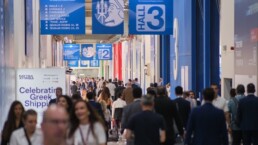

Alternative fuels and seafarer upskilling took centre stage at the ‘Greener Shipping Summit 2024’ held at Posidonia 2024 this week. Under the theme ‘New Technologies and Education’, the thought-provoking summit was organised by Newsfront/Naftiliaki and supported by MARTECMA (Marine Technical Managers Association).
Panel discussions shared insights on topics spanning technology, new shipping professions, energy transition, digitalisation, training and education onboard, marine education, and many more.
Dimitris Fafalios, Chairman of INTERCARGO, keynoted the event. He said: “We cannot achieve the IMO goals without safety. Shipping is an extremely broad term covering many sectors: Dry Bulk, Tankers, Gas Carriers, Ro-Ros, Car Carriers, Ferries, Cruise Ships, and more. Shipping, however, can be divided into two basic economic models. The first is Liners, and the second is Tramp/Bulk, which includes all solid, liquid, and gas bulk carriers. To develop the right regulations for decarbonisation and safety, we must help our regulators to understand the fundamental difference between shipping’s two basic economic models.
“In order to achieve decarbonisation, our industry needs a plentiful supply of truly ‘green’ alternative fuels which are safe,” he added.
Kostas Spyrou, Professor at the School of Naval Architecture and Marine Engineering, National Technical University of Athens, said: “It’s hard to imagine the vessel of the future because everything depends on certain factors that can influence the direction technology will take. We can’t be sure what will happen in 15 years, but greener propulsion broadly is the direction. Data is another big friend helping us monitor the behaviour of our ships and, in the future, this will become even more important. I also see increased levels of autonomy as an emerging trend.”
The challenge of having to train an estimated half a million seafarers to handle the alternative fuels that will power fleets around the world was hotly debated, with panellists and the audience engaging in a constructive debate. Contentious issues included the number of seafarers who will require training, the number of trainers and methods to do so, and whether upskilling would be a prerequisite for the energy transition, given that the shift from steam to diesel had not required extensive upskilling programmes in the past.
According to Fafalios, hundreds of thousands of seafarers around the world will need retraining to handle the new fuels and technologies necessary to push the decarbonisation of shipping forward, and that figure excludes shore-side staff who are also vital to the safe and green operations of fleets worldwide.
Natassa Kouvertari, Project Manager at the Maritime Decarbonisation Hub, Lloyd’s Register, put the number of seafarers who will require training to safely handle alternative fuels at up to 800,000. “Global naval education is not a dream, but it needs to happen gradually across various levels and clusters. It cannot happen overnight. Decarbonisation and digitalisation are two areas of shipping where upskilling, hard skilling, and meta-skilling will play an important role for the safety of our crews and vessels. Many training, learning, and development programmes are already in place, and the IMO will eventually mandate a curriculum for global adoption.”
Spyrou added: “We need to make teaching a bit more motivating for the trainees and the trainers. Digital skills are a priority at both academy level and in the retraining of those already in a career. Sustainability is also an important subject that seafarers need to be educated on. Management skills training is also very important, helping seafarers assimilate information and make the right choices when onboard.”
Spyrou went on to say that a big gap exists in Greece on the issue of partnerships between educational institutions and the shipping industry. “We don’t have partnerships between the industry and educational institutions in Greece, unlike what is happening in Norway, where joint partnerships between academia and shipping proliferate. In Greece, we need to build more stable and concrete structures and systems to facilitate this type of collaboration because there is no formal manner to connect the industry with academia.”
During a separate panel discussion later in the day the issue of alternative fuels cost was in focus, with Technical Director of Star Bulk Carriers Corp. Fotis Belexis noting: “The cost of alternative fuels will be two or three times higher compared to fossil fuels, and that’s very important considering that the highest operational cost of a vessel is the actual fuel it uses. We should also understand that once these alternative fuels finally become available, shipping will be competing with other industries such as aviation in order to secure the required supplies; and that will also drive prices even higher.”
Posidonia 2024 is organised under the auspices of the Ministry of Maritime Affairs & Insular Policy, the Hellenic Chamber of Shipping, and the Union of Greek Shipowners, with the support of the Municipality of Piraeus and the Greek Shipping Cooperation Committee.



Related News.
Hong Kong Global Maritime Trade Summit to return for third edition
The International Chamber of Shipping, in collaboration with the Transport and Logistics Bureau of the Government of Hong Kong and the Hong Kong…

Appetite for US crude oil exports climbs despite high freight
South Korea tops US crude destinations at 568,600 b/d VLCC rates to Asia double, closing arbitrage window European refining margins…
Shipping stocks Rally as Hormuz Traffic plunges 75%
Ship traffic through the Strait of Hormuz — a critical chokepoint handling about 20% of global crude oil and liquefied natural gas shipments — has…
Diana Shipping announces Time Charter Contract for m/v G P Zafirakis with Classic Maritime
Diana Shipping, a global shipping company specializing in the ownership and bareboat charter-in of dry bulk vessels, announced that, through a…
New IMO ESP Code framework for Remote Inspection Techniques
The International Maritime Organisation, through Resolution MSC.584(111) , has adopted amendments to the International Code on the Enhanced…

ABS opens Offshore & Marine Support Center in Bergen
ABS has expanded its capabilities in the Norwegian maritime market with the opening of a cutting-edge support center in Bergen, bringing advanced…
MOL holds giant step memorial ceremony and beach cleanup at Kashima Coast
Memorial and Reflection 20 Years After the Accident: Learning from the Past to Foster an Even Stronger Safety Culture Mitsui O.S.K. Lines, announced…
KEZAD-based Arabian Gulf Steel Industries achieves lowest verified Carbon Footprint for Rebar
CARES UK verified Environmental Product Declaration confirms 139 kg CO₂e per tonne for rebar produced at AGSI’s KEZAD Abu Dhabi facility Arabian…
Indian Register of Shipping announces launch of first fleet support ship INS Surya
Indian Register of Shipping continues to strengthen its role in supporting the Indian Navy and India’s naval shipbuilding capabilities through the…
VLCCs Climbing the Record Charts
LR2 The TC1 75kt MEG/Japan index decreased by only a single point this week to WS928. The corresponding Baltic round-trip TCE fell by $2,000 to…
Subscribe to our newsletter!
if you dont want to swim alone in the ocean of news, sign up for the newsletter, and you will receive daily all the important news of world shipping!
