EU rules drive marine demand for shoreside power; infrastructure needed

EU regulations on shoreside power are poised to introduce low-carbon electricity into marine energy mix with limited impact on the transition into sustainable fuels, assuming charging networks can be rolled out in time, industry analysts said.
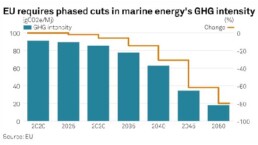
Brussels has allowed shipping companies to use onshore power supply to comply with FuelEU Maritime, which mandates reduction in the life-cycle greenhouse gas emissions intensity of marine energy for ships in EU-related trades of 2% against 2020 levels from 2025, 6% from 2030, and all the way to 80% from 2050 in phases.
The FuelEU Maritime rules separately require container and passenger ships to be connected to charging facilities by 2030 at main EU ports listed in the trans-European transport network, which in turn need to develop the infrastructure to meet 90% of ship operators’ demand, according to the EU’s alternative fuels infrastructure regulation.
While only small ships can be fully electrified due to limited space for on-board battery systems, large, ocean-going vessels could be designed or retrofitted to run on power at berth and turn off their auxiliary engines during “cold-ironing”, leading to lower bunker fuel use and CO2 emissions as well as less air pollution.
“Use of shore power when alongside is the no-brainer of maritime emission reduction,” Tristan Smith, co-founder of shipping consultancy UMAS, told S&P Global Commodity Insights, adding that mandating its use can create “certainty of demand” and promote infrastructure development.
More capacity
Based on an estimate by the nonprofit International Council on Clean Transportation, the EU needs to at least triple its installed show power capacity by 2030, from 309 MW at 51 ports in 15 coastal countries in October 2023, with demand expected to be driven by cruise traffic in Italy, France and Spain.
The EU’s impact assessment suggests containerships and passenger ships alone would require 5.6 GW of capacity to meet their mandates, which could come from new projects or better utilization of existing facilities.
With the regulatory requirements, major European ports like Rotterdam and Hamburg have started to develop onshore power supply networks, partnering with energy companies in some cases.
“Whilst today many ports across Europe do not yet have shore-side electricity installations in place, investment agreements are being signed and concrete plans being developed in order,” said Inesa Ulichina, sustainable shipping policy officer at think tank Transport & Environment, adding that using onshore power could halve energy use by ships at ports due to better efficiency.
Advantages
Analysts said shoreside power could emerge as a strong option for shipping firms to comply with FuelEU Maritime, with its cost expected to be lower than other low-carbon marine energy sources for some years at least.
Platts, part of Commodity Insights, assessed the delivered bunker price for 0.5% sulfur marine fuel at $570/mt in Hamburg May 28, or $13.9/Gigajoule. Industry estimates suggest sustainable marine fuels based on hydrogen generated from renewable energy could be five times more expensive.
The year-ahead contract for German electricity settled at Eur102/MWh on the same day, according to the European Energy Exchange. This was roughly equivalent to $30.7/Gj.
Taking into consideration better energy efficiency of electricity, Smith said shoreside power could be three to four times cheaper than using renewable hydrogen-based green fuels.
GHG factor
Furthermore, onshore power supply has a zero-emission factor by default regardless of the sources of electricity under FuelEU Maritime, while the GHG intensity of marine fuels are calculated based on their well-to-wake emissions.
The regulatory design could discourage procurement of renewable energy, but the impact would be largely mitigated by the EU’s decarbonization policies for its power sector, according to industry participants.
Nikita Pavlenko, a fuel researcher at the ICCT, estimated the EU’s grid electricity emissions factor at 250 grams CO2-equivalent/KWh — which can translate into a 60% GHG cut versus conventional, oil-based bunker fuels. This would be deeper than most biofuels, currently the most used low-carbon bunker fuels, according to Pavlenko.
With the EU targeting a 69% share of renewables in electricity by 2030 under the REPowerEU plan, Joe Bettles, a market analyst at Maersk Mc-Kinney Moller Center for Zero Carbon Shipping, suggested Brussels is aiming to drive the buildouts of shoreside charging facilities with the zero-emission factor.
“The EU’s approach has been that the grid is decarbonizing and will likely continue due to EU mandates,” Bettles said. “This is the right approach to scale a technology which currently has very low adoption.”
Future plans
For the long run, shipping companies would need both onshore power supply and low-carbon fuels to comply with FuelEU Maritime, according to analysts.
As shoreside electricity would typically amount to less than 5% of total energy used by a vessel, Smith said “a switch to clean fuel will be necessary” when FuelEU Maritime requirements become increasingly stringent in the next decade.
“The impact of this pathway on crowding out alternative fuels will be limited … [even as] using existing, grid average electricity is likely cheaper and easier [for meeting parts of the FuelEU Maritime requirements,” Pavlenko,said.
Based on the EU’s estimate, Eur7.4 billion would need to be spent on shoreside charging networks in 2025-2050, and analysts said it would take time for the capital expenditure programs to materialize across the bloc while shipowners enable their vessels to be connected to the grid.
“The challenge is to make sure that the fleet is compatible and can use shore power and that investment is made into supply,” Smith said.
Source: Platts



Related News.

Register Now for the CSN London Maritime Forum “Shipping: Predicting an Unpredictable Future”, 13 October – Two Weeks Left
“Shipping: Predicting an Unpredictable Future” REGISTER HERE Date: 13 September 2026 Time: 09:00-16:00 Venue: Marriott Hotel Regent's Park Following…

Working visit of the Shipping Deputy Minister of Cyprus to Brussels
The Shipping Deputy Minister to the President, Ms. Marina Hadjimanolis, departed on Monday, 28 September 2026, for Brussels, following an official…

Navigating the S-100 Transition: Real-World Trials and the Future of Digital Navigation
As the maritime industry prepares for the implementation of the S-100 data standard, the shift from traditional Electronic Navigational Charts (S-57)…

Electronic evidence is transforming maritime casualty investigations, says The Nautical Institute
New edition of Guidelines for Collecting Maritime Evidence Volume 2 addresses electronic records, AI, digital reconstruction and the changing…

Xeneta freight rates set to climb in early October
“For the high-flying spot rates from Far East to US East and West Coasts, we may just begin to see the end of that rising trend as we get into the…
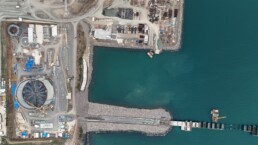
A new gateway to Turkey – Stolthaven Terminals and Rönesans Holding on the DAPEK Ceyhan Terminal
Stolthaven Terminals and Rönesans Holding are building a new chemical and industrial terminal at Ceyhan, on Turkey’s Mediterranean coast. The…

KME & KMSM Family Day 2026 held in Singapore
Promoting Business Understanding and Employee Engagement Through Interaction Between Employees and Their Families K LINE MARINE & ENERGY a…
Maritime Coastguard Agency celebrates World Maritime Day 2026
Transport Secretary Heidi Alexander has written to the International Maritime Organization on World Maritime Day. On Thursday 24 September,…

Paracel Carbon Forestry Project verifies first carbon removal credits
Paracel, a large-scale carbon removals project in Paraguay backed by Trafigura, has verified its first carbon removal credits, totalling over 190,000…

When the Levee Breaks
The weakest June for Chinese crude imports in a decade did not cost a single barrel of throughput. Imports fell 41.3% on the year, runs held above…
Subscribe to our newsletter!
if you dont want to swim alone in the ocean of news, sign up for the newsletter, and you will receive daily all the important news of world shipping!
