Astroscale Unveils World’s First Image of Space Debris Captured through Rendezvous and Proximity Operations
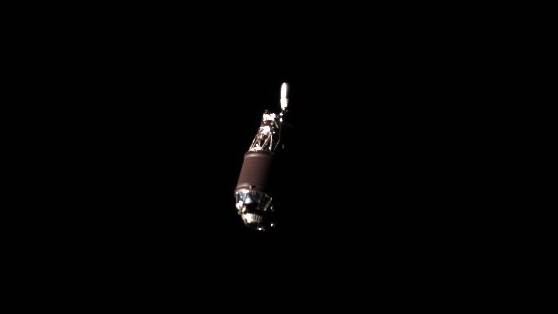

Astroscale Japan Inc. (“Astroscale Japan”), a subsidiary of Astroscale Holdings Inc. (“Astroscale”), a market leader in satellite servicing and long-term orbital sustainability across all orbits, has unveiled the first publicly released image of space debris captured through rendezvous and proximity operations (RPO). The image was taken by its commercial debris inspection demonstration satellite, Active Debris Removal by Astroscale-Japan (ADRAS-J), from several hundred meters behind the space debris, a rocket upper stage. The unprecedented image marks a crucial step towards understanding and addressing the challenges posed by space debris, driving progress toward a safer and more sustainable space environment.
The ADRAS-J spacecraft was selected by JAXA for Phase I of its Commercial Removal of Debris Demonstration (CRD2) program. Astroscale Japan is responsible for the design, manufacture, test, launch and operations of ADRAS-J.
ADRAS-J is a groundbreaking mission as the world’s first attempt to safely approach, characterize and survey the state of an existing piece of large debris through RPO[1]. ADRAS-J is designed to rendezvous with a Japanese upper stage rocket body, demonstrate proximity operations including orbiting around the upper stage, and gather images to assess the rocket body’s movement and condition of the structure. The mission will demonstrate some of the most challenging RPO technologies necessary for on-orbit services.
The ADRAS-J mission recently achieved a key technical milestone: the successful safe and controlled approach to an unprepared space debris object to a relative distance of several hundred meters. Additionally, ADRAS-J successfully demonstrated close approach rendezvous and proximity operations using a safety ellipse approach technique in conjunction with relative navigation inputs from the spacecraft’s suite of rendezvous payload sensors.
In the next phase of the mission, ADRAS-J will attempt to capture additional images of the upper stage through various controlled close approach operations. The images and data collected are expected to be crucial in better understanding the debris and providing critical information for future removal efforts. The major mission achievements completed so far include:
Feb. 18: launch and start of in-orbit operations
Feb. 22: start of the rendezvous phase
Apr. 9: start of Angles Only Navigation and proximity approach from several hundred kilometers
Apr. 16: start of Model Matching Navigation
Apr. 17: approach to the client within several hundred meters
ADRAS-J heralds a new era in RPO missions, paving the way for future on-orbit services while laying the foundation of a sustainable space environment.
Astroscale Japan recently announced its selection for Phase II of JAXA’s CRD2 program. The ADRAS-J follow-on active debris removal spacecraft, ADRAS-J2, will similarly attempt to safely approach the same rocket body through RPO, obtain further images, then remove and deorbit the rocket body using in-house robotic arm technologies.



Related News.

ISLAND OIL: Unveiling of the Sculpture “Cyprus’s Journey Through the Ages” in Protaras – A Tribute and Landmark to Cyprus’s Historical Memory and Cultural Heritage
In a modest ceremony marked by a moving atmosphere, the sculpture “Cyprus’s Journey Through the Ages”, created by acclaimed Cypriot sculptor…

World Maritime Day 2026 from Policy to Practice – powering Maritime Excellence
Global regulations will deliver safer, more resilient shipping when they are implemented worldwide. The international maritime community marks…

Diana Shipping announces Time Charter Contract for m/v DSI Polaris with Dai An Ocean Shipping
Diana Shipping , a global shipping company specializing in the ownership and bareboat charter-in of dry bulk vessels, announced that, through a…

Chief Economists Expect Global Economy to Stabilize, but Fiscal Constraints, Rising Living Costs and AI Investment Uncertainty Threaten Growth
The global economy is stabilizing, but the fiscal support that cushioned successive shocks since 2020 is unlikely to play the same role in the year…

V. welcomes its new graduate cohort as programme expands across the group
Twelve graduates from nine nationalities join 11th year of V.’s expanded international management programme. V., the global ship manager and marine…

From Policy to Practice: Why Seafarers Are the Key to Maritime Excellence
The shipping industry is no stranger to regulation. Seafarers and ship operators work within a vast framework of international conventions, national…

Intermodal Report – Week 38 2026
Please find below the Intermodal market report for week 38 2026. Intermodal Report Week 38 2026 Market Insight By Nikos Tagoulis, Head of…

Allied – Weekly Market Review – Week 38
Please find below the Allied Weekly Report for Week 38 | 2026 ALLIED - Weekly Market Report- Week 38

Record year on the Northeast Passage but Arctic shipping remains very limited
In 2025, a record 103 transit voyages were made via the Northeast Passage. However, this is still equivalent to only around a day and a half of…

[xclusiv] S&P Report 21th September 2026
Please find below the [xclusiv] latest Weekly S&P Report [xclusiv] 2026_09_21 Market Commentary: VLCCs: Freight Boom Reprices the Fleet The VLCC…
Subscribe to our newsletter!
if you dont want to swim alone in the ocean of news, sign up for the newsletter, and you will receive daily all the important news of world shipping!
