Fire not the only danger with lithium-ion batteries


TT Club, the specialist international freight insurance provider is seeking greater emphasis on the critical dangers of toxic gas emissions associated with lithium-ion battery fires. The failure of such batteries has the potential to occur with no prior warning, or with such speed that there is typically no time to react to any warning signs.
Devastating consequences of rapidly spreading, and often challenging to extinguish fires involving the batteries particularly in electric vehicles (EV) on board ships, and other parts of the supply chain have been well-documented in recent months. There is however less awareness of the highly toxic combustion products that are released and their respective impact to the health and wellbeing of those exposed to the gases.
Based on the evidence of past fires the time between the initiation of a failed battery igniting to a discharge of toxic vapour can be measured in seconds rather than minutes. This is due to a process known as thermal runaway. The rapid sequence of events typically occurs where an internal electrical short within one of the battery cells generates heat; this breaks down the internal structure of the battery, increasing the rate of the reaction in an ever-increasing cycle. There is often a dramatic release of energy in the form of heat and a significant emission of toxic gases.
Neil Dalus of TT endeavours to paint a picture of the dangers. “During a lithium battery thermal runaway event, research has shown that significant amounts of vapour can be produced per kWh (kilowatt hour). In many common supply chain scenarios, including ships’ holds and warehouses, the reality is that such vapour clouds are likely to accumulate. Even when the clouds are able to disperse, the potential toxic effects may occur at lower concentrations.”

Potential vapour volume production
Source: Journal of Loss Prevention in the Process Industries 80 (2022)
Drivers, stevedores, ships’ crews and first responders attempting to control the blazes encounter what might appear to be smoke but is in fact a mix of toxic gases, generated quickly and in large volumes. These gases once in the atmosphere behave differently to smoke, often pooling at floor level due to their density. “Traditionally where fires and smoke are concerned one would stay low to avoid inhalation, doing so where lithium battery fires are concerned is likely to prove problematic,” observes Dalus.
The toxicity of gases given off from any given lithium-ion battery differ from that of a typical fire and can themselves vary but all remain either poisonous or combustible, or both. They can feature high percentages of hydrogen, and compounds of hydrogen, including hydrogen fluoride, hydrogen chloride and hydrogen cyanide, as well as carbon monoxide, sulphur dioxide and methane among other dangerous chemicals.
In terms of hazards to the wellbeing of those in the vicinity of such an incident, one particularly problematic component is hydrogen fluoride (HF). Although HF is lighter than air and would disperse when released, a cloud of vapor and aerosol that is heavier than air may be formed (EPA 1993). On exposure to skin or by inhaling, HF can result in skin burns and lung damage that can take time (hours to weeks) to develop following exposure. HF will be quickly absorbed by the body via skin and lungs depleting vital calcium and magnesium levels in tissues, which can result in severe and possibly fatal systemic effects. The hydrogen content of the released gases can give rise to vapour cloud explosion risks which have the potential to cause significant damage.
TT advocates a range of measures to mitigate the risks. A prudent starting point would be to perform a fire risk assessment, considering the specific hazards presented by lithium-ion batteries. Risk mitigation considerations thereafter could include providing operatives with certified full-face self-contained breathing apparatus, chemical-resistant boots among other protective equipment, as well as drench showers for post-response decontamination. Strategic positioning of fire-fighting equipment should also be a key consideration.
Early detection of such an incident can also be pivotal in managing the response, camera and thermal imaging could enable an expedient response. Such equipment might have already become commonplace for some modes, however conducting a thorough risk assessment for example when cargo is stored in warehouses would be prudent. As Dalus comments however, “Given the hazardous nature of this vapour, if any of these measures are not in place then the best course of action is to evacuate the area and leave the incident response to the emergency services, ensuring that the known risks are appropriately communicated.”
Consideration should also be given to the location of any incident that might include clean up and entry. The gases produced potentially leave toxic deposits on all surfaces and in the atmosphere. Therefore, once the incident is under control, potential hazards remain.
Source: TTClub



Related News.

Navigating the Multi-Orbit Era: In Conversation with Intellian’s Jon Harrison at SMM 2026
At SMM 2026 in Hamburg, the rapid evolution of maritime satellite communications took centre stage. Across the exhibition halls, discussions among…

Cyprus ports need joint energy and investment strategy, shipping agents chief says
Cyprus needs a coordinated strategy for shipping, energy and environmental protection to support port investment and modernisation, Cyprus shipping…

MASO Public Affairs introduces MASO Regulatory Intelligence
A new subscription service helping businesses understand what is changing and what it means for them MASO Public Affairs introduces MASO Regulatory…
Anglo-Eastern helps turn CMBTECH’s ammonia ambition into an operational reality
From early feasibility study and risk-based design to newbuilding supervision, crew readiness and technical management, Anglo-Eastern drew on its…

Escalation of attacks threatens to derail recovery in Middle East oil exports
World oil demand is forecast to fall by 2.5 mb/d y-o-y in 4Q26 and 2.6 mb/d on average in 2026. As the Iran war manifests itself through restricted…

New study finds shipping pays twice its share to EU ETS earmarked revenues should triple to help build market for sustainable fuels and technologies
Shipping is responsible for around 10% of EU ETS emissions but pays almost 20% of the ETS bill. Unlike other sectors, it has never received free…

MSARC strengthens maritime mass rescue readiness through training and national live exercise off Dakar, Senegal
Joint MSARC–FHAS programme combines three days of SAR training with a national multi-agency live exercise The Maritime Search and Rescue Council ,…
Sogese report deliveries are still being delayed as container freight rates fluctuate
FOR IMPORTERS Spot rates into the Mediterranean are back at January levels, Far East to Europe reliability sits at pandemic lows, and nearly…

Glencore begins trading on Australian Securities Exchange
Glencore has begun trading on the Australian Securities Exchange under the ASX code GLC. Gary Nagle, Glencore’s CEO, said it was an exciting day for…
BIMCO Shipping Number of the Week
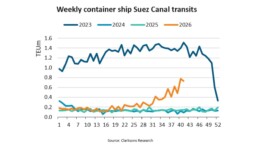
Suez Canal container ship transits exceed 50% of pre-disruption levels "During the first two weeks of October, weekly container ship capacity…
Subscribe to our newsletter!
if you dont want to swim alone in the ocean of news, sign up for the newsletter, and you will receive daily all the important news of world shipping!
