Germany kicks off a significant reduction of CO2 footprint in cereal crops
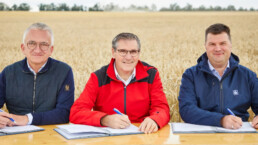

Yara Germany, the Bindewald & Gutting Milling Group and Harry-Brot signed a cooperation agreement aimed at decarbonizing cereal cultivation in Germany through the use of green fertilizers. For this purpose, Norwegian ammonia produced with hydropower will be processed in Rostock.
As early as of 2023/24 growing season, contract farmers of the Bindewald & Gutting Milling Group will use Yara’s green fertilizer on an area of around 1,600 ha. The fertilizer will be produced from green ammonia at Yara’s plant in Rostock, Germany.
Unlike traditional methods that use fossil fuels like natural gas for ammonia extraction, green ammonia is produced using renewable energy sources such as wind, hydropower, or solar energy. This process involves obtaining the necessary hydrogen for ammonia synthesis through electrolysis. The outcome is a fertilizer with up to 90% reduced CO2 footprint, compared to conventional methods.
In this context, Yara Germany, all nine locations of the Bindewald & Gutting Milling Group, and Harry-Brot signed a cooperation agreement with the shared goal of reducing CO2 emissions in cereal production. The partnership will help in reducing carbon footprint along the entire food value chain, starting from fertilizers to sales and ultimately reaching end consumers.
Germans want a climate-friendly food production
An IPSOS study commissioned by Yara revealed that 74% of German consumers want product packaging to display the CO2 footprint, with 53% willing to pay extra for food produced with reduced fossil fuels. By using green fertilizer, grain CO2 footprints can be reduced by up to 30%, offering consumers a sustainable food choice and supporting climate-friendly production.
An additional reduction in field emissions is attainable through optimized fertilizer management, incorporating balanced crop nutrition, the selection of the most efficient nitrogen form, and site-specific fertilization tailored to crop needs. By integrating these approaches with Yara’s digital precision farming tools, the company provides its partners with a comprehensive fertilization solution, complemented by decades of expertise in this domain.
Benoît Lamaison, SVP of the Continental Europe Business Unit, welcomed the cooperation with the Bindewald & Gutting Milling Group and Harry-Brot: “Today’s signing of our cooperation agreement officially kicks off the first project in Germany using Yara’s green fertilizer solution based on fossil-free ammonia. We are looking forward to the cooperation and hope this is the first of many partnerships across the entire food value chain.”
“Our partnership with the Bindewald & Gutting Milling Group and Harry-Brot is a crucial first step to decarbonize German agriculture. It is a concrete example of how food production can be transformed in a sustainable way. However, not only all stakeholders along the food value chain are challenged and invited to actively participate in the green transformation of agriculture but also politicians promoting the expansion of renewable energies,” adds Marco Fleischmann, Managing Director of Yara Germany.
Significant CO2 footprint reduction from the field to baked goods
With nine locations and approximately 500 employees, the Bindewald & Gutting Milling Group is one of Germany’s leading flour producers. Driven by its sustainability objectives, the mill group plans to use this pilot project to assess the CO2 footprint of their grain and monitor the product’s carbon footprint. For them, the partnership with Yara represents a logical extension of their long-standing commitment to pursuing more sustainable production practices over the course of several decades.
As the market leader in bread and bakery products, Harry-Brot is continuously pursuing innovative practices across the entire value chain. Driven by a strong commitment to sustainability, the company is always evolving. In the project partnership, they will transform the resulting flour into high-quality food products, thus covering the complete value chain from raw materials to grocery store shelves.
“The avoidance and reduction of greenhouse gas emissions in all scopes is at the core of our sustainability strategy. While we are continuously working on reducing Scopes 1 and 2 CO2 emissions, with short delivery and transport routes and efficient production, we are still dependent on agriculture and our suppliers when it comes to Scope 3 emissions. If we succeed, starting with fertilization, we can reduce emissions precisely where a large proportion of our supply chain emissions has always occurred. This is why we are proud to be part of this innovative project,” explains Norbert Lötz, Managing Director for Production and Technology at Harry-Brot.
The partners are looking forward to the close cooperation and are hoping for a pull effect in the sector, so that the joint approach to reduce the CO2 footprint in cereal cultivation is replicated by other players as well.
What is the CO2 footprint?
The CO2 footprint provides a measure of a product’s climate-friendliness by encompassing the total greenhouse gases generated throughout its production process. In this calculation, carbon dioxide (CO2) serves as the reference point. To account for the varying impact of different greenhouse gases on global warming, their effects are converted into CO2 equivalents (CO2 eq).
CO2 footprint of nitrogen fertilizers
Today Yara’s nitrate-based mineral fertilizers produced in the European Union and Norway already have a carbon footprint that is about 50 to 60 percent lower compared with most non-EU fertilizers thanks to the use of a best available technology (BAT) catalytic process that was first developed by Yara and later shared with other producers. Using renewable electricity to produce nitrate-based green fertilizers will lower the carbon footprint by a further 80 to 90 percent. The carbon footprint calculations of Yara fertilizers are verified by DNV, an independent quality assurance and certification service provider. Yara is working across all production sites to reduce the remaining climate impact, for example, also by enabling the use of recycled nutrients and further improving the energy efficiency of its production facilities.



Related News.

Island Oil evolves into Island Energies
A new identity that honours the Island Oil legacy and moves the Group forward with confidence Island Oil Limited introduces its new corporate…

Crewing 5.0: How AI is Rewriting the Rules of Maritime Travel – Exclusive Interview with Crewpoint’s Marko Saul
Crew logistics has long been one of the most complex and manually intensive components of ship management, often reliant on travel systems designed…

WISTA International launches new Associate Membership category
WISTA International has introduced a new Associate Membership category, opening its global network to maritime organisations that are unable to…
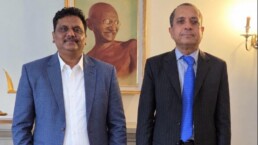
Dr. N Reuben Paul meets Indian Ambassador in Athens on Seafarers’ Welfare and Maritime issues
On the occasion of World Maritime Day, 24 September 2026, Dr. N. Reuben Paul, Chairman of the Merchant Navy Welfare Board (India) and…

Iran Says It Won’t Soften Demands as Trump Rejects Hormuz Offer
Iran stuck to its seven-day proposal for reopening the crucial Strait of Hormuz, saying it won’t soften its conditions, while…

xclusiv S&P Report 28th September 2026
Pls find below the [xclusiv] S&P Report 28th September 2026 [xclusiv] 2026_09_28
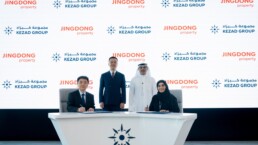
JINGDONG property establish advanced logistics facility in KEZAD
Company to build a 150,000 square-metre logistics facility that will strengthen Abu Dhabi’s logistics ecosystem Khalifa Economic Zones Abu Dhabi –…
Shipping’s transition being hampered by policy uncertainty
The shipping industry is at greater risk than ever of missing its 2030 zero-emission fuel targets, according to a new report. The latest edition of…
New cargo securing guidance prioritises personnel safety and reduces damage risks
The revised guidelines aim to protect personnel, reduce cargo damage and improve port efficiency. Lloyd’s Register has worked with Jurong Port in…
MSI forecasts firm dry bulk market into 2027, driving further newbuilding orders
Strong and volatile freight earnings are likely to continue into next year, supporting owners’ investment appetite in new tonnage Dry bulk vessel…
Subscribe to our newsletter!
if you dont want to swim alone in the ocean of news, sign up for the newsletter, and you will receive daily all the important news of world shipping!
