DNV forecasts oil demand in transport sector to half by 2050


Transport sector will be revolutionized by electrification but increase its share of overall emissions
- Transport has a severe emission challenge, its share of overall emissions grows from 25% today to 30% by 2050 as large part of the transport system will remain fossil fuel dependent.
- Transport of passengers and goods currently accounts for about a quarter of global energy-related CO2emissions and will grow to 30% by 2050.
- Maritime sector energy mix will compromise 50% low- and zero carbon fuels in 2050.
- Oil has staying power in aviation and maritime. Strong policies are needed to ensure necessary decarbonization to hydrogen and sustainable biofuel.
Electricity is continuing to gain traction in previously thought to be hard-to-electrify sectors including heavy trucking and aviation. Electricity’s share in transport will grow from 1% today to 23% in 2050, according to DNV’s latest Transport in Transition report.
DNV’s Transport in Transition report is a deep dive into the energy transition of transport – the most dynamic of the energy demand sectors through to 2050. The report draws on DNV’s system dynamics-based Energy Transition Outlook model and explores the vast changes in fuels, electricity and infrastructure needed to transport ever-larger numbers of people and volumes of freight while at the same time decarbonizing the sector.
Despite oil demand in the transport sector forecast to half by 2050, the present pace of the transition still falls severely short of the goals of the Paris Agreement. Opportunities to accelerate change through pilot projects and uptake of alternative energy need to be seized as soon as possible. Today, transport of passengers and goods accounts for about a quarter of global energy-related CO2 emissions, a share that will grow to 30% by 2050.
Road transport leads the way in reducing reliance of fossil fuels, falling from 38 million barrels per day (bpd) today, to 19 million bpd in 2050, reducing share from 91% to 57%. Conversely, the consumption of oil within aviation will be virtually flat to 2050, with hydrocarbons set to have a 60% share in the sector in the same year.
Driven by the decarbonization push, the fuel mix in the maritime sector will also change significantly over the coming decades. By 2050, it will likely transition from being almost entirely oil-based to an energy mix comprising of 50% low- and zero-carbon fuels, 19% natural gas and 18% biomass. Electricity will obtain only a 4% share, from short sea shipping and port stays for larger vessels.
Regions such as Europe, North America and Greater China are frontrunners in the uptake of battery electric vehicles (BEVs). In parallel, those regions are investing in hydrogen and hydrogen-based fuels as the most promising option for moving heavy goods over long distances. At the other end of the spectrum, regions including Sub Saharan Africa and North East Eurasia remain far away from establishing the infrastructure and producing the quantities of renewable electricity required to decarbonize road transport.

Remi Eriksen, Group President and CEO at DNV said: “Our Transport in Transition report highlights the challenges facing the industry and where further policies and investments are urgently needed to fast-track decarbonization of the transport sector. There is a pressing need for reliable non-fossil fuels to support emission reductions, particularly in the maritime and aviation sectors. It is essential that policy makers accelerate efforts to incentivize research and development, pilot projects and commercial uptake of carbon-neutral and zero-carbon fuels across the transport sector to support mid-century net zero goals.”
The report also underlines the clear challenge in deriving a single solution for the decarbonization of transport with a number of constraints associated to the adoption of biofuels, renewable electricity and CO2. There is no ‘one size fits all’ with a variety of energy sources needed to tackle the challenge in each sector, such as BEVs for passenger vehicles and trucks, fuel cell electric vehicles for the heaviest long-distance trucks, and bio- or hydrogen-based synthetic low or zero-carbon fuels for maritime and aviation.
Encouragingly, as the aviation sector strives to support decarbonization efforts, the results highlight that biofuels are set to supply a quarter of aviation demand by 2050. However, the report emphasises the importance of governmental and industry back-up to manage the rise in advanced biofuels for aviation and maritime, with the sustainable fuel expected to be more expensive than fossil fuel counterparts. On the other hand, for sectors that can use direct electrification, future users will gain from superb efficiency in electric drivetrains and experience cheaper transport.



Related News.

5th CSN Greece ICT Conference, Athens 19th November 2026 “Intelligent Skies, Secure Seas: The AI Impact on ICT” – Save the date
About the Conference The 5th CSN Greece Shipping ICT Conference, titled “Intelligent Skies, Secure Seas: The AI Impact on ICT”, will take place on…
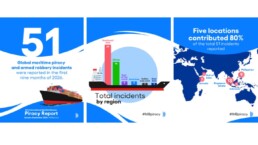
Maritime piracy incidents remain at historic lows despite Somali piracy concerns
The ICC International Maritime Bureau (IMB) has reported the lowest level (51) of piracy and armed robbery incidents since 1992 in the first nine…
Piraeus Port Authority main sponsor of Ferry Shipping Summit 2026
With the participation of more than 200 delegates from several European countries, the Ferry Shipping Summit 2026 took place on 8–9 October 2026 in…

EuroDry announces order for the construction of a third modern 82,000 DWT Kamsarmax Bulk Carrier
EuroDry , an owner and operator of drybulk vessels and provider of seaborne transportation for drybulk cargoes, announced that it has signed a…
India urges Russia, Ukraine to protect Black Sea shipping
India has urged both Russia and Ukraine to ensure safe passage for commercial shipping through the Black Sea as attacks on merchant vessels put…

PD Ports strengthens its commitment to the River Tees with multi-million pound Marine investment
PD Ports has officially opened a new multi-million-pound Marine facility on the banks of the River Tees, reinforcing its long-term commitment to the…

Maritime leaders head to Shanghai for the Annual Summit 2026
Shared seas, shifting horizons Maritime trade stands at a turning point. The rules-based order on which shipping has long depended is under…

Indian Register of Shipping grants type approval to Medha Energy’s 92 kWh LTO Lithium-Ion battery system
Indian Register of Shippinghas successfully completed the Type Approval process for the 92 kWh Lithium-Ion Battery System developed by M/s Medha…

KLine opens a Singapore New Hub for Consolidated Ship Management and Maritime Talenτ
Three Companies, One Roof — Singapore's New Hub for Consolidated Ship Management and Maritime Talenτ A ceremony for around 280 guests sets the stage…
ASA explores measures to Safeguard Free and Safe Navigation at Critical International Maritime Chokepoints
The Asian Shipowners’ Association which accounts for 56% of the world’s fleet capacity and consists of China, Cook Islands, Hong Kong, Japan, Korea…
Subscribe to our newsletter!
if you dont want to swim alone in the ocean of news, sign up for the newsletter, and you will receive daily all the important news of world shipping!
