KIMM conducts demonstration study of the world’s first Filter free indoor ultrafine particle reduction technology using electrostatic method


A technology that uses electrostatic method to reduce ultrafine particle without a filter was developed for the first time in the world.
□ The Korea Institute of Machinery and Materials , an institute under the jurisdiction of the Ministry of Science and ICT, has succeeded in the development of a filter-free air purifying technology to collect ultrafine particles using soft discharge and electrostatic precipitation, and clean collection plates by air spry and vacuum suction. KIMM initiated a full-scale demonstration study in subway stations such as waiting rooms, platforms, and tunnels which are extremely large indoor spaces.
□ Principal Researcher Kim Hak Joon and his research team in the Department of Sustainable Environment Research at KIMM’s Eco-Friendly Energy Conversion Research Division have developed a novel electrostatic precipitator with zero-ozone emission, low back-pressure and high clean air delivery rate. This technology uses microfiber discharge electrodes and non-metallic conductive plates to remove ultrafine particles within a very short time in a large subway station. When a soft discharge which consumes very low current at the micro electrode tips is generated, sufficient unipolar ions are generated without ozone generation and attached onto airborne ultrafine particles, and also the ions are sprayed in the subway station to charge more airborne particles in the station.
□ Any ultrafine particles that get charged by these ions are flowed into air handling units and air purifiers by their suction fans, and are collected in electrostatic precipitation units by electrostatic force. As the collected particles are accumulated on collection plates so the purification capacity of the removal device decreases, a strong airflow is generated in front of the particle collection unit to separate the contaminated dust from the unit. At the same time, a vacuum cleaner sucks in the detached dust from the back and keep the unit clean without using water spray which is a typical cleaning method for electrostatic precipitators.
□ The KIMM research team is currently conducting a full-scale demonstration experiment by installing air handling units and air purifiers equipped with this novel technology in the Yuseong Spa subway station in Daejeon, Korea. The results that have been obtained so far show that this technology can reduce the concentration of ultrafine particle in the inflowing air by up to 90%.
□ With the filter-type air purifying technology that has been commonly used up until now, when dust accumulates on the filter, it blocks airflow through air handling units and air purifiers resulting in a large pressure loss and consequently in a large amount of power consumption. In addition, the filters must be frequently replaced, resulting in replacement costs of at least billions of Korean won per year.
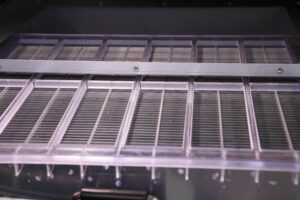
□ Typical air purifiers using the electrostatic precipitation method generate a lot of ozone by hard discharge which consumes a lot of currents at electrodes while creating ions, and the particle collectors must be washed with water during cleaning. Because of this cleaning method, there are several disadvantages, such as requiring at least one day to dry the collectors perfectly before applying high voltage to them, the possibility of freezing of water pipe in winter season, and the generation of a lot of wastewater.
□ Upon applying the newly developed technology by KIMM, almost no ozone is generated when the ions are created. Furthermore, by using air instead of water to clean the dust collector, there is no possibility of secondary pollution. This cleaning method also reduce power consumption by 80%, making it much more economical than conventional electrostatic methods.
□ KIMM’s new technology has been transferred to companies specializing in air cleaning technology, and commercialization is being pursued. In particular, On April 11, a PM2.5 Zero Living Lab will be installed at Daejeon Station Subway Station, where subway users can experience the novel technology and get useful information about how the air quality in subway stations is managed.
□ The principal researcher, Kim Hak Joon, of the Korea Institute of Machinery and Materials stated that this novel filter-free electrostatic precipitation technology is the only one that can quickly supply a large amount of clean air to a large indoor space like subway stations. He also added that the KIMM research team will continue to work toward solving the environmental problems in multi-use facilities such as buildings and schools caused by ultrafine particulate matters using world-first electrostatic technologies.
□ This research study was supported as part of the Basic Research Program funded by the Korea Institute of Machinery and Materials of “The ultra-clean machinery technologies of future electric generation or power systems against PM2.5 fine particles and greenhouse gases” and as part of Research Program “Development of low-cost, eco-friendly passive subway ultrafine dust reduction technology” to Solve Regional Convergence through NRF (National Research Foundation of Korea) both funded by Ministry of Science and ICT.



Related News.

Island Oil evolves into Island Energies
A new identity that honours the Island Oil legacy and moves the Group forward with confidence Island Oil Limited introduces its new corporate…

Crewing 5.0: How AI is Rewriting the Rules of Maritime Travel – Exclusive Interview with Crewpoint’s Marko Saul
Crew logistics has long been one of the most complex and manually intensive components of ship management, often reliant on travel systems designed…

WISTA International launches new Associate Membership category
WISTA International has introduced a new Associate Membership category, opening its global network to maritime organisations that are unable to…

Dr. N Reuben Paul meets Indian Ambassador in Athens on Seafarers’ Welfare and Maritime issues
On the occasion of World Maritime Day, 24 September 2026, Dr. N. Reuben Paul, Chairman of the Merchant Navy Welfare Board (India) and…

Iran Says It Won’t Soften Demands as Trump Rejects Hormuz Offer
Iran stuck to its seven-day proposal for reopening the crucial Strait of Hormuz, saying it won’t soften its conditions, while…

xclusiv S&P Report 28th September 2026
Pls find below the [xclusiv] S&P Report 28th September 2026 [xclusiv] 2026_09_28
JINGDONG property establish advanced logistics facility in KEZAD
Company to build a 150,000 square-metre logistics facility that will strengthen Abu Dhabi’s logistics ecosystem Khalifa Economic Zones Abu Dhabi –…
Shipping’s transition being hampered by policy uncertainty
The shipping industry is at greater risk than ever of missing its 2030 zero-emission fuel targets, according to a new report. The latest edition of…

New cargo securing guidance prioritises personnel safety and reduces damage risks
The revised guidelines aim to protect personnel, reduce cargo damage and improve port efficiency. Lloyd’s Register has worked with Jurong Port in…
MSI forecasts firm dry bulk market into 2027, driving further newbuilding orders
Strong and volatile freight earnings are likely to continue into next year, supporting owners’ investment appetite in new tonnage Dry bulk vessel…
Subscribe to our newsletter!
if you dont want to swim alone in the ocean of news, sign up for the newsletter, and you will receive daily all the important news of world shipping!
