Small propeller defects can result in increased underwater radiated noise


The slightest deviation in the machining, polishing, and finishing of ships’ propeller blades could result in underwater radiated noise and cavitation, even if defects are within the maximum tolerance allowed by classification societies and the ISO 484-1 standard.
A Canada Transport-funded study on the impact of manufacturing tolerances on propeller performance – carried out by Memorial University of Newfoundland, DRDC Atlantic Research Centre, and propeller manufacturer Dominis Engineering – found the slightest change in propeller geometry resulted in “significant” cavitation, and much earlier than previously thought.
The behaviour of a section of propeller blade with leading edge defects of 94µm, 250µm and 500µm were studied using Computational Fluid Dynamics (CFD) at the DRDC-Atlantic Research Centre, and Memorial University of Newfoundland, in a three-year project that concluded last year.
Project lead, Dominis Engineering President Bodo Gospodnetic, said: “Experimental results show that current widely accepted propeller manufacturing tolerances as stated in the ISO standard need to be thoroughly evaluated and investigated further.”
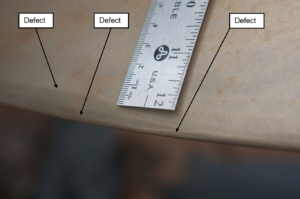
The current tolerance for a defect to the leading edge of a propeller blade is 500µm (0.5mm).
Ship propellers are manufactured according to ISO 484-1, with the majority of propellers made from castings rough machined on CNC (Computer Numerically Controlled) mills and then finished using robotic and manual grinding. However, robotic and manual grinding of propeller surfaces introduces inaccuracies and deviations from the approved design, which can lead to cavitation, erosion, noise, vibration and loss of propeller efficiency.
“The leading-edge is a very challenging area to manufacture accurately yet it has a strong influence on sheet, streak and vortex cavitation,” said Gospodnetic.
Researchers found that a ship with “defective” propeller must travel at a given percentage slower than a vessel with a “correct” propeller to operate below the cavitation inception speed and remain quiet. For example, a ship with a propeller defect of 0.5mm would have to sail at 45% of the speed of a defect-free propeller to avoid cavitation noise. The smaller the defect, the less speed reduction is required to remain quiet.
“The 0.5mm defect tested is one of the tightest ISO 484-1 propeller manufacturing tolerances yet it has been demonstrated that it affects cavitation inception significantly and detrimentally. The rules need tightening up,” said Gospodnetic.
ISO 484-1:2015 has been a standard for propellers since 1982 and although the standard was reviewed in 2015 and 2022, the allowable tolerance and geometry remains unchanged.
“We know that 80% of underwater radiated noise comes from the propeller, but if ships are legislated to be quiet in sensitive habitats such as the Juan de Fuca Strait then they will have to limit their speed to below the cavitation inception speed,” said Gospodnetic.
While initial CFD studies show how very small defects can influence cavitation inception research partners are looking for funding to continue their investigation in second phase model tests in a cavitation tunnel.
The research paper can be viewed in full by clicking on this link



Related News.

5th CSN Greece ICT Conference, Athens 19th November 2026 “Intelligent Skies, Secure Seas: The AI Impact on ICT” – Save the date
About the Conference The 5th CSN Greece Shipping ICT Conference, titled “Intelligent Skies, Secure Seas: The AI Impact on ICT”, will take place on…
Maritime piracy incidents remain at historic lows despite Somali piracy concerns
The ICC International Maritime Bureau (IMB) has reported the lowest level (51) of piracy and armed robbery incidents since 1992 in the first nine…

Piraeus Port Authority main sponsor of Ferry Shipping Summit 2026
With the participation of more than 200 delegates from several European countries, the Ferry Shipping Summit 2026 took place on 8–9 October 2026 in…

EuroDry announces order for the construction of a third modern 82,000 DWT Kamsarmax Bulk Carrier
EuroDry , an owner and operator of drybulk vessels and provider of seaborne transportation for drybulk cargoes, announced that it has signed a…
India urges Russia, Ukraine to protect Black Sea shipping
India has urged both Russia and Ukraine to ensure safe passage for commercial shipping through the Black Sea as attacks on merchant vessels put…

PD Ports strengthens its commitment to the River Tees with multi-million pound Marine investment
PD Ports has officially opened a new multi-million-pound Marine facility on the banks of the River Tees, reinforcing its long-term commitment to the…

Maritime leaders head to Shanghai for the Annual Summit 2026
Shared seas, shifting horizons Maritime trade stands at a turning point. The rules-based order on which shipping has long depended is under…
Indian Register of Shipping grants type approval to Medha Energy’s 92 kWh LTO Lithium-Ion battery system
Indian Register of Shippinghas successfully completed the Type Approval process for the 92 kWh Lithium-Ion Battery System developed by M/s Medha…

KLine opens a Singapore New Hub for Consolidated Ship Management and Maritime Talenτ
Three Companies, One Roof — Singapore's New Hub for Consolidated Ship Management and Maritime Talenτ A ceremony for around 280 guests sets the stage…

ASA explores measures to Safeguard Free and Safe Navigation at Critical International Maritime Chokepoints
The Asian Shipowners’ Association which accounts for 56% of the world’s fleet capacity and consists of China, Cook Islands, Hong Kong, Japan, Korea…
Subscribe to our newsletter!
if you dont want to swim alone in the ocean of news, sign up for the newsletter, and you will receive daily all the important news of world shipping!
