Revised regulations will provide clear framework for innovation in maritime

Rules governing workboats, pilot boats and remotely operated vessels have been revised and remade to support innovation in industry.
The revised Merchant Shipping Regulations 2022 and accompanying Code is now going out for consultation across the industry.
It is felt the new version of the Code will help clarify the survey and inspection requirements and also addresses the growing autonomous vessel industry. Existing rules did not reflect those and other developments which is why the regulations and Code have been revised.
Rob Taylor, Code Vessel Lead for the Maritime and Coastguard Agency said: “We don’t compromise on safety. It’s as simple as that, so the safety underpinning these regulations will not change.
“However, we needed to reflect the fact that there is innovation happening right across the industry and we want to support that with appropriate regulations and guidelines. That’s led to this work to provide a clear framework so that vessel owners and operators can continue to operate in confident that they are fulfilling their legal obligations.”
The consultation is due to last 12 weeks and the link can be found here.
Background
This is a consultation on revoking and remaking the Merchant Shipping (Small Workboats and Pilot Boats) Regulations 1998 (S.I. 1998/1609) (“the 1998 Regulations”) with amendments and modifications that will then provide a coherent legal framework for operators of workboats and pilot boats.
It will clarify the survey and certification requirements and responsibilities and updating the Code of Practice to reflect the current international standards that apply to these vessels and the equipment carried on board. This instrument also introduces new provisions for remotely operated unmanned vessels which now operate in this sector.
The original Code of Practice for the Safety of Small Workboats and Pilot Boats was one of four Codes of Practice published for small commercial vessels operating in UK waters under a common set of standards. The Code set a national standard and was generally accepted by industry because it could be easily referenced and understood, and it created a level playing field within the sector. The Code was also recognised internationally and is used by other national maritime administrations as a basis for standards of their own vessels. As a result, UK flagged workboats were able to win contracts and operate widely across the UK and the rest of Europe.



Related News.

5th CSN Greece ICT Conference, Athens 19th November 2026 “Intelligent Skies, Secure Seas: The AI Impact on ICT” – Save the date
About the Conference The 5th CSN Greece Shipping ICT Conference, titled “Intelligent Skies, Secure Seas: The AI Impact on ICT”, will take place on…
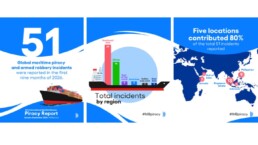
Maritime piracy incidents remain at historic lows despite Somali piracy concerns
The ICC International Maritime Bureau (IMB) has reported the lowest level (51) of piracy and armed robbery incidents since 1992 in the first nine…
Piraeus Port Authority main sponsor of Ferry Shipping Summit 2026
With the participation of more than 200 delegates from several European countries, the Ferry Shipping Summit 2026 took place on 8–9 October 2026 in…

EuroDry announces order for the construction of a third modern 82,000 DWT Kamsarmax Bulk Carrier
EuroDry , an owner and operator of drybulk vessels and provider of seaborne transportation for drybulk cargoes, announced that it has signed a…

India urges Russia, Ukraine to protect Black Sea shipping
India has urged both Russia and Ukraine to ensure safe passage for commercial shipping through the Black Sea as attacks on merchant vessels put…

PD Ports strengthens its commitment to the River Tees with multi-million pound Marine investment
PD Ports has officially opened a new multi-million-pound Marine facility on the banks of the River Tees, reinforcing its long-term commitment to the…

Maritime leaders head to Shanghai for the Annual Summit 2026
Shared seas, shifting horizons Maritime trade stands at a turning point. The rules-based order on which shipping has long depended is under…
Indian Register of Shipping grants type approval to Medha Energy’s 92 kWh LTO Lithium-Ion battery system
Indian Register of Shippinghas successfully completed the Type Approval process for the 92 kWh Lithium-Ion Battery System developed by M/s Medha…

KLine opens a Singapore New Hub for Consolidated Ship Management and Maritime Talenτ
Three Companies, One Roof — Singapore's New Hub for Consolidated Ship Management and Maritime Talenτ A ceremony for around 280 guests sets the stage…
ASA explores measures to Safeguard Free and Safe Navigation at Critical International Maritime Chokepoints
The Asian Shipowners’ Association which accounts for 56% of the world’s fleet capacity and consists of China, Cook Islands, Hong Kong, Japan, Korea…
Subscribe to our newsletter!
if you dont want to swim alone in the ocean of news, sign up for the newsletter, and you will receive daily all the important news of world shipping!
