New independent study confirms bio-LNG’s role in shipping’s decarbonisation

A new study commissioned by SEA-LNG has found that liquified bio-methane can make a major contribution to maritime decarbonisation.
Conducted by the Maritime Energy and Sustainable Development Centre of Excellence at Nanyang Technological University, Singapore , the study explored questions around fuel availability, cost, lifecycle emissions and logistics, providing an overview of the applicability of bio-LNG as marine fuel. It also investigated the feasibility of LNG and bio-LNG as a realistic pathway for the shipping industry to achieve greenhouse gas emission reduction targets in a sustainable manner.
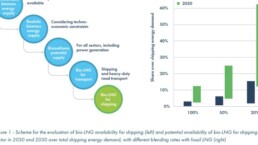
Bio-LNG can be blended with fossil LNG in relatively small amounts to reach the 2030 International Maritime Organization targets and the biofuel proportion in the mix can be increased to meet 2050 targets.
The findings suggest that pure bio-LNG could cover up to 3% of the total energy demand for shipping fuels in 2030 and 13% in 2050. If it is considered as a drop-in fuel blended with fossil LNG, bio-LNG could cover up to 16% and 63% of the total energy demand in 2030 and 2050, respectively, assuming a 20% blending ratio. In the long term, shipowners who have invested in the LNG pathway will need to shift to renewable synthetic LNG (e-LNG).
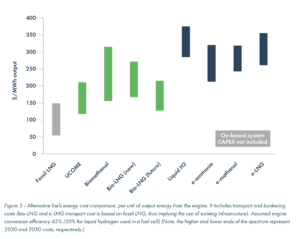
The report also forecasts that the average cost for delivered bio-LNG will fall by 30% by 2050 compared to today’s values, mainly driven by the reduced cost of producing biomethane in large-scale anaerobic digestion plants. This makes bio-LNG one of the cheapest sustainable alternative marine fuels, compared to biomethanol and electro-fuels, including e-ammonia and e-methanol.
Furthermore, the report highlights that the uptake of bio-LNG in shipping will be linked to the widespread use of biomethane across other sectors. This will require national and international standards for biomethane injection into gas grids, plus a commonly accepted certificates of origin scheme to efficiently trade biomethane in its gaseous and liquefied forms and to minimise transportation costs.
Peter Keller, Chairman, SEA-LNG, said: “The decarbonisation of shipping will require the use of multiple low and zero carbon fuels. Every fuel has its own individual, but similar, pathway to net zero. When assessing decarbonisation options for the maritime sector it is essential that each pathway is properly evaluated, not simply the destination. It is crucial that decision making is guided by accurate information that assesses each alternative fuel pathway on a like-for-like and full life-cycle basis (Well-to-Wake).”
Keller added: “The viability of the LNG pathway depends on the volumes of bio-LNG and e-LNG that become available to the shipping industry, and the cost of these fuels in comparison to other zero or low carbon fuels. This latest study from the Maritime Energy and Sustainable Development Centre of Excellence at Nanyang Technological University, Singapore, confirms that bio-LNG is a solution for the decarbonisation of the shipping sector thanks to the mature and commercially available technologies for fuel production and use on-board, existing delivery infrastructure plus the competitive cost compared to other sustainable biofuels and electro-fuels.”
Associate Professor Jasmine Lam, Centre Director, MESD CoE, NTU Singapore, said: “Our research concludes that bio-LNG, produced from sustainable biomass resources, has the potential to meet a significant proportion of future shipping energy demand. The findings show that bio-LNG is among the cheapest sustainable biofuels and can potentially offer significant cost advantage over electrofuels by 2050.”
Bruno Piga, Research Consultant for MESD CoE, NTU Singapore, added: “Bio-LNG can provide up to 80% greenhouse gas emissions reductions compared to marine diesel if methane leakage in the production process and on-board methane slip are minimised. It can be used as a drop-in fuel in existing LNG-fuelled engines and can also be transported, stored and bunkered in ports using the existing LNG infrastructure. This reduces logistics costs considerably compared with other alternative fuels.”
For more information and to download the full report and key findings, please visit the SEA-LNG website here.



Related News.
5th CSN Greece ICT Conference, Athens 19th November 2026 “Intelligent Skies, Secure Seas: The AI Impact on ICT” – Save the date
About the Conference The 5th CSN Greece Shipping ICT Conference, titled “Intelligent Skies, Secure Seas: The AI Impact on ICT”, will take place on…
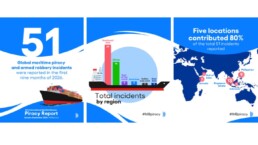
Maritime piracy incidents remain at historic lows despite Somali piracy concerns
The ICC International Maritime Bureau (IMB) has reported the lowest level (51) of piracy and armed robbery incidents since 1992 in the first nine…
Piraeus Port Authority main sponsor of Ferry Shipping Summit 2026
With the participation of more than 200 delegates from several European countries, the Ferry Shipping Summit 2026 took place on 8–9 October 2026 in…
EuroDry announces order for the construction of a third modern 82,000 DWT Kamsarmax Bulk Carrier
EuroDry , an owner and operator of drybulk vessels and provider of seaborne transportation for drybulk cargoes, announced that it has signed a…
India urges Russia, Ukraine to protect Black Sea shipping
India has urged both Russia and Ukraine to ensure safe passage for commercial shipping through the Black Sea as attacks on merchant vessels put…
PD Ports strengthens its commitment to the River Tees with multi-million pound Marine investment
PD Ports has officially opened a new multi-million-pound Marine facility on the banks of the River Tees, reinforcing its long-term commitment to the…
Maritime leaders head to Shanghai for the Annual Summit 2026
Shared seas, shifting horizons Maritime trade stands at a turning point. The rules-based order on which shipping has long depended is under…
Indian Register of Shipping grants type approval to Medha Energy’s 92 kWh LTO Lithium-Ion battery system
Indian Register of Shippinghas successfully completed the Type Approval process for the 92 kWh Lithium-Ion Battery System developed by M/s Medha…
KLine opens a Singapore New Hub for Consolidated Ship Management and Maritime Talenτ
Three Companies, One Roof — Singapore's New Hub for Consolidated Ship Management and Maritime Talenτ A ceremony for around 280 guests sets the stage…
ASA explores measures to Safeguard Free and Safe Navigation at Critical International Maritime Chokepoints
The Asian Shipowners’ Association which accounts for 56% of the world’s fleet capacity and consists of China, Cook Islands, Hong Kong, Japan, Korea…
Subscribe to our newsletter!
if you dont want to swim alone in the ocean of news, sign up for the newsletter, and you will receive daily all the important news of world shipping!
