Port of Rotterdam Authority presents future scenarios for 2050


The world is changing rapidly. More than ever, our future is uncertain. Especially now, it is important to prepare by exploring this future
Understanding what the future might look like is important so that the Port of Rotterdam Authority can respond accordingly. What investments are needed to attract new freight flows, business and clean energy? Where should adjustments be made?
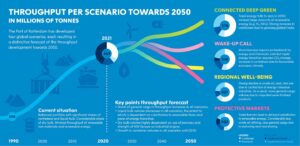
The Port of Rotterdam Authority has developed four diverse global scenarios in detail. Central to these analyses was the issue of how changes in geopolitics, economics, society and technology would impact the port-industrial complex and the size and composition of the port’s throughput. Will there be a global focus on ambitious climate action or will the energy transition stall? Will power blocks erect trade barriers to protect their own industries or will free trade be allowed to flourish? Do consumers prefer quality over price or the exact opposite?
The four scenarios towards 2050 and their corresponding concise story lines are:
- Connected Deep Green: Effective global cooperation with acceleration on digital transparency in logistics chains and global commitment to targets to combat climate change, resulting in global carbon neutrality by 2050, broad prosperity and high economic growth and a maximum temperature rise of 1.5 degrees Celcius this century.
- Regional Well-Being: From a shared commitment to transition, in the absence of sufficient global trust, a tilt towards a regional focus on clean and healthy environments, privacy and well-being emerges within clusters of countries by early 2030. This results in a deteriorating business environment for basic industry in north-western Europe and moderate economic growth.
- Protective Markets: A world with distrust between power blocks, global geopolitical tensions and suboptimal integration in logistics chains. There are competing economic interests in a fragmented world with focus on self-sufficiency, financial prosperity, resilience and defence. No global carbon neutrality before 2100 and low economic growth.
- Wake-Up Call: Increasing concerns about the economic impact of external shocks such as food and energy availability or extreme weather mark a turning point. There is growing awareness that strategic cooperation and rigorous measures are needed to reduce carbon emissions. This results in strategically strong EU policies, moderate economic growth and late but rapid transition to renewable energy.
- The impact of each scenario has on throughput in the port of Rotterdam is summarised in the infographic below:
Allard Castelein, CEO of Port of Rotterdam Authority: “These latest estimates show that our portfolio will radically change in the next 30 years. The global scenarios help us to strengthen the position of the port-industrial complex in a targeted manner by focusing on sufficient production and processing capacity, good connectivity with key hinterland markets and accelerating sustainability.”



Related News.
5th CSN Greece ICT Conference, Athens 19th November 2026 “Intelligent Skies, Secure Seas: The AI Impact on ICT” – Save the date
About the Conference The 5th CSN Greece Shipping ICT Conference, titled “Intelligent Skies, Secure Seas: The AI Impact on ICT”, will take place on…
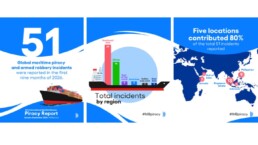
Maritime piracy incidents remain at historic lows despite Somali piracy concerns
The ICC International Maritime Bureau (IMB) has reported the lowest level (51) of piracy and armed robbery incidents since 1992 in the first nine…
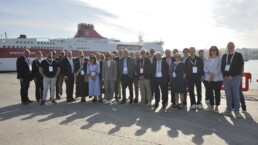
Piraeus Port Authority main sponsor of Ferry Shipping Summit 2026
With the participation of more than 200 delegates from several European countries, the Ferry Shipping Summit 2026 took place on 8–9 October 2026 in…
EuroDry announces order for the construction of a third modern 82,000 DWT Kamsarmax Bulk Carrier
EuroDry , an owner and operator of drybulk vessels and provider of seaborne transportation for drybulk cargoes, announced that it has signed a…
India urges Russia, Ukraine to protect Black Sea shipping
India has urged both Russia and Ukraine to ensure safe passage for commercial shipping through the Black Sea as attacks on merchant vessels put…
PD Ports strengthens its commitment to the River Tees with multi-million pound Marine investment
PD Ports has officially opened a new multi-million-pound Marine facility on the banks of the River Tees, reinforcing its long-term commitment to the…
Maritime leaders head to Shanghai for the Annual Summit 2026
Shared seas, shifting horizons Maritime trade stands at a turning point. The rules-based order on which shipping has long depended is under…
Indian Register of Shipping grants type approval to Medha Energy’s 92 kWh LTO Lithium-Ion battery system
Indian Register of Shippinghas successfully completed the Type Approval process for the 92 kWh Lithium-Ion Battery System developed by M/s Medha…
KLine opens a Singapore New Hub for Consolidated Ship Management and Maritime Talenτ
Three Companies, One Roof — Singapore's New Hub for Consolidated Ship Management and Maritime Talenτ A ceremony for around 280 guests sets the stage…
ASA explores measures to Safeguard Free and Safe Navigation at Critical International Maritime Chokepoints
The Asian Shipowners’ Association which accounts for 56% of the world’s fleet capacity and consists of China, Cook Islands, Hong Kong, Japan, Korea…
Subscribe to our newsletter!
if you dont want to swim alone in the ocean of news, sign up for the newsletter, and you will receive daily all the important news of world shipping!
