North Member Decarbonisation Journey signals multiple routes to sustainability

Launch of a North P&I Club’s Member Decarbonisation Journey Series on strategies for more sustainable shipping sees the first two plans confirm that no ‘One size fits all’.
As North P&I Club Members make firm choices on the routes they believe will lead towards net zero shipping, the marine insurer has launched the ‘Member Decarbonisation Journey Series’, a set of briefings offering transparency on the available options.
Part of the ‘Navigating Decarbonisation’ initiative through which North is sharing its expertise on the risks and rewards of strategies for ship sustainability, the Decarbonisation Journey series is described by Loss Prevention Executive, Mark Smith, as “in the spirit of mutuality”. In the interests of industry transparency, it has been devised to offer harmonised insights into the way Members plan to meet the International Maritime Organization targets for shipping to reduce CO2 emissions.
First to report have been longstanding North Members, d’Amico International Shipping (DIS) and Eastern Pacific Shipping (EPS). Instantly, two well-known shipping organisations have provided an example of the way operational considerations can drive companies adhering to the highest quality standards can arrive at different conclusions.
Transition through LNG
Capt. Anil Singh, Chief Operating Officer of Eastern Pacific Shipping (EPS), explains the ship manager’s approach to decarbonisation as a “holistic alternative marine fuel programme”.
“Nobody knows yet which technologies or alternative energy sources will lead us to net zero, but we do know that today there are already proven solutions available to lower emissions,” he says. “LPG, ethane, ammonia and methanol are going to be the way forward for EPS’ dual-fuel fleet.”
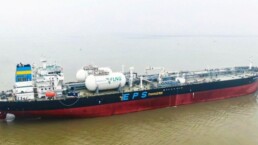
In the immediate term, however, “LNG is widely available in the market and proven to lower carbon dioxide, sulphur oxide, nitrogen oxide and particulate matter levels.” In what is believed to be a world-first for a vessel of its type, EPS has chosen dual fuel engines including LNG as a fuel to power a Long Range -2 (LR-2) tanker.
EPS’ submission to the North Decarbonisation Journey series highlights LNG for its transitional role as a marine fuel that helps reduce carbon footprint per ton-mile of cargo transported. “It’s a step in the right direction towards the IMO goal of reduced emissions”, the company says, and “positions EPS as a transportation provider of choice in the shipping industry whilst attracting charterers”.
The ABS-classed LR2 tanker Atlantic Jade (110,000 dwt), delivered in the first half of 2022, features two ‘Type-C’ LNG fuel tanks to enable transits of up to 18,000 miles. With fuel tanks positioned on deck to prevent reduction of cargo carrying capacity, LNG fuel is pumped to the main engines via a Pump Vaporiser Unit (PVU), while three generators and two auxiliary boilers feed off compressed boil-off gas (BOG) from the LNG tanks. The auxiliary engines could also run on distillate, residual fuels, or biofuels/biodiesel blends.
EPS notes that bunkering LNG takes longer than traditional fuels, also highlighting safety as paramount – and the necessary mitigation provided by alarms, trips and emergency shut down devices, plus full crew training and certification for LNG as a fuel.
Longer term, EPS also says its dual fuel strategy will allow ships to be powered by other liquid marine fuels “including – but not limited to – biofuels, distillates, and residual fuels”, with switching between fuels achieved “without loss of speed or power”. However, broadly speaking, Capt. Singh earmarks biofuels as “reserved for legacy tonnage, which are still being phased out”.
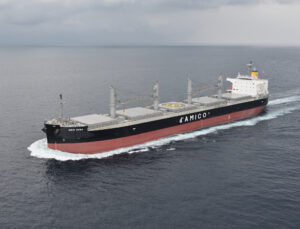
Where North’s Member Decarbonisation Journey is concerned, the position has special piquancy because product tanker owner DIS has committed to a sustainable biofuel blend as its preferred candidate for use aboard its LR1 Tankers.
Drop-in biofuels
Salvatore d’Amico, d’Amico Fleet Director, says: “While we closely monitor the development of alternative fuels of the future and new propulsion technologies, and invest in innovative digital designs, we believe that using biofuel blends can speed up decarbonisation of existing tonnage with immediate effect. Drop-in solutions bring an immediate benefit to the environment with very low investment.”
The entire DIS fleet of LR1 product tankers has now been certified for operation on a ‘B30’ biofuel blend, whose formulation includes 30% biofuel derived from renewable feedstock.
The DIS Decarbonisation Journey document has ship personnel reporting biofuels as easy to handle during trials carried out with Trafigura, engine makers and classification societies on the DIS vessels Cielo di Rotterdam and Medi Roma. The trials also showed the blend achieving CO2 emission reductions of up to 30%, and 24.4% gains in terms of the Carbon Intensity Indicator (CII) developed by IMO.
It is important to note that these calculations are based on the impact of biofuels ‘well to wake’, where IMO’s CII scale is currently based on ‘tank to wake’ impacts. However, DIS also notes that biofuels provide a viable solution to comply with the Fuel EU regulation entering into force in 2025.
Tank cleaning and fuel system flushing are necessary, while care is advisable on cylinder oil injection rates – although but no specific recommendations are made on lubricant selection. The potential for microbial growth is also manageable, whether through regular testing or biocide dosing if necessary.
Based on proven standards for quality and testing (respectively, EN and ISO), the blend’s characteristics mean that, subject to a full risk assessment and modified fuel handling, it can be dropped in without any adjustment to engine parameters, DIS says.

As North’s Mark Smith emphasises, therefore: “For ship owners and managers today, there is no ‘one size fits all’ solution. There are many variables involved in owning and operating different ship types, and that means different companies will inevitably choose the option that best suits their operational requirements when seeking to meet IMO targets.
”Over time, a range of different operational technologies and fuel choices will emerge as our industry transitions to a low carbon future.”



Related News.

Navigating the Multi-Orbit Era: In Conversation with Intellian’s Jon Harrison at SMM 2026
At SMM 2026 in Hamburg, the rapid evolution of maritime satellite communications took centre stage. Across the exhibition halls, discussions among…
Cyprus ports need joint energy and investment strategy, shipping agents chief says
Cyprus needs a coordinated strategy for shipping, energy and environmental protection to support port investment and modernisation, Cyprus shipping…

MASO Public Affairs introduces MASO Regulatory Intelligence
A new subscription service helping businesses understand what is changing and what it means for them MASO Public Affairs introduces MASO Regulatory…
Anglo-Eastern helps turn CMBTECH’s ammonia ambition into an operational reality
From early feasibility study and risk-based design to newbuilding supervision, crew readiness and technical management, Anglo-Eastern drew on its…

Escalation of attacks threatens to derail recovery in Middle East oil exports
World oil demand is forecast to fall by 2.5 mb/d y-o-y in 4Q26 and 2.6 mb/d on average in 2026. As the Iran war manifests itself through restricted…
New study finds shipping pays twice its share to EU ETS earmarked revenues should triple to help build market for sustainable fuels and technologies
Shipping is responsible for around 10% of EU ETS emissions but pays almost 20% of the ETS bill. Unlike other sectors, it has never received free…

MSARC strengthens maritime mass rescue readiness through training and national live exercise off Dakar, Senegal
Joint MSARC–FHAS programme combines three days of SAR training with a national multi-agency live exercise The Maritime Search and Rescue Council ,…
Sogese report deliveries are still being delayed as container freight rates fluctuate
FOR IMPORTERS Spot rates into the Mediterranean are back at January levels, Far East to Europe reliability sits at pandemic lows, and nearly…
Glencore begins trading on Australian Securities Exchange
Glencore has begun trading on the Australian Securities Exchange under the ASX code GLC. Gary Nagle, Glencore’s CEO, said it was an exciting day for…
BIMCO Shipping Number of the Week
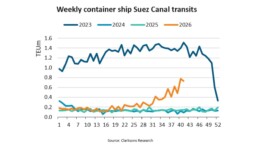
Suez Canal container ship transits exceed 50% of pre-disruption levels "During the first two weeks of October, weekly container ship capacity…
Subscribe to our newsletter!
if you dont want to swim alone in the ocean of news, sign up for the newsletter, and you will receive daily all the important news of world shipping!
