Is THOR’s superpower shipping’s silver bullet?
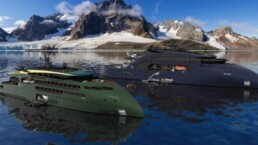

Shipbuilder and designer Ulstein is looking to take its revolutionary Thorium powered vessel concept from the drawing board to the deep blue sea. Is this the solution that industry, and society, have been searching for to enable a truly sustainable maritime future?
Everything about the launch of ULSTEIN THOR was unexpected.
The vessel concept, a 149m 3R design with a Thorium Molten Salt Reactor, took the industry, and wider society, by surprise. Its unveiling at Seatrade, Miami in late April unleashed a wave of global media coverage, spilling over beyond the trade press onto news platforms like CNN, kickstarting countless conversations about the future of Thorium as one of the most viable sources of clean energy for deep sea shipping.
No one was as taken aback as Ulstein’s Chief Designer Øyvind G. Kamsvåg.
“I think we’d been operating in a bit of a bubble,” he says, from Ulstein’s base in the spectacular surroundings of Ulsteinvik on the west coast of Norway. “We were excited, of course, but had no idea it’d take off in this way – that other stakeholders, from maritime and beyond, would seize on the potential and huge commercial and environmental opportunity here.”
He continues: “I think the timing has been absolutely critical. I mean we’ve been thinking about Thorium and nuclear vessels since 2008, but we didn’t know if the industry was ready. Now, clearly, it is! So, how can we take this from the drawing board to operation as a key enabler for a sustainable maritime industry?
“That’s the next, critical step… and we’re not alone in being keen to move forwards.”
THOR to the rescue
Kamsvåg’s reference to the concept as a “a key enabler” is one of the aspects that supercharged interest in what was almost immediately recognised as so much more than a standalone vessel concept.
At the time of its launch, Ulstein presented the idea as a way to charge an all-electric cruise ship concept, ULSTEIN SIF, demonstrating its commercial viability. However, its potential was seen to stretch far beyond that, as Kamsvåg now reveals.
“THOR has a superpower, right?” he smiles. “And there’s a multitude of applications and operational capabilities where that can be utilised. Beyond the zero emissions and remote replenishment, research and rescue functionality, the vessel’s reactor could be used as an emergency power supply for regions hit by natural disasters, epidemics, or conflicts.
“Similarly, it could be utilised as part of society’s renewable energy mix and compensate for fluctuating power supplies – e.g., from offshore wind parks – by supporting grid networks. The huge power capacity available could also be utilised for producing alternative fuels, or synthetic fuels through a CO2 refinery, or for delivering shore power at ports.
“And all that functionality is before we even get on to the different vessel types where THOR can either be used to recharge all-electric ships, or integrated MSRs can be housed within vessels as the primary power source.”
An almost breathless Kamsvåg notes, “that’s pretty much all of deep-sea shipping”, before taking a brief pause.
Let’s do the same.
Tomorrow’s solutions today
Ulstein, for those unfamiliar with the relatively small, privately-owned business, is renowned within its niche for delivering innovations that shift industry paradigms. The most obvious are the X-BOW and the X-STERN; sloping designs that glide through the oceans to deliver greater operability, comfort, operational functionality and energy efficiency. June saw the company sign its first contract to design TWIN X-STERN offshore wind CSOVs (construction service operating vessels) with dual-fuel methanol engines: an agreement that shows how Ulstein takes an effective, step-change approach on the path to a zero emissions future.
“We always design with the best solution in mind for the application,” Kamsvåg notes, “but we’re guided by our vision to create tomorrow’s solutions for sustainable marine operations. That’s driven all our innovations – from the X-BOW to hybrid and electric solutions – and THOR is clearly connected to that creative ‘red thread’.”
The headline grabber with the concept was undoubtedly the use of the MSR, which works by dissolving Thorium – an abundant, naturally occurring metal with low radioactivity – in liquid salt. This creates a chain reaction that heats the salt, producing steam to drive a turbine and generate emissions free electricity. The technology is proven and safe, but, until Ulstein took centre stage, had yet to be incorporated into a vessel design.
However, it was the application that proved as stimulating for stakeholders as the energy source, as Torill Muren, Lead Naval Architect, Ulstein Design & Solutions, makes clear.
Enabling change
“THOR essentially operates as a floating, mobile, multi-purpose ‘power station’,” she says, “one that never needs refuelling – instantly creating the ocean infrastructure needed to facilitate a new battery revolution.
“In THOR’s case, it would offer the charging capacity to satisfy the power needs of four expedition cruise ships (ULSTEIN SIFs), as well as providing research facilities for polar operations, and acting as a rescue vessel for remote regions where there is simply no emergency response capacity.
“We see it as the missing piece of the puzzle when it comes to enabling safe, sustainable operations, anywhere on Earth. As such, it really does have the capability to transform our industry.”

Electric revolution
It’s this potential that really captures the imagination.
At present, there’s no “silver bullet” for deep sea maritime, with heated debate on which fuel will accelerate the industry towards the zero emissions horizon. Batteries are already established within short sea circles and THOR – when solid-state batteries come online – could literally transfer the same development to the deep for relevant segments, while others use integrated MSRs as their dedicated power source.
Again, it’s a question of infrastructure.
“Look at the adoption of electric cars in Norway,” says Kamsvåg, by way of comparison. “65% of all cars sold in Norway last year were electric, with that figure rising to 84% in January 2022. Nobody that needs a car wants to wreck the environment, but you must have the charging infrastructure in place to enable a meaningful switch to zero emissions transport; something that has been achieved with great success in Norway. THOR, or a concept like it, is the solution for establishing that same charging infrastructure at sea.
“In fact,” he continues, “that’s such a unique commercial opportunity. Why doesn’t somebody, a wealthy individual or a progressive company, buy a fleet of THORs and suddenly create a network of floating charging stations to power green shipping? What an amazing opportunity for a new, sustainable revenue stream. The possibilities of this are almost limitless.”
Generating interest
“Limitless” is a phrase that also works to describe the interest in THOR since it thundered onto the scene at Seatrade. Ulstein says it has been inundated with enquiries and media requests from people eager to probe the feasibility of MSRs and the concept, and, Muren states, it’s all been positive.
“We expected some pushback,” she notes, “but apart from a few outlying comments here and there on social media it’s been universally enthusiastic. The Class societies we’ve spoken to are, if anything, eager to push this and look into the idea of drafting approvals in principle and white papers. At the same time research is gathering momentum, with new funding just allocated by the Norwegian Research Council (NFR) for a maritime nuclear power project at the Norwegian University of Science and Technology (NTNU).
“We know that technology developers and suppliers very clearly see the potential, Flag States have, so far, seemed very positive, and forward-thinking clients are intrigued by the idea of a reliable, emissions free and stable source of power.”
The word “stable” brings Kamsvåg back into the conversation, with the topic of timing resurfacing.
Accelerating innovation
“I think that’s been key,” he states. “The war in Ukraine and the shifting geopolitical situation have demonstrated the need for energy security, or even self-sufficiency, while the very pressing demand for transitioning to more sustainable ways of doing business is top of everyone’s agendas now. We need to take action to change, and THOR, and Thorium, demonstrate a tangible way forward.”
But, is this feasible? Can it work? And when?
Kamsvåg seems convinced that MSRs are ideal for maritime, pointing to the fact that other nuclear solutions are already in use on, for example, naval air craft carriers and submarines. MSRs, he says, offer a simpler, safer option. Technology developers are already well underway with analogous projects (such as power barges and desalination plants) and the interest is clear… so “yes” is his unequivocal answer to the first two questions.
But when?
Kamsvåg delivers a final smile, noting: “Well, if you asked me to give a conservative estimate I’d say 10 to 15 years before all the pieces are in place to launch THOR into operations. BUT, when there’s a very clear need, it’s human nature to supercharge innovation to achieve goals. Just look at how quickly a COVID vaccine was developed, tested and approved. A ten-year approval norm became one year when we had no choice.
“And do we have a choice in switching to a zero-emissions maritime industry? No, we do not. It’s time for THOR.”



Related News.
Navigating the Multi-Orbit Era: In Conversation with Intellian’s Jon Harrison at SMM 2026
At SMM 2026 in Hamburg, the rapid evolution of maritime satellite communications took centre stage. Across the exhibition halls, discussions among…
Cyprus ports need joint energy and investment strategy, shipping agents chief says
Cyprus needs a coordinated strategy for shipping, energy and environmental protection to support port investment and modernisation, Cyprus shipping…

MASO Public Affairs introduces MASO Regulatory Intelligence
A new subscription service helping businesses understand what is changing and what it means for them MASO Public Affairs introduces MASO Regulatory…
Anglo-Eastern helps turn CMBTECH’s ammonia ambition into an operational reality
From early feasibility study and risk-based design to newbuilding supervision, crew readiness and technical management, Anglo-Eastern drew on its…

Escalation of attacks threatens to derail recovery in Middle East oil exports
World oil demand is forecast to fall by 2.5 mb/d y-o-y in 4Q26 and 2.6 mb/d on average in 2026. As the Iran war manifests itself through restricted…
New study finds shipping pays twice its share to EU ETS earmarked revenues should triple to help build market for sustainable fuels and technologies
Shipping is responsible for around 10% of EU ETS emissions but pays almost 20% of the ETS bill. Unlike other sectors, it has never received free…

MSARC strengthens maritime mass rescue readiness through training and national live exercise off Dakar, Senegal
Joint MSARC–FHAS programme combines three days of SAR training with a national multi-agency live exercise The Maritime Search and Rescue Council ,…
Sogese report deliveries are still being delayed as container freight rates fluctuate
FOR IMPORTERS Spot rates into the Mediterranean are back at January levels, Far East to Europe reliability sits at pandemic lows, and nearly…
Glencore begins trading on Australian Securities Exchange
Glencore has begun trading on the Australian Securities Exchange under the ASX code GLC. Gary Nagle, Glencore’s CEO, said it was an exciting day for…
BIMCO Shipping Number of the Week
Suez Canal container ship transits exceed 50% of pre-disruption levels "During the first two weeks of October, weekly container ship capacity…
Subscribe to our newsletter!
if you dont want to swim alone in the ocean of news, sign up for the newsletter, and you will receive daily all the important news of world shipping!
