Gravity-defying spike waves rewrite the rule book
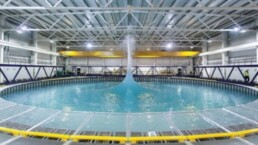

Researchers studying wave breaking have found that axisymmetric ‘spike waves’ can far exceed limits that were previously thought to dictate the maximum height of ocean waves
In a new study on ocean wave breaking, researchers have demonstrated that the breaking behaviour of axisymmetric ‘spike waves’ is quite different to the long-established theories on the breaking of travelling waves.
Travelling waves break when waves become so steep that the crest is no longer stable. This leads to a breakdown of wave motion and energy loss. As a result, the height of the wave is limited by the breaking process.
‘Much of our understanding of wave breaking is routed in theories developed and experiments carried out in two dimensions when waves are moving in one direction,’ explained lead author Dr Mark McAllister, Department of Engineering Science, University of Oxford. ‘However, wave breaking in the ocean is a three-dimensional process.’
To establish the differences between wave breaking in two dimensions and three dimensions, researchers used the circular wave tank at FloWave Ocean Energy Research at the University of Edinburgh to reproduce an extreme three-dimensional axisymmetric wave, the spike wave.
Watch on YouTube – https://youtu.be/XEnWuXbUa5w
Results from the wave tank demonstrated that axisymmetric wave breaking behaviour was very different to the wave breaking associated with travelling waves.
As the waves formed, a large vertical jet of water erupted from the crest of the wave before going into freefall and colliding with the surface of the water below.
The experiments showed that, unlike travelling waves, the crest height of the spike wave was not restricted by the onset of breaking but by the stability of the jet.
Dr McAllister said: ‘This study has revealed the fundamental mechanisms through which highly directionally spread and crossing waves can become much larger than other waves, accelerating upwards much faster than gravity for a short fraction of time.’
The new research at three orders of magnitude larger than previous experiments reveals significant implications for maritime safety. As Professor Ton van den Bremer, Engineering Science, University of Oxford and Delft University of Technology explains, ‘The spike wave is an idealised example of a type of behaviour that makes so-called crossing seas, where wave systems travel in different directions, so dangerous for shipping and offshore structures.’
Understanding the dynamics of the spike wave could ultimately lead to advances in maritime safety based on improved data on wave height limitations and breaking behaviour in extreme conditions.
The study undertaken in collaboration with researchers from the University of Edinburgh, The University of Manchester, Shanghai Jiao Tong University and Delft University of Technology is part of a large-scale investigation of crossing seas that can produce extreme three-dimensional waves.



Related News.

Navigating the Multi-Orbit Era: In Conversation with Intellian’s Jon Harrison at SMM 2026
At SMM 2026 in Hamburg, the rapid evolution of maritime satellite communications took centre stage. Across the exhibition halls, discussions among…
Cyprus ports need joint energy and investment strategy, shipping agents chief says
Cyprus needs a coordinated strategy for shipping, energy and environmental protection to support port investment and modernisation, Cyprus shipping…

MASO Public Affairs introduces MASO Regulatory Intelligence
A new subscription service helping businesses understand what is changing and what it means for them MASO Public Affairs introduces MASO Regulatory…
Anglo-Eastern helps turn CMBTECH’s ammonia ambition into an operational reality
From early feasibility study and risk-based design to newbuilding supervision, crew readiness and technical management, Anglo-Eastern drew on its…

Escalation of attacks threatens to derail recovery in Middle East oil exports
World oil demand is forecast to fall by 2.5 mb/d y-o-y in 4Q26 and 2.6 mb/d on average in 2026. As the Iran war manifests itself through restricted…
New study finds shipping pays twice its share to EU ETS earmarked revenues should triple to help build market for sustainable fuels and technologies
Shipping is responsible for around 10% of EU ETS emissions but pays almost 20% of the ETS bill. Unlike other sectors, it has never received free…

MSARC strengthens maritime mass rescue readiness through training and national live exercise off Dakar, Senegal
Joint MSARC–FHAS programme combines three days of SAR training with a national multi-agency live exercise The Maritime Search and Rescue Council ,…

Sogese report deliveries are still being delayed as container freight rates fluctuate
FOR IMPORTERS Spot rates into the Mediterranean are back at January levels, Far East to Europe reliability sits at pandemic lows, and nearly…

Glencore begins trading on Australian Securities Exchange
Glencore has begun trading on the Australian Securities Exchange under the ASX code GLC. Gary Nagle, Glencore’s CEO, said it was an exciting day for…
BIMCO Shipping Number of the Week
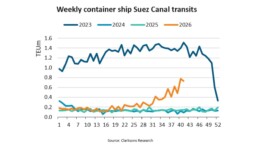
Suez Canal container ship transits exceed 50% of pre-disruption levels "During the first two weeks of October, weekly container ship capacity…
Subscribe to our newsletter!
if you dont want to swim alone in the ocean of news, sign up for the newsletter, and you will receive daily all the important news of world shipping!
