SCZONE signs MOU with H2-Industries to establish a green hydrogen plant in East Port-Said
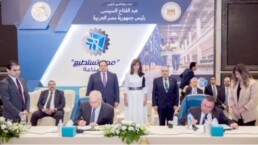

The General Authority for Suez Canal Economic Zone signed a memorandum of understanding with H2-Industries Inc. to build a new Waste-to-Hydrogen facility at a new greenfield site in East Port Said, a project with an estimated cost of US$4 billion.
Ambassador Nabila Makram minister of Emigration witnessed the signing between Eng. Yehia Zaki, SCZONE’s Chairman, and Mr. Michael Stusch, H2-Industries CEO, at the “Egypt Can” conference that is held by The Egyptian Ministry of Emigration.
“This agreement between SCZONE and H2-Industries is to pave the way towards producing green hydrogen project from waste recycling in East Port-Said integrated zone”. Eng. Yehia Zaki, SCZONE’s Chairman said.
“The MOU is not mandatory until H2-Industries finish all the feasibility studies we need to go ahead with the final contract coinciding with COP27 next November,” Zaki added.
“This project has the double benefit of creating valuable clean hydrogen while addressing the important issue of waste management by using organic waste, including plastic waste. This is just the first of 3 international projects where governments, around the globe, realize that organic waste and especially plastic waste, if treated correctly, can be a valuable asset and used to generate significant amounts of clean energy with our project in East Port Said,” Michael Stusch said.
H2-Industries will produce clean hydrogen powering Egypt’s domestic energy transition and allowing it to become an exporter of clean hydrogen and a global leader in a new hydrogen economy.
“We are convinced that Waste-to-Hydrogen power plants, with its unique impact on local GDP, local environment, and low-cost energy supply will become a significant part of each country’s energy portfolio, especially in Africa”, added Mr. Stusch.
This project targets a production capacity of 300,000 tons of green hydrogen per year, which means that the power plant will be able to dispose of 4 million tons of Municipal Solid Waste (MSW) per year, transported by a fleet of hydrogen-powered waste trucks which can be transported and used to fill storage tanks.



Related News.
Navigating the Multi-Orbit Era: In Conversation with Intellian’s Jon Harrison at SMM 2026
At SMM 2026 in Hamburg, the rapid evolution of maritime satellite communications took centre stage. Across the exhibition halls, discussions among…
Cyprus ports need joint energy and investment strategy, shipping agents chief says
Cyprus needs a coordinated strategy for shipping, energy and environmental protection to support port investment and modernisation, Cyprus shipping…

MASO Public Affairs introduces MASO Regulatory Intelligence
A new subscription service helping businesses understand what is changing and what it means for them MASO Public Affairs introduces MASO Regulatory…
Anglo-Eastern helps turn CMBTECH’s ammonia ambition into an operational reality
From early feasibility study and risk-based design to newbuilding supervision, crew readiness and technical management, Anglo-Eastern drew on its…
Escalation of attacks threatens to derail recovery in Middle East oil exports
World oil demand is forecast to fall by 2.5 mb/d y-o-y in 4Q26 and 2.6 mb/d on average in 2026. As the Iran war manifests itself through restricted…
New study finds shipping pays twice its share to EU ETS earmarked revenues should triple to help build market for sustainable fuels and technologies
Shipping is responsible for around 10% of EU ETS emissions but pays almost 20% of the ETS bill. Unlike other sectors, it has never received free…
MSARC strengthens maritime mass rescue readiness through training and national live exercise off Dakar, Senegal
Joint MSARC–FHAS programme combines three days of SAR training with a national multi-agency live exercise The Maritime Search and Rescue Council ,…
Sogese report deliveries are still being delayed as container freight rates fluctuate
FOR IMPORTERS Spot rates into the Mediterranean are back at January levels, Far East to Europe reliability sits at pandemic lows, and nearly…
Glencore begins trading on Australian Securities Exchange
Glencore has begun trading on the Australian Securities Exchange under the ASX code GLC. Gary Nagle, Glencore’s CEO, said it was an exciting day for…
BIMCO Shipping Number of the Week
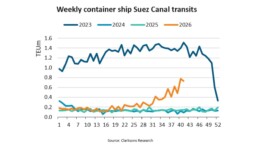
Suez Canal container ship transits exceed 50% of pre-disruption levels "During the first two weeks of October, weekly container ship capacity…
Subscribe to our newsletter!
if you dont want to swim alone in the ocean of news, sign up for the newsletter, and you will receive daily all the important news of world shipping!
