H2-Industries set to clear the oceans of plastic waste and produce clean fuel from innovative ship design
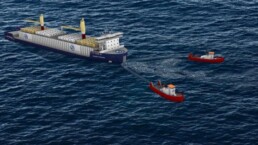

H2-Industries and TECHNOLOG Services, a naval architecture company, have joined forces to develop 3D designs for an innovative concept ship that will collect plastic waste that currently blights the world’s oceans and then converts it into clean hydrogen, allowing surplus hydrogen to be shipped back to shore.
Plastic pollution in oceans and other bodies of water continues to grow sharply and could more than double by 2030, according to an assessment by the UN Environment Programme (UNEP). Plastic debris is currently the most abundant type of litter in the ocean, making up 80 per cent of all marine debris found from surface waters to deep-sea sediments. According to the International Union for Conservation of Nature (IUCN) at least 14 million tons of plastic end up in the ocean every year. Plastic is found on the shorelines of every continent, with especially high levels of plastic waste found near popular tourist destinations and densely populated areas.
Flexible design to match capacity
The ship is being designed to be more than 150 metres in length, the exact size to be clarified at the design stage, depending on optimal storage capacity. The plan is for the ship to travel at four knots with the waste plastic collected by two smaller vessels towing a two-mile net that funnels the waste from the surface and up to ten metres below it. The most novel feature of the vessel will be the open bow design that allows the collected plastic waste to be fed onto conveyors and into the storage hold.
This waste will be converted into hydrogen by the same thermolysis process that the H2-Industries’ plants will be using on shore. For every 600 kg of waste collected, approximately 100 kg of hydrogen can be produced and, then, stored in liquid organic hydrogen carrier, a fluid generally referred to as “LOHC,” which is a special liquid that can carry hydrogen, in 20-foot containers. These containers will be transferred to smaller vessels by onboard cranes for delivery to shore. Because of the benefit of removing harmful plastic waste from the ocean, hydrogen produced in this manner can be classified as “beyond green,” or “greener than green”as it has been dubbed, recently.
LOHC carrier fluids bind hydrogen chemically and, within H2-Industries’ process, the stored hydrogen is neither volatile nor capable of self-discharging. The LOHC can be hydrogen-charged and discharged only in combination with a certain catalyst, infusing and releasing hydrogen, as often as needed making it remarkably cost-effective. H2-Industries storage solutions work by charging (hydrogenation) and discharging (dehydrogenation) the LOHC. The charging and discharging are independent processes using proprietary catalyst technology.
Creating a maritime hydrogen infrastructure
The ship will be designed to run on electric motors using the LOHC produced, on board, as its fuel and creating electricity using H2-Industries’ 19 inch eRelease racks. Each rack will hold 48 KW of installed power and there will be multiple racks to deliver the approximately two MW that a ship of this size will require. This is the same technology H2-Industries has developed and which it intends to deploy in cruise liners, super-tankers, and large container ships. H2-Industries has received preliminary approval to build its first LOHC hub in East Port Said in Egypt and is currently in discussions with more than 20 countries and, as well, with several ports worldwide.
Michael Stusch, CEO of H2-Industries says: “It is becoming increasingly clear that the shipping industry can make a positive impact on reducing global emissions. At H2-Industries, the plan is to help decarbonise industry and power generation, while cleaning up our water resources and converting pollutants into an energy source. To achieve this, we are looking for investors. Once the investment is in place, we expect each ship will be built within roughly 24 months.”
One constraining factor for production is the volume of plastic feedstock. One rotary kiln can handle 600 kgs of waste every hour and that will generate approximately. 100 kgs of hydrogen. Each ship will be designed to be fitted with multiple kilns to match the speed of plastic collection. It is envisaged that each ship will collect plastic for around a year in one location before moving on to another water waste site. To ensure no marine wildlife is endangered during the waste collection process, the vessel will employ industry tested technology developed for the seawater intake for desalination plants designed to protect wildlife and habitats.



Related News.
Navigating the Multi-Orbit Era: In Conversation with Intellian’s Jon Harrison at SMM 2026
At SMM 2026 in Hamburg, the rapid evolution of maritime satellite communications took centre stage. Across the exhibition halls, discussions among…
Cyprus ports need joint energy and investment strategy, shipping agents chief says
Cyprus needs a coordinated strategy for shipping, energy and environmental protection to support port investment and modernisation, Cyprus shipping…

MASO Public Affairs introduces MASO Regulatory Intelligence
A new subscription service helping businesses understand what is changing and what it means for them MASO Public Affairs introduces MASO Regulatory…
Anglo-Eastern helps turn CMBTECH’s ammonia ambition into an operational reality
From early feasibility study and risk-based design to newbuilding supervision, crew readiness and technical management, Anglo-Eastern drew on its…

Escalation of attacks threatens to derail recovery in Middle East oil exports
World oil demand is forecast to fall by 2.5 mb/d y-o-y in 4Q26 and 2.6 mb/d on average in 2026. As the Iran war manifests itself through restricted…
New study finds shipping pays twice its share to EU ETS earmarked revenues should triple to help build market for sustainable fuels and technologies
Shipping is responsible for around 10% of EU ETS emissions but pays almost 20% of the ETS bill. Unlike other sectors, it has never received free…

MSARC strengthens maritime mass rescue readiness through training and national live exercise off Dakar, Senegal
Joint MSARC–FHAS programme combines three days of SAR training with a national multi-agency live exercise The Maritime Search and Rescue Council ,…
Sogese report deliveries are still being delayed as container freight rates fluctuate
FOR IMPORTERS Spot rates into the Mediterranean are back at January levels, Far East to Europe reliability sits at pandemic lows, and nearly…

Glencore begins trading on Australian Securities Exchange
Glencore has begun trading on the Australian Securities Exchange under the ASX code GLC. Gary Nagle, Glencore’s CEO, said it was an exciting day for…
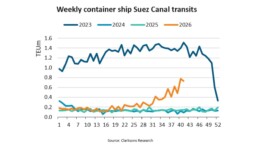
BIMCO Shipping Number of the Week
Suez Canal container ship transits exceed 50% of pre-disruption levels "During the first two weeks of October, weekly container ship capacity…
Subscribe to our newsletter!
if you dont want to swim alone in the ocean of news, sign up for the newsletter, and you will receive daily all the important news of world shipping!
