500 sensors in a depth of 500 meters – how Finland makes sure the world’s first approved nuclear waste repository is safe for hundreds of generations
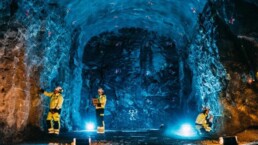

VTT Technical Research Centre of Finland is ready to share its 40 years of technical excellence and support of safety nuclear waste management. High public trust in nuclear energy within Finland will be shared as part of the success stories at the upcoming NEA hosted International Conference on Geological Repositories on April 5th, in Helsinki, Finland.
Posiva, the leading final disposal operator in the world, has submitted the operating license for the world’s first final disposal facility of spent nuclear fuel. Named ONKALO®, the repository is located on the western coast of Finland on the grounds of the Olkiluoto nuclear power plant. VTT has collaborated with Posiva for decades to support the Finnish success story of world-class operating plants, new built plants, regulations, and repositories.
“With Finland constructing and soon operating the world’s first spent fuel final repository, we are paving the way for other countries to adapt best practices and accelerate their own programs in a safe and efficient manner. Getting to this final stage while also adhering to the highest quality of oversight by the Finnish Radiation and Nuclear Safety Regulator (STUK) shows our attention to detail and accuracy in the overall safety of the repository,” adds Dr. Erika Holt, Project Manager from VTT.
Finland has two nuclear power plant operators with 5 reactors in their fleet, making up over 40% of the Finnish electricity share and having one of the highest utilization loading rates in the world. Over 70% of Finnish citizens accept nuclear power and nuclear power plants in Finland, and nuclear power is also endorsed by the Finnish Green Party.
Energy self-sufficiency under development in all EU member states
Having a long-term storage site approved for operation comes at a pivotal time as the EU Commission has taken steps to include nuclear power energy in Taxonomy Regulation as a low-carbon, transitional form of energy. However, for nuclear activities to be considered sustainable within the Taxonomy Regulation, the country in question must have a repository for nuclear waste in operation by 2050.
The safety measures in place at ONKALO are a result of more than 40 years of geological siting studies, technical innovative research, mathematical modeling, laboratory testing and long-term in-situ real environment tests utilizing the expertise of VTT Technical Research Centre of Finland to support Posiva and their owners TVO and Fortum.
Unlike ground-level facilities, underground repositories are constructed to have greater benefit from the bedrock as a natural barrier to prevent nuclear waste from harming the environment. Both surface and deep repositories also use the engineered multi-barrier principle to prevent such migration of radioactive isotopes to the surrounding water bodies, land and air.
It has been critical to demonstrate to various stakeholders, including the local municipality, that the final repository for deposition will have no consequences to their safety and quality of life for hundreds of generations to come.
“We have several monitoring systems in place measuring factors, such as pressure, temperature, humidity, strain, displacement, and electrical resistivity, to demonstrate moisture and gas movements. We installed 500 sensors at a depth of 500 meters, which can send data with wires and wireless communication through the several layers of rock, clay and steel. These monitoring systems have been installed in the in-situ environment to verify the functionality of the whole engineering barrier system, models and plans in the real disposal environment. Monitoring brings the evidence that the repository will be keeping the outside world safe from the nuclear fuel waste,” says Dr. Arto Laikari, Senior Scientist from VTT.
Underground deep geological repositories are also safe from several outside threats.
“Natural earthquakes and unintentional human intrusion are all theoretical, yet any possible scenarios and threats have been taken into account within the repository safety case in Finland. In addition, citizens feel much more comfortable with radioactive waste securely stored deep within the bedrock rather than in warehouses above ground. Monitoring and modeling of the engineered barriers, repository and surrounding site show no fractures are transporting water from the repository to the Baltic Sea or the environment in general so any environmental threat is also minimized,” says Dr. Holt.
“VTT has supported Posiva’s successful implementation of the world’s first geological repository. They have provided valuable technical expertise in a wide-range of domains to prove the feasibility and safety of the disposal final solutions,” says Tiina Jalonen, Senior Vice President of Development at Posiva.
Posiva’s final disposal facility will undergo a Trial Run of Final Disposal (TRFD) in 2023 before proceeding to the operational phase with acceptance of spent nuclear fuel for final deep geological disposal. The world will be a safer place, and nuclear energy a sustainable solution to address global energy demands.



Related News.

Navigating the Multi-Orbit Era: In Conversation with Intellian’s Jon Harrison at SMM 2026
At SMM 2026 in Hamburg, the rapid evolution of maritime satellite communications took centre stage. Across the exhibition halls, discussions among…
Cyprus ports need joint energy and investment strategy, shipping agents chief says
Cyprus needs a coordinated strategy for shipping, energy and environmental protection to support port investment and modernisation, Cyprus shipping…

MASO Public Affairs introduces MASO Regulatory Intelligence
A new subscription service helping businesses understand what is changing and what it means for them MASO Public Affairs introduces MASO Regulatory…

Anglo-Eastern helps turn CMBTECH’s ammonia ambition into an operational reality
From early feasibility study and risk-based design to newbuilding supervision, crew readiness and technical management, Anglo-Eastern drew on its…
Escalation of attacks threatens to derail recovery in Middle East oil exports
World oil demand is forecast to fall by 2.5 mb/d y-o-y in 4Q26 and 2.6 mb/d on average in 2026. As the Iran war manifests itself through restricted…
New study finds shipping pays twice its share to EU ETS earmarked revenues should triple to help build market for sustainable fuels and technologies
Shipping is responsible for around 10% of EU ETS emissions but pays almost 20% of the ETS bill. Unlike other sectors, it has never received free…
MSARC strengthens maritime mass rescue readiness through training and national live exercise off Dakar, Senegal
Joint MSARC–FHAS programme combines three days of SAR training with a national multi-agency live exercise The Maritime Search and Rescue Council ,…
Sogese report deliveries are still being delayed as container freight rates fluctuate
FOR IMPORTERS Spot rates into the Mediterranean are back at January levels, Far East to Europe reliability sits at pandemic lows, and nearly…
Glencore begins trading on Australian Securities Exchange
Glencore has begun trading on the Australian Securities Exchange under the ASX code GLC. Gary Nagle, Glencore’s CEO, said it was an exciting day for…
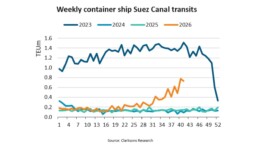
BIMCO Shipping Number of the Week
Suez Canal container ship transits exceed 50% of pre-disruption levels "During the first two weeks of October, weekly container ship capacity…
Subscribe to our newsletter!
if you dont want to swim alone in the ocean of news, sign up for the newsletter, and you will receive daily all the important news of world shipping!
