Nor-Shipping 2022 Thought Leader – Jan Ole Huseby, Global Head of Ocean Industries, DNB

Funding ambitions
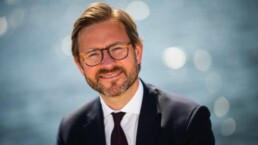
Jan Ole Huseby, EVP Global Head of Ocean Industries, DNB, assesses how the financial sector can help shipping and ocean businesses meet sustainable objectives, while offering expert analysis of today’s, and tomorrow’s, key challenges and opportunities.
“The people and the buzz of being together again.”
Jan Ole Huseby, the man in charge of DNB’s renowned Ocean Industries division, is crystal clear on what he’s most looking forward to at Nor-Shipping 2022, taking place 4-7 April. After two years of lockdowns, digital meetings and social distancing the affable 44-year-old is keen to feel a sense of community once more, rubbing shoulders with clients and colleagues from across the world in the same place, at the same time.
“It was a very wise move postponing Nor-Shipping to April,” he remarks, “allowing enough time for restrictions to lift and borders to open.
“Now we can really get down to business.”
Of course, DNB has never stopped doing just that.
Raising expectations
The Oslo-headquartered bank has been one of the world’s leading maritime, offshore and ocean finance institutions for more than 50 years. It now employs close to 200 expert staff globally and enjoys a strong position across capital structures, a broad product platform and has clear ambitions about its role in the energy transition.
And 2021, despite the obvious challenges, proved to be a(nother) good year.
“Last year alone we raised over USD 7bn in bonds and over USD 1bn in equity for our shipping clients,” Huseby states. “Obviously we had the pandemic and the changes in the world around us, but our business model is based on long-term operations, and we manage to balance risk with identifying new opportunities.”
Wind is one such target area where DNB has been quick to act, leveraging its lengthy track record and understanding of offshore to build a strong position in this burgeoning sustainable sector.
Huseby says the bank now has “the leading position” in the offshore wind services sector, “having raised more than USD 1bn in capital since 2020.”
Principled investments
With Nor-Shipping looming on the horizon – DNB is a main partner of Your Arena for Ocean Solutions – Huseby says that the aforementioned global community will be key to unlocking progress. Collaboration is key, he believes, leading to an interesting Q and A about exactly how finance fits into the ‘big picture’ of an industry in transition.
How can DNB, as a financial institution, help enable shipping’s transformation on course to 2050 and beyond?
Firstly, for us, it is about working hand-in-hand with clients, understanding their needs, helping them seize opportunities, and then following them through the transition ahead. Secondly, there’s the advisory aspect. Thanks to our broad client base, with many different companies across numerous industries, we have a full-picture understanding, seeing how different pieces of the puzzle fit together and how a development in one area can enable progress in another. That’s incredibly useful.
Lastly, we are committed to this transition and expect the same from our clients – leading developments and showing determination to make a difference. This is a joint effort. No one can achieve the change that is needed alone.
On that note, how have the Poseidon Principles been accepted, both by other banks and the industry as a whole?
This is a first of its kind banking initiative (integrating climate considerations into lending decisions) and we’ve seen a fantastic response. We now have 28 international ship finance banks, from all over the world, as signatories. Together we constitute about 50% of the global ship finance portfolio, close to USD 200billion.
What’s more, it’s also been accepted by the industry, as demonstrated by the high response rate on data submission. After all, the data owners and operators have to submit (which helps calculate the alignment of portfolios to meet IMO climate objectives) is the same type of data they already report, with the same metrics the IMO uses. The industry is getting more transparent, and this builds on that trend.
At the end of the day, I think everyone in the value chain broadly recognises the scale of the challenge ahead and wants to play their part. Any meaningful tools, such as the Principles, that help enable positive change are welcomed.
Do owners need help with reporting – how can they handle the added burden?
On the one hand, regulatory demands are increasing, meaning that companies must expect an added administrative burden on the reporting side. On the other hand, voluntary and best-practice reporting standards are also developing quickly, and it might not always be clear what this entails in practice. So, it always makes sense to seek assistance if there’s a need for help or clarification.
Industry organisations like the Norwegian Shipowners’ Association now publish guidance on ESG reporting, which aims to help understanding and standardisation. And remember, banks like DNB are here as partners, ready to help any client with questions as to how they can improve their reporting focus.
Larger owners and operators can accept the extra workload and cost of reporting, but can smaller ones? Smaller players need to transition too, so how can you help them gain access to finance in this environment?
Access to sustainable finance needs to be inclusive, absolutely. There also needs to be a balance between maintaining the integrity and level of ambitiousness of products and instruments, whilst simultaneously keeping the administrative burden at an acceptable level for everyone.
We have to remember that, at this stage, the sustainable finance market is still under development. As it progresses the emergence of commonly accepted benchmarks and science-based trajectories at industry level will not only make it easier for smaller companies to access this type of finance, but will also add transparency and simplify peer review.
How do you see DNBs role in the industry evolving, or progressing, over the next five to ten years? What will the main focus areas be?
DNB has successfully transitioned from a pure provider of bank debt to an advisor across the entire capital structure in the maritime space.
Going forward we intend to utilise our structuring and distribution expertise to facilitate energy transition in the industry. This can only be achieved with strong collaboration throughout all stakeholder groups and the utilisation of different pockets of capital. This is where our strength lies, and this is where we will make a difference.
Any final words?
I look forward to seeing you at Nor-Shipping!
Nor-Shipping 2022, Your Arena for Ocean Solutions, takes place 4-7 April, with the main exhibition in Lillestrøm and a series of knowledge sharing, networking and partner events throughout Oslo.



Related News.

Navigating the Multi-Orbit Era: In Conversation with Intellian’s Jon Harrison at SMM 2026
At SMM 2026 in Hamburg, the rapid evolution of maritime satellite communications took centre stage. Across the exhibition halls, discussions among…

Cyprus ports need joint energy and investment strategy, shipping agents chief says
Cyprus needs a coordinated strategy for shipping, energy and environmental protection to support port investment and modernisation, Cyprus shipping…

MASO Public Affairs introduces MASO Regulatory Intelligence
A new subscription service helping businesses understand what is changing and what it means for them MASO Public Affairs introduces MASO Regulatory…

Anglo-Eastern helps turn CMBTECH’s ammonia ambition into an operational reality
From early feasibility study and risk-based design to newbuilding supervision, crew readiness and technical management, Anglo-Eastern drew on its…

Escalation of attacks threatens to derail recovery in Middle East oil exports
World oil demand is forecast to fall by 2.5 mb/d y-o-y in 4Q26 and 2.6 mb/d on average in 2026. As the Iran war manifests itself through restricted…

New study finds shipping pays twice its share to EU ETS earmarked revenues should triple to help build market for sustainable fuels and technologies
Shipping is responsible for around 10% of EU ETS emissions but pays almost 20% of the ETS bill. Unlike other sectors, it has never received free…

MSARC strengthens maritime mass rescue readiness through training and national live exercise off Dakar, Senegal
Joint MSARC–FHAS programme combines three days of SAR training with a national multi-agency live exercise The Maritime Search and Rescue Council ,…

Sogese report deliveries are still being delayed as container freight rates fluctuate
FOR IMPORTERS Spot rates into the Mediterranean are back at January levels, Far East to Europe reliability sits at pandemic lows, and nearly…

Glencore begins trading on Australian Securities Exchange
Glencore has begun trading on the Australian Securities Exchange under the ASX code GLC. Gary Nagle, Glencore’s CEO, said it was an exciting day for…

BIMCO Shipping Number of the Week
Suez Canal container ship transits exceed 50% of pre-disruption levels "During the first two weeks of October, weekly container ship capacity…
Subscribe to our newsletter!
if you dont want to swim alone in the ocean of news, sign up for the newsletter, and you will receive daily all the important news of world shipping!
