Europe can halve power sector gas consumption for electricity and save EUR 323 billion by doubling new renewable energy, according to Wärtsilä report
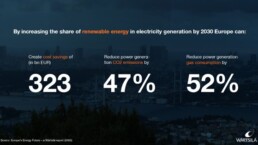
Europe can cut its power sector gas consumption in half, reduce energy costs by EUR 323 / USD 356 billion and increase energy independence by 2030 if it rapidly scales up its renewable capacity, according to a new report from Wärtsilä.
To tackle the energy crisis and enable rapid decarbonisation, the technology company is calling on European leaders to implement a monumental but achievable level of cross-country coordination and investment to deliver up to 80GW per year of renewable capacity, backed by flexible balancing technologies.
The ambitious approach modelled in the report would see renewable energy share in electricity generation increase from around 33% today to over 60% by 2030 and would have a direct impact on reducing electricity bills in the short & long term, potentially by up to 10%.
This approach could cut annual power sector gas usage by 52% across the continent by 2030. This can enable the region to avoid 5,456 TWh of gas consumption, equivalent of 3.5 years of Russian gas supply to the EU[i], significantly increasing energy independence.
The report, Europe’s Energy Future, demonstrates how accelerating renewables could also help solve the immediate energy crisis. The modelling of 33 European countries, including 27 EU member states, plus UK, Norway, Switzerland and the Balkans, shows that if renewables are scaled up to 50% of the capacity mix by 2025 then Europe could save EUR 98 / USD 108 billion in energy costs.
Sushil Purohit, President, Wärtsilä Energy and EVP Wärtsilä, said: “Cutting Europe’s dependence on expensive baseload fossil fuels and increasing energy independence need not cost more for power companies or energy consumers. Accelerating the transition to a clean energy system could save EUR 323 / USD 356 billion by 2030 compared to continuing the current pace of renewables growth.
“That is why we are calling for fast decisions to accelerate renewables, tackle the energy price crisis and enable rapid decarbonisation to avert the climate emergency. The time is now.”
To reach the ambitious scenario modelled by Wärtsilä, European countries should collectively add an average 80GW of new renewable capacity each year to 2030.To provide baseload power, wind & solar must be deployed alongside balancing technologies, such as energy storage and future-proof balancing engines capable of running on sustainable fuels.
Wärtsilä modelled two scenarios for Europe’s energy transition over the coming decade. The baseline scenario, based on the IEA’s Renewables 2021 statistics[ii] shows European countries adding 40GW of new renewables capacity every year until 2030 (i.e. the level of deployment currently seen in Europe). This would achieve a 50% share of renewable power by 2030. The ambitious scenario would see double the level of renewables added – 80GW per year, to reach 61% renewable power by 2030.
Carbon emissions are also halved in under the ambitious model, from 911 MMT CO2 in 2021 to 479 MMT CO2 in 2030. This reduction in emissions equates to nearly the entire annual carbon footprint of the UK[iii].



Related News.

Navigating the Multi-Orbit Era: In Conversation with Intellian’s Jon Harrison at SMM 2026
At SMM 2026 in Hamburg, the rapid evolution of maritime satellite communications took centre stage. Across the exhibition halls, discussions among…
Cyprus ports need joint energy and investment strategy, shipping agents chief says
Cyprus needs a coordinated strategy for shipping, energy and environmental protection to support port investment and modernisation, Cyprus shipping…

MASO Public Affairs introduces MASO Regulatory Intelligence
A new subscription service helping businesses understand what is changing and what it means for them MASO Public Affairs introduces MASO Regulatory…
Anglo-Eastern helps turn CMBTECH’s ammonia ambition into an operational reality
From early feasibility study and risk-based design to newbuilding supervision, crew readiness and technical management, Anglo-Eastern drew on its…

Escalation of attacks threatens to derail recovery in Middle East oil exports
World oil demand is forecast to fall by 2.5 mb/d y-o-y in 4Q26 and 2.6 mb/d on average in 2026. As the Iran war manifests itself through restricted…
New study finds shipping pays twice its share to EU ETS earmarked revenues should triple to help build market for sustainable fuels and technologies
Shipping is responsible for around 10% of EU ETS emissions but pays almost 20% of the ETS bill. Unlike other sectors, it has never received free…

MSARC strengthens maritime mass rescue readiness through training and national live exercise off Dakar, Senegal
Joint MSARC–FHAS programme combines three days of SAR training with a national multi-agency live exercise The Maritime Search and Rescue Council ,…

Sogese report deliveries are still being delayed as container freight rates fluctuate
FOR IMPORTERS Spot rates into the Mediterranean are back at January levels, Far East to Europe reliability sits at pandemic lows, and nearly…

Glencore begins trading on Australian Securities Exchange
Glencore has begun trading on the Australian Securities Exchange under the ASX code GLC. Gary Nagle, Glencore’s CEO, said it was an exciting day for…
BIMCO Shipping Number of the Week
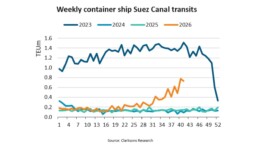
Suez Canal container ship transits exceed 50% of pre-disruption levels "During the first two weeks of October, weekly container ship capacity…
Subscribe to our newsletter!
if you dont want to swim alone in the ocean of news, sign up for the newsletter, and you will receive daily all the important news of world shipping!
