New decarbonisation study points to key role of ports in unlocking investment in future fuel infrastructure

Arup, LR and The Resilience Shift study focuses on the integration of fuel demand for early adopters in green corridors, ports, and energy systems.
A study by Arup, Lloyd’s Register and The Resilience Shift has outlined the critical role of ports in driving and supporting the case for investment in energy infrastructure.
Focusing on a case study of a green shipping triangle in the Atlantic Ocean, the research highlights the risks and opportunities associated with developing infrastructure for alternative fuels and how ports can unlock investment for the production and supply of alternative fuels.
The study, which brings together research and expertise into the hydrogen economy (Arup), maritime decarbonisation (Lloyd’s Register Maritime Decarbonisation Hub) and resilience for ports (The Resilience Shift), evaluates land-side infrastructure for fuels derived from blue hydrogen (produced from natural gas using carbon capture) and green hydrogen (produced from renewable energy and water). It takes a whole-system view of the challenges and opportunities associated with these technologies – building on Arup’s hydrogen experience across the sectors – demonstrating the need for careful integration with port and energy systems using a sustainability and resilience focused framework.
Regardless of the fuel of choice, the research shows that demand for alternative fuels is intrinsically linked with the concept of green corridors – where the transition can start through a multi-stakeholder initiative. This total value approach can unlock investment and highlight the opportunity for ports as resilient zero carbon gateways to growth, bringing co-benefits in local social, environmental, financial and economic value.
Coalitions are forming around numerous green corridor proposals, and this study can support these coalitions and their potential infrastructure investors to adopt a whole value chain approach to potential challenges and demonstrate the scale of the infrastructure projects to undertake.
The authors used an innovative approach of looking at the demand side of shipping and the impacts on the need for and scale of land-side infrastructure. Using a scenario of a green shipping triangle in the Atlantic, connecting Brazil, South Africa and Morocco, the authors explore how this will drive decarbonisation in practice and what the challenges and opportunities are with a whole-system resilience-led approach, where ports act as the linking piece between shipping and the energy systems.
Charles Haskell, LR Maritime Decarbonisation Hub Programme Manager, said: “Green corridors between major port hubs can accelerate and mobilise demand for zero-emission solutions, supporting first mover viability. But the impact goes beyond shipping and the fuel supply. This study models how these changes will impact land-side infrastructure, and the investment and opportunities to transition to low carbon resilient energy systems.”
Filippo Gaddo, Head of Economics, Arup said: “International shipping is a major and vital industry for a global interconnected economy – and its decarbonisation is essential as we move towards a more sustainable society. The scale of infrastructure for low carbon fuel supply is large and there is a need for significant investment in initial path-finders projects. Our study shows that an integrated approach that addresses the total value of the projects can unlock significant co-benefits, strengthening their case for investment. Delivering such projects, while demonstrating their whole-system benefits, will reduce risk of future uncertainty in the sector – helping to futureproof it both in terms of investment and sustainability.”
Mark Button, Resilience4Ports Programme Manager, said: “In our complex and uncertain world, resilience is essential to the business continuity of ports and the critical infrastructure systems that ports connect. We want to see a whole-systems approach to port and energy infrastructure investment that can drive decarbonisation and deliver the multiple benefits of ports becoming resilient, low carbon gateways.”
The study is available to download at: https://www.arup.com/perspectives/publications/research/section/port-energy-supply-for-green-shipping-corridors



Related News.

Navigating the Multi-Orbit Era: In Conversation with Intellian’s Jon Harrison at SMM 2026
At SMM 2026 in Hamburg, the rapid evolution of maritime satellite communications took centre stage. Across the exhibition halls, discussions among…
Cyprus ports need joint energy and investment strategy, shipping agents chief says
Cyprus needs a coordinated strategy for shipping, energy and environmental protection to support port investment and modernisation, Cyprus shipping…

MASO Public Affairs introduces MASO Regulatory Intelligence
A new subscription service helping businesses understand what is changing and what it means for them MASO Public Affairs introduces MASO Regulatory…
Anglo-Eastern helps turn CMBTECH’s ammonia ambition into an operational reality
From early feasibility study and risk-based design to newbuilding supervision, crew readiness and technical management, Anglo-Eastern drew on its…

Escalation of attacks threatens to derail recovery in Middle East oil exports
World oil demand is forecast to fall by 2.5 mb/d y-o-y in 4Q26 and 2.6 mb/d on average in 2026. As the Iran war manifests itself through restricted…

New study finds shipping pays twice its share to EU ETS earmarked revenues should triple to help build market for sustainable fuels and technologies
Shipping is responsible for around 10% of EU ETS emissions but pays almost 20% of the ETS bill. Unlike other sectors, it has never received free…

MSARC strengthens maritime mass rescue readiness through training and national live exercise off Dakar, Senegal
Joint MSARC–FHAS programme combines three days of SAR training with a national multi-agency live exercise The Maritime Search and Rescue Council ,…

Sogese report deliveries are still being delayed as container freight rates fluctuate
FOR IMPORTERS Spot rates into the Mediterranean are back at January levels, Far East to Europe reliability sits at pandemic lows, and nearly…

Glencore begins trading on Australian Securities Exchange
Glencore has begun trading on the Australian Securities Exchange under the ASX code GLC. Gary Nagle, Glencore’s CEO, said it was an exciting day for…
BIMCO Shipping Number of the Week
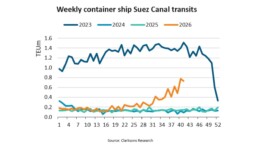
Suez Canal container ship transits exceed 50% of pre-disruption levels "During the first two weeks of October, weekly container ship capacity…
Subscribe to our newsletter!
if you dont want to swim alone in the ocean of news, sign up for the newsletter, and you will receive daily all the important news of world shipping!
