Technology innovations to revolutionise aviation unveiled in new Cranfield University and Inmarsat report
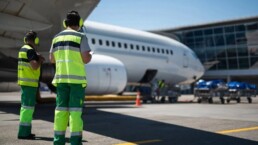

Research explores 21 cutting-edge concepts, such as conscious aircraft, trajectory based operations, artificial intelligence and digital trust technology, set to define future of aviation
With a rebound in air travel now underway, a new report published today by Cranfield University and Inmarsat highlights the critical role that digital connectivity will play in accelerating aviation’s long-term recovery. Titled ‘Why the future of aviation starts with connectivity’, the study offers insights and direction for key aviation stakeholders and governments as they reconsider their priorities for the industry’s future. This will be fuelled largely by a monumental shift in passenger behaviour and expectations following the pandemic, as well as increased consumer awareness of their impact on the climate.
The report highlights a number of transformative changes ahead for the aviation industry and examines how airlines can take advantage of the enormous opportunities created as a result.
As part of their research, experts from Cranfield University have developed a Digital Connectivity Timeline, which outlines when 21 of the industry’s most critical technological innovations can be expected to reach adoption. It focuses on three distinct timeframes: five years (technologies at advanced stages of development and in some cases are being piloted by organisations ahead of market adoption), between five to ten years (technologies under early development with potential to be trialled in some sectors), and beyond the next decade (concepts under consideration for product or service offering development).
These technologies will enable a range of innovative concepts to make their way onto aircraft and airspace, helping to define the future of aviation while leading to important step changes in passenger experience and sustainability efforts. Amongst the concepts explored are:
- How the ‘Conscious Aircraft’ uses sensing and communication technologies to create an integrated aircraft health, maintenance, and performance management system that is capable of a fully aware state, with the ability to either take or suggest appropriate action. For example, it can accurately predict the health of aircraft components and automatically reconfigure them to optimise their lifecycle. In addition, it can sense changes in the external environment, like weather or a volcanic ash cloud. With the reduced need for planned maintenance, as well as anticipating the potential for component failures, maintenance costs would be cut by an estimated 30%.
- How the ‘Connected Journey’ will enhance a passenger’s experience with more efficient and personalised wayfinding through airports, more intelligent and response baggage tracking, real-time updates on flight disruptions, and seamless high-speed inflight connectivity.
- How Trajectory Based Operations are a critical step towards the future management of air traffic, allowing more efficient traffic sequencing and routine deployment of so-called fuel efficient ‘green descents’ to airport terminal areas.
- How Artificial Intelligence (AI) and digital trust technologies have enormous potential to be applied across all aviation sectors. AI can provide intelligent advice on aircraft management issues and make informed decisions under pressure – when there is the need to make a diversion, for example – with camera-based traffic detection, or helping crew to anticipate and prevent critical situations. Machine Learning (ML) can improve accuracy of any application involving optimisation, from sensor calibration to fuel tank checks to icing detection.
The report also examines how the complexity and interoperability of future ecosystems are significant challenges for technology providers, regulators and airlines alike.
Philippe Carette, President of Inmarsat Aviation, said: “Our new report with Cranfield University has considered how the role of digital connectivity, in all its forms, can enable and accelerate meeting the rapidly changing needs of air travellers and of the aviation sector itself. It has identified specific challenges and opportunities that, if addressed, will have a direct beneficial effect on the sector’s resilience, its contribution to reducing climate change, and to new customer service offerings that will enhance passengers’ willingness to travel in the post-pandemic world.
“Harnessing the technological innovations explored in this report will be nothing short of revolutionary for our industry, and at Inmarsat, we can’t wait to play our part in bringing them to life through our global connectivity and world-leading ORCHESTRA network of networks.”
Professor Karen Holford CBE FREng, Chief Executive and Vice-Chancellor, Cranfield University: “While this is a time of great challenge for the aviation industry, reports such as this one show the path that technology can put us on towards a brighter and more sustainable future. ‘Digital aviation’ and the foundation of connectivity needs to stop being just a concept of tomorrow, and become the reality of today. This report sets out the many technological possibilities and what can be achieved in the short to medium term. What is needed now is for us all to redouble our efforts to make them a reality.”



Related News.

Navigating the Multi-Orbit Era: In Conversation with Intellian’s Jon Harrison at SMM 2026
At SMM 2026 in Hamburg, the rapid evolution of maritime satellite communications took centre stage. Across the exhibition halls, discussions among…
Cyprus ports need joint energy and investment strategy, shipping agents chief says
Cyprus needs a coordinated strategy for shipping, energy and environmental protection to support port investment and modernisation, Cyprus shipping…

MASO Public Affairs introduces MASO Regulatory Intelligence
A new subscription service helping businesses understand what is changing and what it means for them MASO Public Affairs introduces MASO Regulatory…

Anglo-Eastern helps turn CMBTECH’s ammonia ambition into an operational reality
From early feasibility study and risk-based design to newbuilding supervision, crew readiness and technical management, Anglo-Eastern drew on its…

Escalation of attacks threatens to derail recovery in Middle East oil exports
World oil demand is forecast to fall by 2.5 mb/d y-o-y in 4Q26 and 2.6 mb/d on average in 2026. As the Iran war manifests itself through restricted…

New study finds shipping pays twice its share to EU ETS earmarked revenues should triple to help build market for sustainable fuels and technologies
Shipping is responsible for around 10% of EU ETS emissions but pays almost 20% of the ETS bill. Unlike other sectors, it has never received free…

MSARC strengthens maritime mass rescue readiness through training and national live exercise off Dakar, Senegal
Joint MSARC–FHAS programme combines three days of SAR training with a national multi-agency live exercise The Maritime Search and Rescue Council ,…

Sogese report deliveries are still being delayed as container freight rates fluctuate
FOR IMPORTERS Spot rates into the Mediterranean are back at January levels, Far East to Europe reliability sits at pandemic lows, and nearly…

Glencore begins trading on Australian Securities Exchange
Glencore has begun trading on the Australian Securities Exchange under the ASX code GLC. Gary Nagle, Glencore’s CEO, said it was an exciting day for…
BIMCO Shipping Number of the Week
Suez Canal container ship transits exceed 50% of pre-disruption levels "During the first two weeks of October, weekly container ship capacity…
Subscribe to our newsletter!
if you dont want to swim alone in the ocean of news, sign up for the newsletter, and you will receive daily all the important news of world shipping!
