As EU celebrates 30 years of Natura 2000, NGOs call for these areas to be actually ‘protected’ and for an EU-wide trawl ban in them
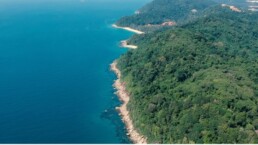

Despite a six-fold increase of the Natura 2000 surface at sea in the last 20 years, most threatened marine habitats and species remain in poor conservation status
Strasbourg – As the EU celebrates the 30th anniversary of Natura 2000, NGOs highlight EU countries’ lax implementation of EU nature laws and permissiveness towards widespread destructive fishing, resulting in the conservation status of threatened marine habitats and species remaining overall dire. NGOs call to quickly redress the balance and create an EU-wide ban on bottom trawling in marine protected areas to really protect Europe’s most valuable and threatened ocean biodiversity and species.
EU countries have been in a race to designate new areas at the expense of putting in place proper management measures. Over the last 20 years, while the total marine protected area surface in Europe has multiplied by six, still 57% of Atlantic habitats and 75% and 40% of Baltic and Mediterranean species remain in bad conservation status1. Destructive fishing is prevalent inside the Natura 2000 network2, with several million hours recorded annually 3.
Vera Coelho, Senior director of advocacy at Oceana in Europe, said: “As we celebrate 30 years of a pioneering piece of EU nature legislation, let’s not be misled by percentages but be honest about the reality: marine protection in Europe is mostly meaningless. Most marine Natura 2000 sites are merely lines on a map that still allow the most harmful fishing methods, like bottom trawling, to go on inside them. It is questionable as to why they’re called Marine Protected Areas given their lack of actual protection.”
Marc-Philip Buckhout, Marine Policy Officer at Seas At Risk said: “30 years after the establishment of the Natura 2000 network bottom trawling still occurs in 86% of the area designated to protect bottom habitats, hampering conservation and recovery. Banning bottom trawling from marine protected areas, would help reverse biodiversity loss and contribute to ocean climate change mitigation with net socio-economic benefits.”
NGOs are calling for EU countries to ban the most destructive forms of fishing in all existing marine protected areas (MPAs) and to focus on creating new strictly protected areas in order to reach the 10% EU target (from less than 0.1% currently). Strictly protected MPAs, which are no-take zones excluding all extractive and destructive activities, are our best allies to rapidly and effectively rebuild marine biodiversity and climate resilience of the ocean.
Paradoxically, the Natura 2000 legislation contains strict provisions to evaluate and restrict activities detrimental to the ecological objectives of MPAs, with for instance, a “non-deterioration” rule to prevent damage from any ongoing activities in the site that applies from day one of designation.
For years, though, implementation of the legislation by EU countries has been poor and inconsistent 4, as they have often exempted fishing activities from any environmental impact assessment inside MPAs. The European Commission has also closed its eyes too long, allowing EU countries to breach the law, to the point of accepting low standards of protection for Natura 2000.
EU Commissioner Sinkevičius and Executive Vice-President Timmermans have an opportunity to act decisively, on behalf of the European Commission, to ban bottom trawling in all EU MPAs in the upcoming EU Action Plan on the oceans and in the upcoming Nature Restoration Law expected this Spring 2022. Without this ban, the ocean targets from the 2030 Biodiversity Strategy cannot be achieved.
Background
Recent data shows that most protected habitats and species in marine Natura 2000 sites are in poor conservation status in all EU regions. Further, the conservation status of many habitats and species is unknown due to lack of data from EU countries.
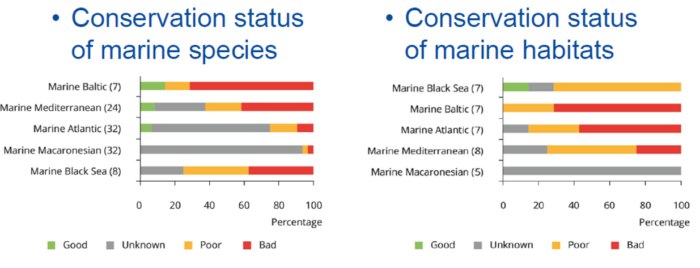
Conservation status of marine species and habitats by EU region (EEA State of Nature 2020)
Natura 2000 is the largest network of protected areas in the world, both on land and at sea, offering resting and breeding grounds for Europe’s most valuable and threatened species and habitats. It covers 11.1% of EU seas, of which only 0.1% is strictly protected from any damaging activities.
The EU 2030 Biodiversity Strategy set targets to protect at least 30% of EU seas, with 10% strictly protected. To achieve the 30%, at EU level, it means almost tripling the area currently protected under Natura 2000 by an additional 18.9%.
A recent analysis by Oceana revealed the permissiveness of EU Member States vis- à vis threats from human activities in Natura 2000 areas: 70% of the 3449 marine sites assessed were affected by at least one major threat (e.g. maritime traffic, fishing, submarine pipelines and cables, anchorage areas, aquaculture farms, dredging, offshore oil and gas installations). Further, a socio-economic analysis by Seas At Risk concluded that a ban on bottom-contacting gear in MPAs would yield net benefits as soon as four years after the ban came into force, even taking into consideration the displacement of fishing activities.
At the end of 2021, NGOs delivered a petition, signed by over 150,000 citizens demanding that the European Union include a ban on bottom trawling, starting in Marine Protected Areas, in its upcoming Action Plan on oceans.



Related News.

Navigating the Multi-Orbit Era: In Conversation with Intellian’s Jon Harrison at SMM 2026
At SMM 2026 in Hamburg, the rapid evolution of maritime satellite communications took centre stage. Across the exhibition halls, discussions among…
Cyprus ports need joint energy and investment strategy, shipping agents chief says
Cyprus needs a coordinated strategy for shipping, energy and environmental protection to support port investment and modernisation, Cyprus shipping…

MASO Public Affairs introduces MASO Regulatory Intelligence
A new subscription service helping businesses understand what is changing and what it means for them MASO Public Affairs introduces MASO Regulatory…
Anglo-Eastern helps turn CMBTECH’s ammonia ambition into an operational reality
From early feasibility study and risk-based design to newbuilding supervision, crew readiness and technical management, Anglo-Eastern drew on its…

Escalation of attacks threatens to derail recovery in Middle East oil exports
World oil demand is forecast to fall by 2.5 mb/d y-o-y in 4Q26 and 2.6 mb/d on average in 2026. As the Iran war manifests itself through restricted…
New study finds shipping pays twice its share to EU ETS earmarked revenues should triple to help build market for sustainable fuels and technologies
Shipping is responsible for around 10% of EU ETS emissions but pays almost 20% of the ETS bill. Unlike other sectors, it has never received free…
MSARC strengthens maritime mass rescue readiness through training and national live exercise off Dakar, Senegal
Joint MSARC–FHAS programme combines three days of SAR training with a national multi-agency live exercise The Maritime Search and Rescue Council ,…

Sogese report deliveries are still being delayed as container freight rates fluctuate
FOR IMPORTERS Spot rates into the Mediterranean are back at January levels, Far East to Europe reliability sits at pandemic lows, and nearly…

Glencore begins trading on Australian Securities Exchange
Glencore has begun trading on the Australian Securities Exchange under the ASX code GLC. Gary Nagle, Glencore’s CEO, said it was an exciting day for…
BIMCO Shipping Number of the Week
Suez Canal container ship transits exceed 50% of pre-disruption levels "During the first two weeks of October, weekly container ship capacity…
Subscribe to our newsletter!
if you dont want to swim alone in the ocean of news, sign up for the newsletter, and you will receive daily all the important news of world shipping!
