Petrobras begins contracting supplier to develop the patented HISEP technology
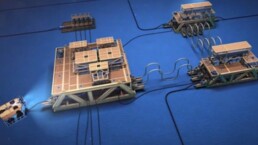

Equipment is capable of separating CO2-rich gas from oil on the seabed. Company adopted early engagement, early involvement of suppliers to mitigate risks in the process and accelerate the development of the technology.
Petrobras, the operator of the Libra consortium, started contracting suppliers to execute the design, construction, installation and testing of HISEP®, a technology patented by the company that aims to separate and reinject, still on the seabed, gas with high CO2 content produced alongside with the oil. The contracting started after conceptual evaluations and pilot tests were completed onshore, when Petrobras and the supplier companies worked in partnership to carry out conceptual studies and to validate the performance of the underwater pumps that will reinject the CO2-rich gas into the reservoir. The expectation is that the manufacturer will be selected by August/2022 and that the equipment will be installed in 2025.
HISEP® could open up a new frontier of exploration and development of deepwater and ultra-deepwater oil production in regions where reservoir fluids with high gas-to-oil ratio and CO2 content are present. HISEP® will provide increased oil production by freeing up space in the surface gas processing plant. Pilot testing is planned to be carried out in the Mero 3 area, which is expected to go into production in 2024. After two years of testing, with the technology proven, HISEP® may be used in other areas, such as Libra Central and Jupiter, where the innovation has the potential to make the production development project feasible. Once the HISEP® technology is proven, it will also be possible to develop offshore production units with smaller and less complex gas processing plants, which have lower construction costs and deadlines, as well as lower operating costs.
Early engagement
Petrobras has been in partnership with market companies in the manner understood by the concept of early engagement, i.e., with the involvement of suppliers in the development of the technology from the early stages of the process, for the definition and development of the solution to be adopted in the final product. The goal is to make the technology not only feasible, but also replicable and commercially advantageous to the market.
Since 2017, the companies have been consulted to identify the equipment that had already been developed by them and that could be adapted for the project, as well as the main existing technological bottlenecks so that the project could become a reality. Over the years, conceptual studies and performance tests have been successfully developed with the partnerships, such as verification of the performance of subsea centrifugal pumps for injection of dense gas, rich in CO2.
The Libra Consortium is operated by Petrobras (40%), in partnership with Shell (20%), Total (20%), CNPC (10%) and CNOOC Limited (10%), and is managed by Pré-Sal Petróleo S.A (PPSA)



Related News.

Navigating the Multi-Orbit Era: In Conversation with Intellian’s Jon Harrison at SMM 2026
At SMM 2026 in Hamburg, the rapid evolution of maritime satellite communications took centre stage. Across the exhibition halls, discussions among…

Cyprus ports need joint energy and investment strategy, shipping agents chief says
Cyprus needs a coordinated strategy for shipping, energy and environmental protection to support port investment and modernisation, Cyprus shipping…

MASO Public Affairs introduces MASO Regulatory Intelligence
A new subscription service helping businesses understand what is changing and what it means for them MASO Public Affairs introduces MASO Regulatory…

Anglo-Eastern helps turn CMBTECH’s ammonia ambition into an operational reality
From early feasibility study and risk-based design to newbuilding supervision, crew readiness and technical management, Anglo-Eastern drew on its…

Escalation of attacks threatens to derail recovery in Middle East oil exports
World oil demand is forecast to fall by 2.5 mb/d y-o-y in 4Q26 and 2.6 mb/d on average in 2026. As the Iran war manifests itself through restricted…

New study finds shipping pays twice its share to EU ETS earmarked revenues should triple to help build market for sustainable fuels and technologies
Shipping is responsible for around 10% of EU ETS emissions but pays almost 20% of the ETS bill. Unlike other sectors, it has never received free…

MSARC strengthens maritime mass rescue readiness through training and national live exercise off Dakar, Senegal
Joint MSARC–FHAS programme combines three days of SAR training with a national multi-agency live exercise The Maritime Search and Rescue Council ,…

Sogese report deliveries are still being delayed as container freight rates fluctuate
FOR IMPORTERS Spot rates into the Mediterranean are back at January levels, Far East to Europe reliability sits at pandemic lows, and nearly…

Glencore begins trading on Australian Securities Exchange
Glencore has begun trading on the Australian Securities Exchange under the ASX code GLC. Gary Nagle, Glencore’s CEO, said it was an exciting day for…

BIMCO Shipping Number of the Week
Suez Canal container ship transits exceed 50% of pre-disruption levels "During the first two weeks of October, weekly container ship capacity…
Subscribe to our newsletter!
if you dont want to swim alone in the ocean of news, sign up for the newsletter, and you will receive daily all the important news of world shipping!
