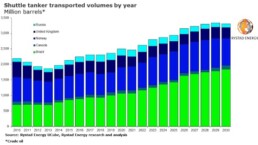

Demand for shuttle tankers in countries with robust offshore oil production and limited pipeline infrastructure is set to grow continuously in the coming years, as produced volumes in need of transport rise to 3.3 billion barrels per year before the end of the decade, jumping 35% from 2.5 billion in 2021, a Rystad Energy report shows.
The analysis focuses on the five key shuttle tanker markets – Brazil, Canada, Norway, the UK and Russia. In locations where subsea pipelines are unviable, shuttle tankers are crucial for moving liquids from wells to refineries and terminals. Apart from minor dips in total utilization across these countries in 2018 and 2021, shuttle tanker activity has increased year-on-year since 2013 and is set to grow further by a compound annual growth rate (CAGR) of 3.5% between 2021 and 2030.
The North Sea was once the pioneer region and largest market for shuttle tankers due to its harsh environmental conditions and fragmented field structure, but the concept has been exported to other offshore areas with great success. Brazil is now the largest market for shuttle tankers due to its ultra-deep-water oilfields and will account for more than half the shuttle market demand from 2026.
“There is a need for a new influx of shuttle tankers to meet the increasing demand and replace some of the ageing capacity that will be taken out of service. Crude oil extraction will continue for many years to come and, given the robust economics and competitiveness of the offshore industry, new investments in offshore production are likely to continue building, ensuring a bright future lies ahead for the shuttle tanker industry,” says Oddmund Føre, senior vice president of energy service research with Rystad Energy
The surge in offshore production in Brazil has seen a significant rise in the utilization of shuttle tankers, with activity soaring by 55% from 695 million barrels for 2013 to 1.07 billion in 2021. A further increase of 72% is forecast by the end of 2030 when total volumes handled by shuttle tankers in the country will hit 1.84 billion barrels. This meteoric rise will see Brazil solidify its position as the global leader in shuttle tanker activity.
Despite being surpassed by Brazil, Norway and the UK remain significant players in the shuttle tanker market. Norwegian shuttle tankers handled 763 million barrels in 2021, while counterparts in the UK handled 312 million. In comparison, Canadian shuttle tankers transported just 96 million barrels, and Russian shuttle tankers moved 213 million. However, the Russian market is set to experience steady declines over the next few years, falling by almost half to 122 million barrels by 2030.
Tracking the vessels
With nearly 100 vessels now in operation and a handful on order, the shuttle tanker market remains one of the smallest and most surveyable shipping market segments. Despite its small size, there are significant variations and differences across regional shuttle tanker markets. The North Sea and the Norwegian side of the Barents Sea have around 25 shuttle tankers in operation and comprise 25% of the global market. Although the North Sea market provides more diversification than other markets, Equinor and state-owned Petoro are responsible for over 35% of the volumes shuttled off oilfields.
The high standards and operational knowledge in the North Sea have helped other regions adopt the same infrastructure. Brazil is now the largest market with 40 vessels and three times the production of the North Sea. Unlike in the North Sea, however, Brazilian field operators have developed their form of regulation without authorities playing an active role. Knutsen NYK Offshore Tankers (KNOT) and Altera Infrastructure are two of the main shuttle tanker owners operating in Brazil with decades of experience operating vessels in the North Sea, helping create continuity and efficient operations in Brazil’s deep waters. The Brazilian market is less diversified, with Petrobras handling 70% of offshore shuttle tanker production with vessels that are either chartered by the Brazilian state giant itself or international operators. While international companies must leave Brazil every 90th day to meet local content regulations, Petrobras can operate more efficiently with significantly more trips per vessel than its international competitors.
In Russia, the shuttle tanker market is the same size as the North Sea but is divided into the Arctic Russia and Far East Russia markets. The former is focused on shuttling from Arctic oilfields to Murmansk, with the latter shuttling crude and condensate from the Sakhalin fields to the Asian market. Due to the relatively light-weight class of Russian shuttle tankers and the fact that they are ice-classed, there tends to be a higher vessel intensity per barrel produced in the region than in other markets.
Looking ahead
The North Sea will be a crucial driver for increased activity as a new investment spree follows the Norwegian government’s tax regime, introduced in mid-2020, which is aimed at incentivizing sanctioning activity to be filed by the end of 2022. Brazil has also been vocal about its ambitions to become more energy independent, with many wells to be drilled by 2030. In addition, we see that a growing number of international players are entering the stage in Brazil with their stake in crude oil production. This trend alone will drive shuttle tanker demand upwards as the vessel intensity per barrel produced is higher than local leader Petrobras.



Related News.

Navigating the Multi-Orbit Era: In Conversation with Intellian’s Jon Harrison at SMM 2026
At SMM 2026 in Hamburg, the rapid evolution of maritime satellite communications took centre stage. Across the exhibition halls, discussions among…

Cyprus ports need joint energy and investment strategy, shipping agents chief says
Cyprus needs a coordinated strategy for shipping, energy and environmental protection to support port investment and modernisation, Cyprus shipping…

MASO Public Affairs introduces MASO Regulatory Intelligence
A new subscription service helping businesses understand what is changing and what it means for them MASO Public Affairs introduces MASO Regulatory…

Anglo-Eastern helps turn CMBTECH’s ammonia ambition into an operational reality
From early feasibility study and risk-based design to newbuilding supervision, crew readiness and technical management, Anglo-Eastern drew on its…

Escalation of attacks threatens to derail recovery in Middle East oil exports
World oil demand is forecast to fall by 2.5 mb/d y-o-y in 4Q26 and 2.6 mb/d on average in 2026. As the Iran war manifests itself through restricted…

New study finds shipping pays twice its share to EU ETS earmarked revenues should triple to help build market for sustainable fuels and technologies
Shipping is responsible for around 10% of EU ETS emissions but pays almost 20% of the ETS bill. Unlike other sectors, it has never received free…

MSARC strengthens maritime mass rescue readiness through training and national live exercise off Dakar, Senegal
Joint MSARC–FHAS programme combines three days of SAR training with a national multi-agency live exercise The Maritime Search and Rescue Council ,…

Sogese report deliveries are still being delayed as container freight rates fluctuate
FOR IMPORTERS Spot rates into the Mediterranean are back at January levels, Far East to Europe reliability sits at pandemic lows, and nearly…

Glencore begins trading on Australian Securities Exchange
Glencore has begun trading on the Australian Securities Exchange under the ASX code GLC. Gary Nagle, Glencore’s CEO, said it was an exciting day for…

BIMCO Shipping Number of the Week
Suez Canal container ship transits exceed 50% of pre-disruption levels "During the first two weeks of October, weekly container ship capacity…
Subscribe to our newsletter!
if you dont want to swim alone in the ocean of news, sign up for the newsletter, and you will receive daily all the important news of world shipping!
